
On May 2, 1983, New Order released their second studio album, Power, Corruption & Lies, through Factory Records. Recorded at Britannia Row Studios in Islington in 1982 and produced by the band, the eight-track LP reached No. 4 on the UK Albums Chart. More importantly, it captured Bernard Sumner, Peter Hook, Stephen Morris, and Gillian Gilbert taking command of their own identity. Movement had carried the strain of Joy Division’s immediate aftermath; its successor placed guitar, bass, drums, synthesizers, and sequencers inside a language that belonged to New Order.
The album’s title appears to have come from the back-cover copy of a 1975 Penguin edition of George Orwell’s Animal Farm, which described its revolution as one in which “idealism was betrayed by power, corruption and lies.” Peter Hook is credited with spotting the phrase. A persistent online story later attributed the words to graffiti supposedly spray-painted by German artist Gerhard Richter on a Cologne Kunsthalle in 1981. In 2017, however, Galería Blanca Soto reported that Richter biographer and Gerhard Richter Archive director Dietmar Elger had asked the artist about the alleged intervention directly; Richter denied it.
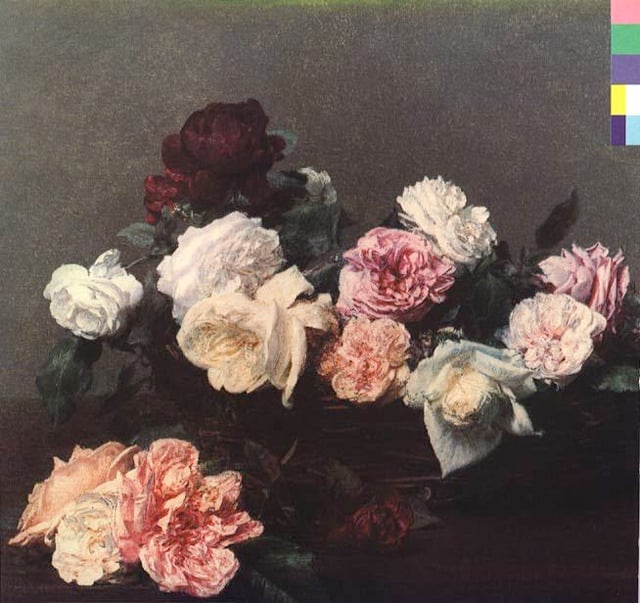
Factory designer Peter Saville met the severity of the title with unexpected beauty, placing a reproduction of Henri Fantin-Latour’s 1890 painting A Basket of Roses on the cover. Saville had gone to London’s National Gallery in search of a Renaissance portrait of a dark prince, but abandoned the idea as too literal. A postcard of Fantin-Latour’s flowers offered a more suggestive answer: beauty could carry power, corruption, and deceit far more discreetly than a tyrant’s face.
New Order’s movement toward electronics had begun during Joy Division. Peter Hook later recalled that Ian Curtis introduced him to Kraftwerk by giving him copies of Autobahn and Trans-Europe Express, while Joy Division used the latter as pre-show music. The 1981 debut Movement extended those ideas under producer Martin Hannett, and the singles “Everything’s Gone Green” and “Temptation” carried New Order further into sequencers, drum machines, and electronic rhythm. At Britannia Row, the quartet produced itself, making the new equipment part of the compositional process. Sumner became the principal singer, while the arrangements preserved the band’s collective balance: Gilbert and Morris programmed and played keyboards, Hook’s bass carried melody, and Sumner moved between guitar and electronics.
The surrounding singles belong to the same fertile period, although their chronology needs separating. “Blue Monday” was released on March 7, 1983, eight weeks before Power, Corruption & Lies; “Confusion” followed in August. Neither appeared on the original UK LP, in keeping with New Order and Factory’s practice of treating singles as separate objects. Across the album, guitar music and electronics remain in constant exchange. “The Village” gives sequenced motion a buoyant melody; “Your Silent Face” stretches a Kraftwerk-like figure across six stately minutes; “Ultraviolence” pairs programmed force with abrasive guitar; and “Ecstasy” leans into machine funk and processed voices. “5 8 6” and “Blue Monday” grew from the same run of 1982 experiments, including the long-form “Prime 5 8 6,” later issued as “Video 5 8 6,” so their rhythmic kinship runs deeper than an easy DJ transition.
The album’s finest song still comes first. “Age of Consent” begins as though the listener has entered mid-performance: Hook’s upper-register bass is already running, Morris locks the tempo into place, and Sumner’s guitar rings across both before his voice appears. A synthesizer widens the second half without disturbing the song’s human momentum. Its mixture of propulsion and uncertainty gives the vocal a precarious lift, carrying Joy Division’s physical discipline into a brighter form that belongs to New Order alone.
Watch New Order’s 1983 interview with Mike Andrews on Riverside below. The band’s full 1984 Play at Home special can be seen here.
Artwork detail: The colored blocks in the upper-right corner of the front cover encode the Factory catalogue number FACT 75, while the LP’s inner sleeve spells out the album title and band name. A decoder wheel on the back explains Saville’s system. The same code appears on New Order’s “Blue Monday” and “Confusion” sleeves, as well as Section 25’s From the Hip.






 Or via: