


Na skale
Nad wodą
Czaruje melodią
For thousands of years, human beings have imagined voices calling to us from beyond the known world. The siren may be one of our oldest attempts to give desire a body. She waits at the boundary between land and sea, reason and longing, safety and surrender. Her song has power because the sailor brings something to it: loneliness, hope, curiosity, the wish to discover what lies beyond the horizon. Perhaps this is why the legend survives. The danger has never been merely the siren. It is our extraordinary capacity to hear, in the vast and indifferent world, precisely what we most wish were calling our name.
Dawid Walkusz’s Syrena begins with the patience of something seen from a great distance: a bass line moving heavily beneath the surface, drums keeping a measured pace, and guitars and synths spreading a pale haze around Julia Frycz’s voice. The arrangement, channeling Current Joys, Cocteau Twins, Motorama, and Slowdive, belongs loosely to post-punk, coldwave, dreampop, and hypnagogic pop; though its strongest quality is less categorical than physical. The song seems to advance through water, every beat slightly burdened, every melodic phrase suspended between sleep and recognition.
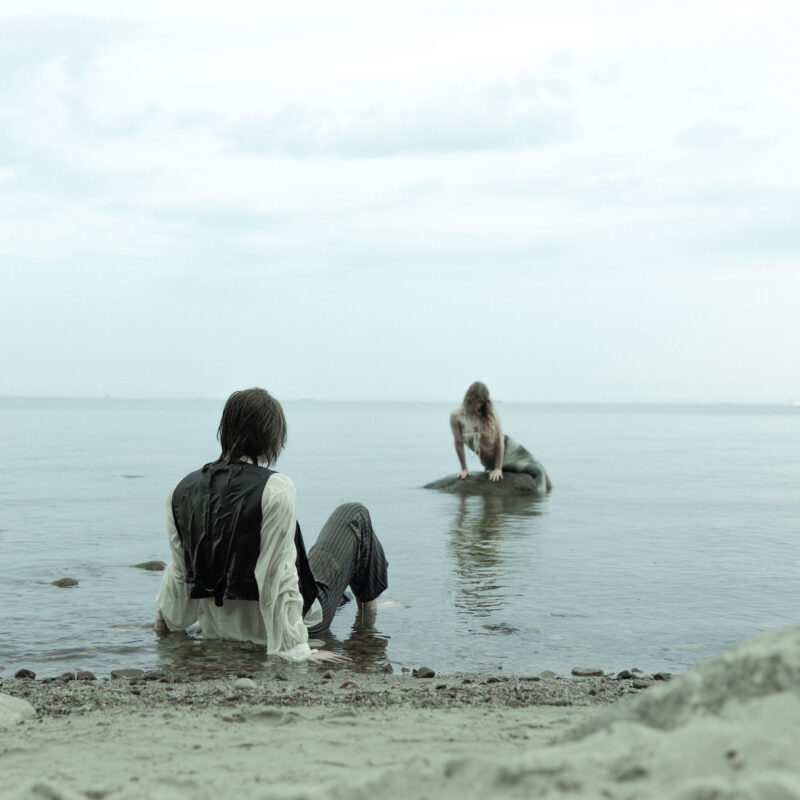
Frycz, a visual artist and vocalist with Emrere, gives Syrena its strange center of gravity. Her singing carries the calm authority of a figure who already knows how the story ends. Walkusz had written the instrumental and recorded early vocal parts before Frycz joined him, yet the collaboration feels unusually unified, as though both musicians had been picturing the same coastline without realizing it. Their subject is the siren, familiar from folklore as an emblem of beauty sharpened into danger, and the Polish lyrics render her with almost childlike clarity: she sits upon a rock above the water, her eyes glint, she appears angelic, and beneath the surface waits a tail.
This simplicity gives the song room to become stranger. Sailors are drawn toward her by longing and tenderness, losing their way before affection itself becomes fatal. Walkusz and Frycz avoid turning the myth into theatrical gothic excess. The menace comes from softness, from the slow reassurance of the voice and the bass line’s stubborn tread. Desire becomes a navigational error. Love becomes a current capable of carrying someone farther than intended.
The accompanying video extends this idea along the seaside, where cairns, stones, and open water create a setting suspended somewhere between Romantic poetry and Pre-Raphaelite painting. Frycz appears among the rocks as the siren, recalling the doomed women of Waterhouse and the river-bound Ophelia of Shakespeare, while Maciej Cimaszkiewicz’s cinematography favors natural forms over elaborate staging. Walkusz, who handled the editing and post-production, worked closely with Frycz to preserve the same visual language that had developed around the song. The shoreline becomes a psychological border, a place where the familiar world thins out and the sailor’s attraction begins to resemble surrender.
Watch Syrena below:
Syrena is the first glimpse of Walkusz’s second solo album, Fantometyka, due in spring 2027, and it suggests a broader, more confident development from his debut, Monochrom. The earlier record established his attraction to austere rhythms and blurred textures; here, those elements have acquired a more sensual sense of space. The song moves slowly, almost ceremonially, and its danger lies in how comfortable that pace becomes. By the time the siren has finished singing, the sailor’s fate feels less like catastrophe than consent.
Listen to Syrena below, and order the single here.
Follow Dawid Walkusz:






 Or via: