


Wir fliegen immer weiter
Wie zwei Schatten durch die Nacht
Auf der Flucht vor dem Morgengrauen
Wir fliegen immer höher
The newly anointed Kalte Steine come out of Leipzig like cold breath rising off its foundations: cellar air, frozen memory, and German syllables striking cobblestone and concrete. It is a fitting birthplace for such music, an old city of stone, history, and black-clad pilgrimage, where Wave-Gotik-Treffen turns the streets each year into one of the world’s great gatherings of the gothic faithful. Across four singles — Shattered, Dysthymia, Wüste aus Beton, and Kinder der Nacht — the project sketches a world of private fracture, nocturnal flight, and civic numbness, where romance curdles into ruin, and the outside world feels like a machine learning how to forget the people trapped inside it. These songs move through darkwave with their coats buttoned to the throat: lean, glacial, severe, and lit by the small, doomed glow of people trying to feel something before morning comes.
Kalte Steine’s world is isolation, inner struggle, and emotional detachment rendered in stark monochrome: sleepless nights, quiet inner collapse, that ugly little private cinema behind the eyes where every mistake gets a midnight rerun. The mood carries the chill of distance; of a society gone numb around the edges, of people speaking from behind glass, feigning connection.
“Kalte Steine is a way for me to externalize my inner world – a mix of personal struggle and the atmosphere of a society that often feels distant, numb, and almost unreal,” he says. “The songs live somewhere between inner conflict and a cold, dystopian outside world, where both begin to blur into each other. Even when the songs are written from a third-person perspective, they also reflect parts of myself.”
Shattered depicts a woman broken by old wounds, bodily scars, unanswered questions, and the feeling of having no escape. She retreats into dreamlike darkness, where pain briefly disappears and life feels whole again. Waking returns her to collapse, fragmentation, and the fading remains of her inner light. The song walks the corridor between private fracture and public decay, where the self starts to resemble a necropolis. Sung in alternating German and English, the song carries some of the glacial absurdity and deadpan chill of Grauzone’s Eisbär, though stripped of that song’s strange new wave mischief and pushed toward something more inward and severe. There is a little Joy Division in the way the bass seems to walk ahead of the body, dragging the rest of the song through a room with no windows, and a familiar bloodline running through Lebanon Hanover, She Past Away, Molchat Doma, and French Police, but Kalte Steine has the sense to keep the arrangement lean. The guitar draws its thin silver line, the rhythm moves with the steady resignation of a train leaving a city in which you have already failed.
The other songs deepen the record’s sense of private catastrophe and nocturnal escape. Dysthymia, a taut, minimalist post-punk track laced with post-punk gloom, studies a woman sealed within a cold interior life, where consolation remains visible yet unreachable. Its imagery is spare and severe: empty rooms, distant candles, bodies moving like husks through the street. By the end, feeling itself has hardened, and what once carried warmth has become mineral, mute, and almost beyond rescue.
Wüste aus Beton, with its almost piano-like guitar strumming melancholia, brings the horror back to the city like a somber dream. Smoke, rain, concrete, tired neon, and blank faces form a civic purgatory in which the individual is gradually absorbed into the greater machine. The deep vocals guide a bleak journey through a place drained of color and purpose, one body among many, lost in the gray arithmetic of modern life.
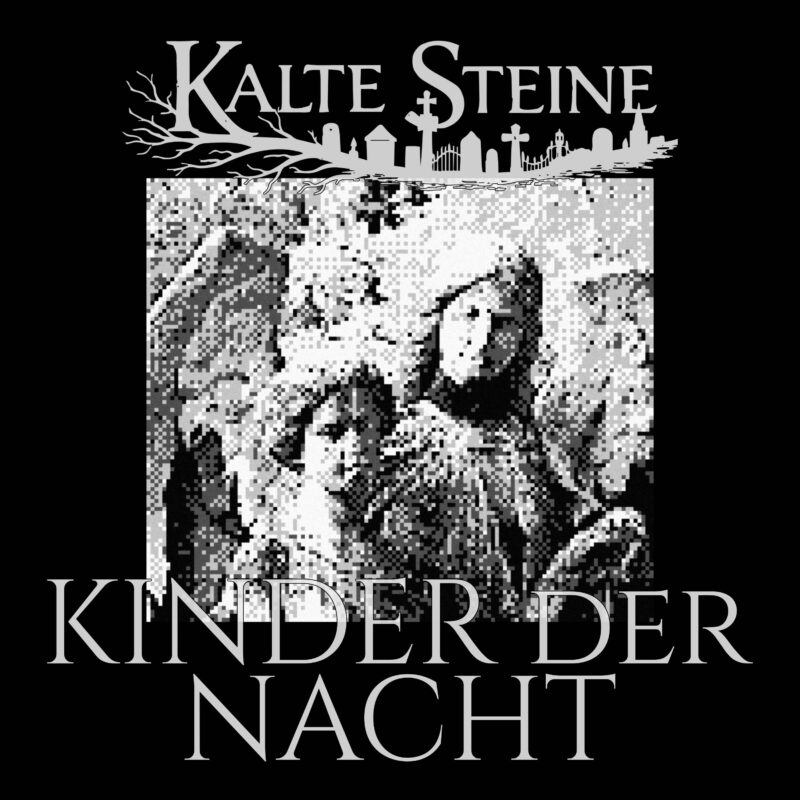
The haunting Kinder der Nacht, with its ascending, cobwebbed melodic motif, turns from inward collapse toward gothic flight. Two figures move through the night as companions and fugitives, bound by affection, hunger, and exile from the daylit world. The song gives them the grandeur of doomed creatures in an old horror engraving: hunted by emissaries of light, sustained by moonlit motion, and destined to perish together when morning arrives.
Listen to Kalte Steine’s singles below:
Follow Kalte Steine:





 Or via: