I’m not fragile like a flower, but fragile like a bomb
A hometown can keep an inconveniently accurate record of your ambitions. Someone remembers what you promised at seventeen; someone else knows when you stopped calling. Returning means encountering earlier versions of yourself, along with the friends who helped you become them. For Vilnius quartet LOCAL BLOOD, that reckoning begins in Plungė, western Lithuania, where their shared history took root more than a decade ago. Their self-titled third album considers what survives the journey from youthful expectation to adult experience, with belonging becoming a more complicated proposition at every turn.
Released on November 5, the self-titled LP LOCAL BLOOD follows people who keep getting tangled in their own efforts to connect. A domestic argument becomes a ridiculous dance; a successful online identity leaves its owner alone in a castle; a would-be cowboy straps himself onto a failing horse and heads for the dancefloor. The jokes have consequences. Beneath the exaggerated poses sit exhaustion, damaged intimacy, and the desire to be recognised by someone who can see past the performance.
Musically, these eight songs roam through post-punk, gothic rock, and electronics with a welcome appetite for odd combinations. Chiming keyboards and metallic signals recur throughout, passing between western guitar figures, severe basslines, and passages of almost pastoral unease. The vocals travel from a subterranean baritone to expansive, impassioned choruses, giving the record both its theatrical weight and its flashes of absurdity. LOCAL BLOOD allow their contradictions plenty of room to move.
“With this album, we wanted to push ourselves further while staying connected to the sound that defines LOCAL BLOOD. It’s a record shaped by everything we’ve experienced together over the past few years — both on stage and off. We wanted it to feel raw, honest, and alive. Releasing it and taking these songs on the road across Europe feels like the beginning of a new chapter for us.” — LOCAL BLOOD
Šuokis opens with a chiming synth figure greeting a deep electronic bass tone, creating a small observatory of warbling metal and antiquated computer signals. The solemn baritone and bouncing bass pattern suggest Joy Division being drawn further into Kraftwerk’s electronic orbit, with early Agent Side Grinder offering another useful point of reference. As higher melodies and phased alarm tones gather above the rhythm, the arrangement acquires the bright, strange optimism of an early computer display, green lettering blinking across black glass. Sung in the Samogitian dialect, the opener places a regional voice inside this electronic machinery. Its repeated phrases take on the insistence of a communal chant, making the band’s first recording in the dialect an immediately physical statement of identity.
In Come Around, the electronic chirping takes on the contour of a Morricone whistle, ushering in a stretch of spaghetti-western post-punk with rumbling drums and circling guitars. Nick Cave’s dramatic gravity meets Agent Side Grinder’s measured delivery as a domestic dispute slips between complaint and slapstick. An argument about being fed without cutlery gives way to the blunt admission, “I cannot get healthy in the same place that makes me sick.” Then come the flailing limbs and an exasperated appeal to be heard. The absurdity catches how undignified a serious argument can become when both people have exhausted their eloquence. Increasingly unruly synth experiments crowd the closing stretch, while “But sometimes I come around” leaves the possibility of reconciliation awkwardly open.
Unicorn begins with drums that have the clipped dancefloor discipline of Gang of Four, setting up a thick, melodic bassline that holds firm beneath quivering metallic guitar effects and bubbling synths. Against that agile arrangement, the low vocal delivery sounds almost administrative while cataloguing a procession of modern identities: the overworked employee, the motivational gym enthusiast, the online saviour whose tears benefit from excellent lighting. Each role carries its own claim to authority, and the first-person delivery implicates the person trying them on. The repeated accounting of a seven-day working week makes ambition feel increasingly punitive. During the final quarter, the guitars grow heavier and the voice rises with them; the swing between “I am a winner” and “I am a loser again” finally produces a musical rupture worthy of the strain.
Long intervals between deep bass notes leave the opening of Vandeny exposed to an uneasy synth drone. The voice sounds more regretful here, and the eventual arrival of a steady drumbeat brings a measure of stability to the drifting arrangement. Guitar and bass melodies develop through layers of misty texture, recalling the rural eeriness and patient unfolding of And Also the Trees. The Lithuanian lyrics move through rivers, night swimming, and the feeling of having lost part of oneself. Water offers somewhere to withdraw and attempt a difficult conversation with the self. As the closing repetitions turn toward courage, the music gives that effort time to gather strength. Following the crowded social performances of Unicorn, this is a persuasive change of scale.
Buzzing synths and hurried strumming open Pankielis before giving way to a shout and a low, springing riff, setting up one of the record’s most forceful performances. Small piano-like notes and electronic chirps continue beneath the heavier playing, needling the arrangement while the voice becomes increasingly theatrical. The chorus reaches toward Killing Joke’s confrontational grandeur, with a delivery that recalls Jaz Coleman’s accusatory force. Inside this commotion stands a castle built on a terrible foundation: virtual victories, trend chasing from the bathroom, and the lonely pleasure of being excellent at games. The distinction between “Experience points” and “the point of the experience” neatly exposes the bargain. By the time “I just wanna be local” becomes the repeated appeal, the album’s title has acquired a palpable ache. All that carefully accumulated status has left an elementary need for company unanswered.
On Rose, the returning keyboard warbles introduce a deep melody with the rounded attack of piano, and the rhythm settles into a western saunter. Early on, the croon suggests Agent Side Grinder riding alongside Ritual Howls; as the notes lengthen, a Dave Gahan-like confidence enters the phrasing. The lyrics supply a gloriously ungainly companion for this music: a deadbeat horse named Rose, whose rider has sensibly equipped himself with a helmet and seatbelt. A lyrical reference to Whitesnake’s Is This Love completes the dancefloor fantasy. Rose needs a friend, and the lonely rover singing about her could clearly use one too. The closing na-na-na refrain turns that odd little predicament into an invitation for everyone else to join in.
A shuffling drum pattern moves through eerie electronic tones on White Lies, while sustained notes and a low bass knell give the opening a sombre darkwave footing. The desire for a body initially comes across with unnerving composure, as though absence has become an everyday inconvenience. That restraint gives the later vocal ascent considerable force: the phrasing opens toward Gahan again, and the guitars and bass swell around it. A more exposed passage, picked out with piano-like accents, brings the admission of slipping away into painful focus. Dinner and bedtime doomscrolling sit beside the fear of disappearance, giving the song a recognisably ordinary setting for its distress. The plea to be written about as taller after death carries the record’s concern with self-presentation into the obituary, where even the smallest flattering adjustment might feel like consolation.
Low percussion seems to travel through stone at the start of 8 Stitches, surrounding the slow, almost recited vocals with an enclosed, cavernous resonance. Echoing guitars gradually widen the space, establishing the album’s most thoroughly gothic setting. The lyrics place flowers inside a picture of a relationship that continues in the mind after its physical comforts have gone. An empty side of the bed and the arrival of a stranger suggest the awkward work of trying to repair a life while still reaching for the person who left it. The rhythmic subdivisions quicken before a rush of guitar with a folkish edge carries the voice upward. Repeated through that gathering force, “Your love to admire” sounds like a thought being tested for its ability to hold everything together.
Those recurring electronic chirps give the songs a family resemblance through every change of setting, from the domestic standoff of Come Around to the stone chambers of 8 Stitches. LOCAL BLOOD’s willingness to let absurd humour occupy the same space as emotional damage gives the album much of its character. Its people can be ridiculous, vain, and painfully difficult to reach, yet their need for affection remains legible. Across a record concerned with where its makers come from, the desire for a place among other people proves just as pressing as the geography.
LOCAL BLOOD is available now through Spotify and other streaming platforms. A 12-inch vinyl edition is available to pre-order via Bandcamp. Listen below.
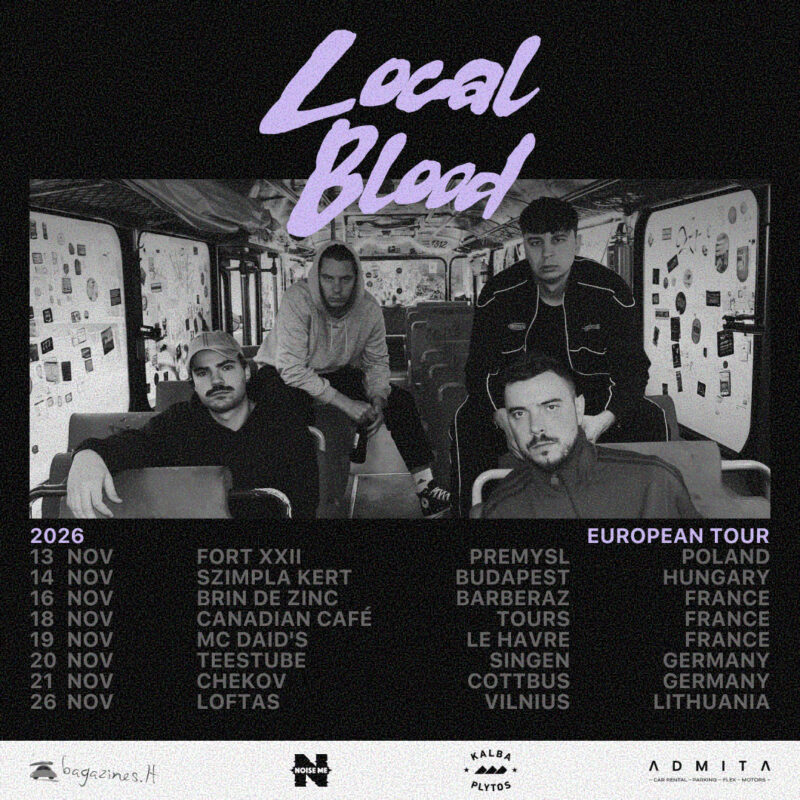
Based in Vilnius, Lithuania, LOCAL BLOOD developed their combination of post-punk, darkwave, and alternative rock across Dystopian Disco (2022) and Loverman (2023). The quartet have toured Europe and received a Best Rock Act nomination at Lithuania’s M.A.M.A. Music Awards. Recorded during the summer of 2026, their third album accompanies a European run through Poland, Hungary, France, and Germany, followed by a November 26 album release concert at LOFTAS in Vilnius, with Kaunas alternative rock band RŪMAI joining them.
Remaining November 2026 tour dates:
- November 16 — Barberaz, France — Brin de Zinc
- November 18 — Tours, France — Canadian Café
- November 19 — Le Havre, France — Mc Daid’s
- November 20 — Singen, Germany — Teestube
- November 21 — Cottbus, Germany — Chekov
- November 26 — Vilnius, Lithuania — LOFTAS (album release show)
Follow LOCAL BLOOD: