Ashes are what remain when the fire has finished its work, when the heat has departed and the substance of a former life has been reduced to a fine grey residue. The outline of a face in an old photograph, the scent of a room abandoned decades earlier, or the sudden recognition of a voice once intimately familiar can summon an entire world from the smallest surviving fragment. Memory has a strange relationship with decay, preserving certain impressions with exquisite precision while allowing entire years to vanish into obscurity. Perhaps ruins have such a hold on the imagination because their empty rooms invite us to picture everything that once filled them.
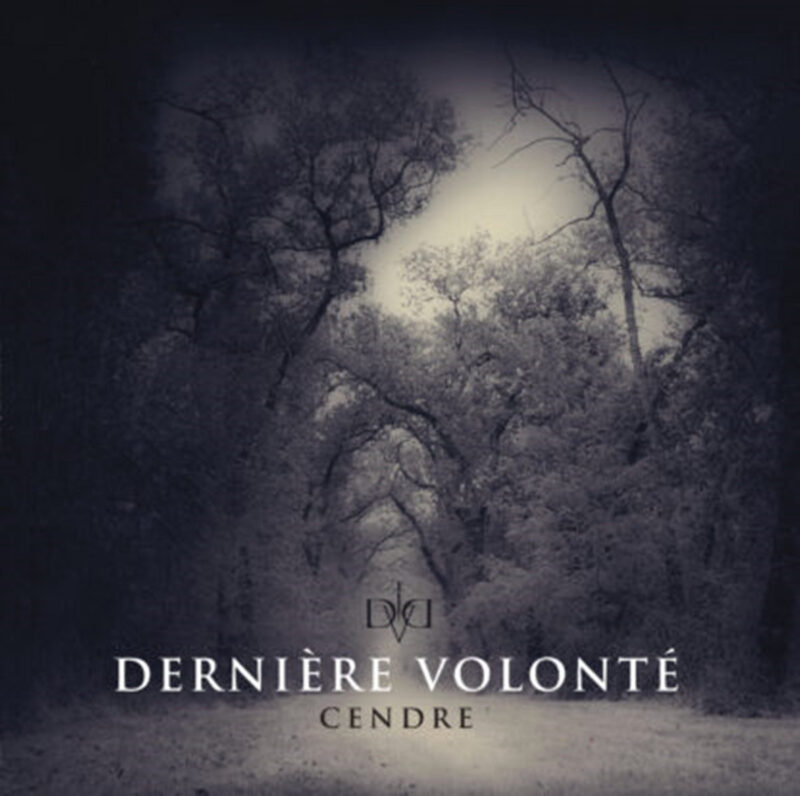
For nearly three decades, French musician Geoffroy D. has explored similarly desolate territory through Dernière Volonté, whose music often suggests the solemn grandeur of abandoned cathedrals and military processions. His new album, Cendre, takes its title from the French word for ash. On WAVES #549, Brussels DJ and broadcaster Phil Blackmarquis talks with Geoffroy about the old instruments he brought back into the studio and the friends he remembers in these songs.
Geoffroy began the project in the mid-1990s, working in martial industrial and dark ambient with ceremonial percussion, austere electronics, and distant melodic phrases. A decisive turn came with 2003’s Les Blessures de l’ombre and 2006’s Devant le miroir, when organs and neoclassical arrangements brought out the tenderness in his melodies. The records sit somewhere between the stately romanticism of Dead Can Dance and the French electronic sensibilities of Taxi Girl, with Geoffroy’s restrained vocals at the center of songs about love, loss, and the passage of time.
From 2019 onward, drum machines and arpeggiators drew Dernière Volonté closer to his electronic project Position Parallèle. On Cendre, he returns to the neoclassical darkwave of those earlier records, with funeral organs and solemn rhythms back in the foreground. “Maudits” has the snap of a club track, and “Ombres” changes direction late in the song before settling into a figure that repeats to the end. Even at their fullest, the arrangements leave room for the close, measured sound of Geoffroy’s voice.
Silences et Grésillements released the twelve-track Cendre on September 25, 2026. Tesco Distribution carries the CD, black vinyl, and a translucent crystal-blue pressing limited to 250 copies.
Order Cendre here or listen on Apple Music or Spotify.
Dernière Volonté on WAVES #549
In the October 20 episode, first aired on Brussels’ Radio Panik, Geoffroy describes Cendre as the last part of a trilogy about decline and says Dernière Volonté will carry on. An early title borrowed the opening of a Pierre Motin poem, “Souviens-toi que tu n’es que cendre,” or “Remember that you are but ashes.” Geoffroy tells Blackmarquis that he had tired of the arpeggiators and drum machines he’d used on the previous records. Returning to older synthesizers and samplers let him work orchestral and folk sounds back into the songs and give Dernière Volonté and Position Parallèle distinct identities again.
“L’âne et le roi” gave the album its direction when Geoffroy paired an operatic excerpt with Jacques Prévert’s “Chanson du mois de mai.” “Harmonies du soir” takes him back to Paris in the 1990s, while the choir-like voices in “Vanités” came from samples he manipulated in the studio. The rivers in “Ombres” come from walks around Angoulême, where thoughts about humanity’s decline take a personal turn as he considers where he’d like to spend the end of his life.
Geoffroy dedicates “Célébration” to Stéphane of Nuit et Brouillard. The conversation also turns to the death of Albin Julius and how losing friends has altered Geoffroy’s work. Getting the new songs to sit together took months of revisions. He’d already reached the mastering stage when he went back to recording and mixing, and he explains why he prefers to keep that work in his own hands.
Blackmarquis also previews Orages & Miséricordes, a companion release that continues the dark ambient work of Dernière Volonté’s 1998 debut, Obéir et Mourir. Geoffroy drew on material from old tapes and newer recordings for the instrumental double album. Geoffroy self-released it in a double-CD edition of 199 copies. Order Orages & Miséricordes from Tesco.
After asking Geoffroy about his September set at Tower Transmissions in Dresden and his impatience with long tours, Blackmarquis switches to a blind listening test. It starts about 38 minutes into the English edition. Taxi Girl and Depeche Mode take Geoffroy back to records he heard as a child, and a selection from Oxygène gets him talking about why he keeps returning to Jean-Michel Jarre’s Équinoxe. Shriekback’s “The Big Hush” brings up Michael Mann’s Manhunter, while a Nico track gets the two of them talking about Dead Can Dance.
Listen to the Interview with Dernière Volonté on WAVES #549, below:
More ways to listen to WAVES #549
- Original French edition on Mixcloud
- English edition on Mixcloud
- Radio Panik episode archive and downloads
Blackmarquis founded Brussels’ DARKOTHEQUE parties, where he DJs, and co-hosts WAVES with Fernando Wax. The show has been on the air since 2014, covering post-punk, minimal synth, new wave and EBM, with guests including Peter Hook, Gary Numan and The Hacker. Blackmarquis and Wax also lead the team behind Red Maze Records and curate its My Precious! compilations. Their fifth volume brings together exclusives and unreleased tracks from artists including Antiflvx and Extra Bleu Ciel. Listen to My Precious! Vol. 5.
Follow Dernière Volonté
Follow Phil Blackmarquis and WAVES:
Phil Blackmarquis:
WAVES:
Red Maze Records: