


You wait until tonight
Diversion of the trace
Get ready for the vamp
The stage, the other face
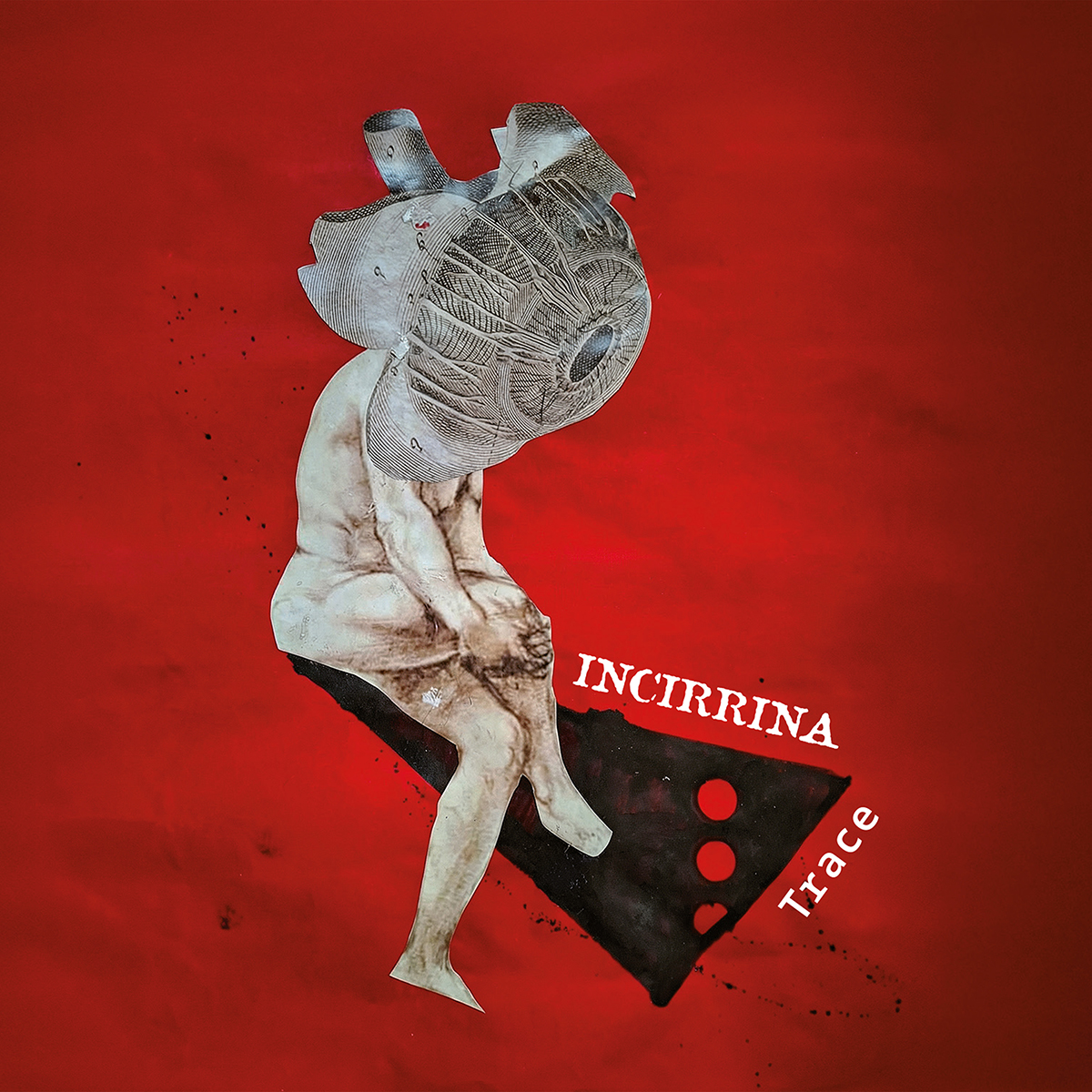
Some things are monuments: raised in stone, fixed in place, built to instruct the future on what must be remembered. A trace is different. It is smaller, stranger, more unstable: a smear of light on glass, a footprint in dust, a pulse still moving beneath the surface. A trace does not announce itself from above. It survives at the edge of disappearance, carrying proof that something passed through, resisted, or remained. On their third full-length album, Trace, Athens dark synth duo Incirrina follow those marks through the maze of the “seeming real,” where what is imposed, cruel, and inhumane presents itself as inevitable truth.
Here, the night is not merely a setting. It is a stage, a shelter, a ritual chamber, and a corridor of escape. Cold analogue electronics flicker like neon over wet stone; basslines gallop and coil; drum machines strike with martial insistence; voices rise from the fog like warnings, spells, accusations, and prayers. Trace is a record of movement, but also of refusal: a dance through dread, memory, alienation, and defiance.
With Trace, George Katsanos and Irini Tiniakou expand the distinctive sonic universe they established with Lip Led Scream in 2022 and 8.15 in 2019, experimenting with instrumentation, rhythm, and vocal approach. The album gathers 11 songs written between 2023 and 2025 and shaped through the discipline of a 24-channel console, exploring the boundaries of dark electronic, synthwave, coldwave, minimal synth, and darkwave without reducing itself to the tropes of any of these genres.
Thematically, the songs explore the uniqueness of human experience and the struggle to preserve inner freedom and individuality in dystopian times. Celebrating diversity and self-expression while continuing to connect, create, and work with others becomes a way out of the false order. The album itself is the result of such a process: its creators consider themselves, against the odds, artisans and friends who make music, share it, and reinvent themselves. As its title indicates, Trace is the imprint of searching for wondrous, meaningful diversions, novel transformations, and transitory acts of care and defiance.
Katsanos brings analogue synthesizers, octapad, drum programming, electric bass guitar, kantele, alto melodica, samples, waterphone, and vocals into Incirrina’s sonic architecture, while Tiniakou’s synthesizers and unmistakable voice give the duo much of its spectral charge. Her delivery can feel whispered, wounded, commanding, or ritualistic, cutting through the electronic framework with theatrical force. On Trace, that chemistry is central: machinery and voice, pulse and poetry, body and alarm.
“Mutate” opens the album with drones that sound like metal being cut, before a galloping bass synth melody pushes the track forward with immediate force. Katsanos’ analogue electronics and drum programming give the song its relentless propulsion, while Tiniakou’s voice begins close, dark, and breathy before sharpening into an old-school goth edge. Buzzing synth sighs gather around the pulse, and when the drums lock into a dance beat, the track surges with classic 80s synthpop and darkwave energy. It churns, glows, and moves with the confidence of an opening manifesto.
Through its lyrics, “Mutate” frames the night as a ritual of self-remaking, where performance, fashion, fire, and the dance floor become weapons against conformity. The lyrics reject fixed identity, social obedience, faceless control, and dull authority, choosing eruption over submission. Through theatrical reinvention, the song turns mutation into survival, style into armor, and the transformed body into a radiant act of defiance.
“Find” begins with an ascending synth loop that feels almost mystical, rising and falling like a coded signal in the dark. Cinematic synth sighs drift beneath the melody, while Katsanos’ spare electronic framework leaves enough empty space for tension to gather around every repetition. Tiniakou’s vocal sounds haunted, sad, and resigned, drawing from the emotional severity of classic 80s minimal synth without slipping into pastiche.
The song’s lyrical structure reads like a minimalist inventory of growth through pressure. Time, wrongdoing, pain, courage, thought, and speech become stages in the difficult work of self-recognition. The song suggests that fear is not defeated by silence, but by naming it; even in isolation, the act of speaking proves that something has passed through the void and been heard.
“Alexia” opens with crackling, popping percussion before dark synth pads enter, followed by a sharp wail, a simple bass synth figure, and a buzzing melodic line. Katsanos’ programming keeps the track grounded in pulse, while the surrounding electronics feel vaporous, nocturnal, and lunar. Tiniakou’s reverbed vocal arrives with a witchy, dreamlike aura, giving the song the feel of a darkwave/minimal synth apparition.
The imagery in “Alexia” follows a spectral woman through night, landscape, dream, and city before she disappears into morning. The words move through sand, mirrors, snow, memory, and the senses, turning the title figure into a myth of escape. She is present everywhere and unreachable at once, making reality feel briefly fragile, sensual, temporary, and unfinished.
“She Is In The Dream” opens with an ominous weight, led by a thicker EBM-style bass synth and droning, cold, wind-like pads. Compressed claps snap through the atmosphere as Tiniakou’s vocal moves from gauze to witchy clarity. Midway through, a Kraftwerk-like synth pulse enters, shifting the track toward a hypnotic blend of synthpop, darkwave, and minimal synth. Katsanos’ low-end pressure and rhythmic architecture give the nightmare a dancefloor skeleton, while the vocal performance turns the dream into accusation.
Lyrically, “She Is In The Dream” turns desire, guilt, shame, and punishment into a recurring nightmare. The song’s words conjure a woman as judge, accuser, and wounded image, forcing the lyrical narrator into a confrontation with dread and bodily pain. Erotic fixation and religious torment blur together, and waking offers no real escape; the dream remains lodged in the body.
“Region” begins with rustling, clockwork-like sounds before giving way to a deep bass synth and cinematic pad. A wistful keyboard melody enters, then a hi-hat beat, and Tiniakou’s voice carries the song toward something almost folkloric. There is a fairy-tale quality here, like a legend told in a cottage on a windswept moor, but the atmosphere is private, wounded, and strange. Katsanos’ palette of analogue synths and unusual textures gives the track an antique mechanical shimmer.
The lyrics for “Region” recount the return to childhood as a half-lit emotional geography. Dollhouses, trains, books, toys, sealed crimes, and unhealed time gather into a place where memory stays open. The words address someone lost inside a soundless internal territory, offering devotion and protection as if love might still survive fear, absence, and remembrance.
“Always Here” opens slowly with misty, faint droning before a pulsing bass synth enters like a rapid heartbeat. A quick bell-like warning flickers through the atmosphere, and Tiniakou’s whispered delivery heightens the sense of threat. When the beat locks in, Katsanos’ programming gives the song a darkwave dancefloor charge, with the deep bass melody pushing forward like blood under pressure. As the bell motif returns more frequently and becomes more melodic, Tiniakou’s voice cracks through the layers like a command.
Lyrically, “Always Here” is a stark meditation on emotional survival. The song presents laughter, tears, thought, and dreaming as necessary acts against numbness and surrender. Without feeling, imagination, and reflection, the lyrics warn, people fade into the false reality of the “seeming real.” Renewal begins by rediscovering what was present all along, beneath fear and resignation.
“Diver” sets itself in motion with a machine-gun percussion beat, a dull warning synth, pulsing electronics, and icy cinematic pads. Katsanos’ drum programming turns the track into a piece of urban machinery, while the synths move like rails, screens, and locked doors. Tiniakou’s voice carries an electroclash edge while remaining rooted in darkwave, adding human volatility to the mechanical enclosure.
The lyrical terrain of “Diver” transforms public transit into a claustrophobic descent through anxiety, compulsion, and sensory overload. The words move through trains, tracks, crowds, voices, bodily signals, and the pressure of routine until motion itself becomes a cage. Maps and routes fail to locate the heart; the body keeps traveling, but the self remains trapped inside noise, metal, and panic.
“Presence” is built around a deep, dark synth melody that rises and falls in repeated melodic beats, building tension until layers of icy pads gather beneath it. Katsanos’ electronics create the sensation of moving forward through a storm, while Tiniakou’s vocal begins with almost melancholic restraint before the song’s drama tightens around her. The result is cold but not empty, severe but not distant.
In its lyrical arc, “Presence” turns perception into a borrowed, compromised act. The song moves through urban machinery, denial, surveillance, and mass anonymity until one figure breaks the spell. Beauty becomes a disruptive force that strips away false sight, forcing blindness before clarity. Freedom does not arrive through comfort, but through confrontation with reality.
“Sometimes” is the vocal exception on Trace, carried by George Katsanos. His sorrowful delivery has a gravity reminiscent of Brendan Perry’s deeper, mournful register in Dead Can Dance. Misty synths and a piano-like melody give the track a slightly folky darkwave character, while the snare drumbeat moves like a despondent march forward. The arrangement does not overstate the pain; it simply walks with it.
The confession at the center of “Sometimes” is one of emotional collapse. The words cycle through tears, death-wish imagery, longing, helplessness, suffocation, despair, and emptiness without dressing the pain in abstraction. Its repetition gives the song the force of a private admission, capturing depression not as a single dramatic event, but as waves that keep returning.
“Alien Room” moves on a pulsing bass synth, witchy vocal wails, cold harmony effects, and a dance beat that keeps the room spinning. Katsanos’ low-end movement and programming give the song its hypnotic structure, while Tiniakou’s voice turns the domestic setting into an incantation. The atmosphere feels ritualistic, almost brushing against dungeon synth in places, but the track remains physical, tense, and strange.
In the song’s strange domestic vision, “Alien Room” turns ordinary space into a paranoid science-fiction chamber. Couches, windows, drinks, stained floors, broken objects, and living-room details become signs of invasion. The words mix pulp cosmic imagery with everyday dread, suggesting that the end-times charge may arrive not through spectacle, but through ordinary collapse inside the home.
“ΚΡΥΦΟ (Hidden)” closes the album with a propulsive darkwave beat, whoops and wails, smoldering Greek-language vocals from Tiniakou, and a catchy guitar riff. Katsanos’ rhythmic drive gives the finale its bodily force, making the track one of the album’s most dancefloor-friendly moments. After so much dread, memory, pressure, and transformation, the closer does not retreat into shadow; it moves through it.
Sung in Greek, “ΚΡΥΦΟ (Hidden)” centers on concealment, self-address, and unheard voices. The song connects private suffering with children, sand, earth, sea, breath, betrayal, dawn, and the first cry of awakening. Hidden knowledge becomes both a burden and a force pressing toward revelation, turning secrecy into motion and suppressed pain into sound.
By the time “ΚΡΥΦΟ (Hidden)” fades, Trace has completed a circuit through mutation, fear, memory, transit, perception, collapse, invasion, and disclosure. Incirrina’s third album is not merely a genre exercise in dark electronic, synthwave, and coldwave form. It is a document of friendship, craft, and resistance: the work of artisans who make music together, share it, and reinvent themselves against the odds. Its title becomes its method. Trace leaves behind the imprint of searching for wondrous diversions, meaningful transformations, and small, transitory acts of care and defiance.
Incirrina’s Trace is out now via Cold Transmission Music. Listen to the album below, and order it here.
George Katsanos and Irini Tiniakou’s journey as Incirrina began in Athens in late 2017. The duo released 8.15 in 2019 through Geheimnis Records, followed by the digital maxi single Utter in 2020, the split maxi single Devastations / R.Daneel with The Man & His Failures in 2021, and Lip Led Scream in 2022 via Cold Transmission. They later released Immersion in 2024 and the singles “Only One Smile Alone” and “ΚΡΥΦΟ (Hidden)” in 2025.
They have appeared at numerous gigs, live stages, and festivals across Greece and Europe, including Germany, France, Belgium, the Netherlands, Italy, Switzerland, Hungary, Austria, the Czech Republic, Slovakia, and Croatia. Their festival appearances include Death Disco Open Air Festival, Wave-Gotik-Treffen, Athens Music Week, Metavasis Festival, Japan Festival, schwarts + Bruits De La Cave Festival, Athens Digital Arts Festival, Pliisken Festival, Cold Transmission Festival, and Morphic Festival. They have also opened in Athens for Front 242, Soviet Soviet, Die Selektion, and Potochkine.
Beyond the club and concert stage, Incirrina have also moved into theatre. In 2024, they composed music for Andrew Keatley’s Alligators, directed by Giannis Laspias at Gloria Theatre in Athens, with the music performed live on stage. They also composed soundscapes and orchestrated songs for Little Women, adapted, translated, and directed by Athina Hatziathanassiou at Alambra Theatre.
Their unique blend of analogue electronic instrumentation, distinct vocal quality, and band chemistry has made their live performances especially powerful, described as having emotional melodies that stick in the mind, heavy and strong beats that impel the body to dance, and vocals that cut through the musical layers, leaving a lasting impact.
Upcoming Live Dates
- 10 July 2026 — TBA
- 24 October 2026 — Sounds From The Heart Festival, Dynamo / Werk 21, Zürich, Switzerland
- 25 October 2026 — Lovataraxx & Incirrina, Die Stadtmitte, Karlsruhe, Germany
Follow Incirrina:






 Or via: