


A war of words, They want you on their side, It’s all for power, To conquer and divide.
Promises have a strange power: they ask us to believe in something that has not happened yet, turning a word given in the present into a bridge toward the future. At their best, they hold up friendships, love affairs, movements, contracts, countries, and songs — invisible, but load-bearing. But somewhere along the way, the promise became another tool of persuasion, polished into a slogan, stamped onto a product, fed through a corporate choir, and sold back to us under fluorescent light. Now promises arrive dressed in branding, panic, and performance, offered by people who profit when everyone else starts doubting the ground beneath their feet. The word remains, but the weight has changed: what once carried trust now often carries leverage.
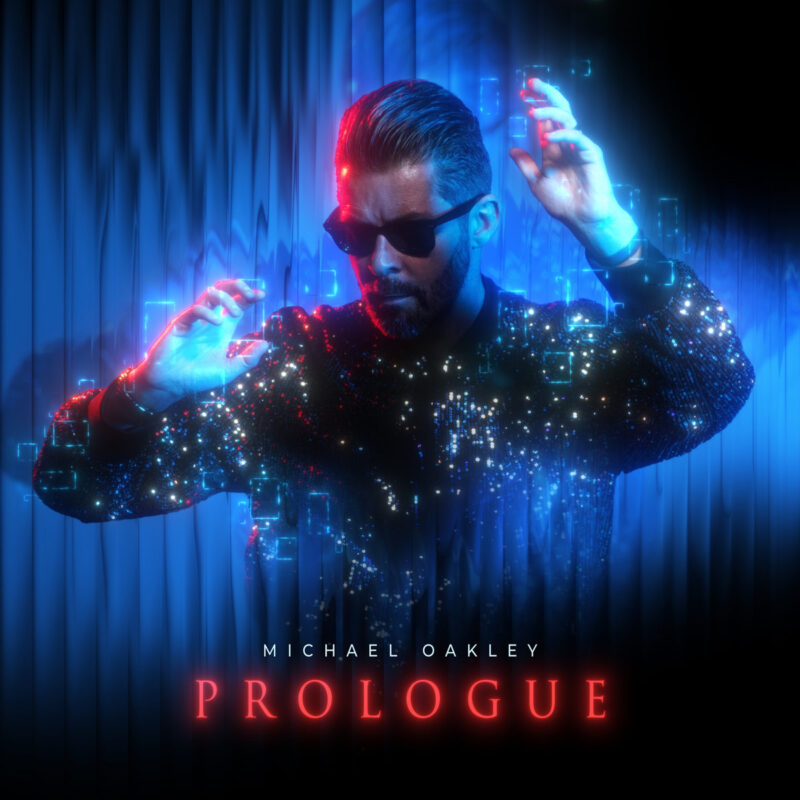
That crisis of faith runs through “World of Promises,” the new single from Scottish synthwave and synthpop artist Michael Oakley. The track appears on his new album Prologue, out now via NewRetroWave, and finds Oakley turning the bright machinery of retro-futurist pop toward something darker: a world of overstimulation, public fracture, and language drained of meaning.
Musically, “World of Promises” moves with a sleek, late-night pressure: a seductive bass synth, compressed dance-floor stomp, warping metallic accents, cinematic pads, and Oakley’s silk-smooth vocal delivery cutting through the dry ice. The reference points are there — Depeche Mode, Pet Shop Boys, New Order, The Midnight, FM-84 — but Oakley pushes the track into a glossier, more high-stakes register, where synthpop romance meets corporate dread and the dance floor starts to look like a control room.
Lyrically, “World of Promises” takes aim at false hope, weaponized messaging, corporate agendas, and the way public life turns people into factions. Oakley frames the song as a question of trust: “Do our words still mean a thing?” From there, the track spirals through cracked social bonds, power games, and the sense that every statement arrives with a hidden hand behind it. The song’s title becomes less a phrase of optimism than a warning label for an age built on empty guarantees.
The video turns that idea into a neon-noir surveillance thriller. It opens inside a red-lit club world of dark glasses, glowing tubes, shadowed faces, and bodies caught in the blur of VHS damage. Oakley appears amid the party’s controlled chaos, while a red-haired woman in patterned sunglasses watches from above, then from a bank of monitors, studying security footage as if she were tracking a target through a private system of power.
From there, the clip cuts between bound figures, gloved hands, a blindfolded man wrapped in rope, a silver briefcase, and a gun and martini left under club lights. The imagery plays like a retro cyber-crime caper spliced into a nightclub fever dream: CCTV grids, scan-mode graphics, coded data, red rooms, blue corridors, and sudden flashes of violence held back by the video’s stylized restraint. Captions break the tension with “WHOA. HEY!”, “THAT’S HER!”, and “STOP!!!” as the video’s mystery red-haired femme fatale, brandishing the silver briefcase, gives two men the slip—giving the clip the feel of the Tech Noir scene in The Terminator, The Starck Club scene in Robocop, or a late-night broadcast from a cult film aired on Nightflight.
By the final stretch, the video widens into a chase for the woman with the case, moving through backstage rooms, club corridors, a logo wall, and a burst of falling papers. When her pursuer tries to vaporize her, the blast rebounds, turning the weapon back on him and leaving smoke curling around his boots as she slips outside to a waiting car. There, the case is opened for a man whose interest only deepens the mystery — a sly nod to the glowing, unknowable MacGuffin at the center of Quentin Tarantino’s Pulp Fiction. It is sleek, theatrical, and slightly absurd in the best way: part espionage fantasy, part nightclub power struggle, part commentary on who gets watched, who gives the orders, and who walks away with the prize.
Watch the video for “World of Promises” below:
Michael Oakley is a Scottish synthwave producer, songwriter, and musician whose work draws from synthpop, new wave, and widescreen 1980s studio craft. Born in Glasgow, Oakley moved to Los Angeles in 2016 before settling in Canada in 2018. A self-taught musician, he first broke through with the California EP in 2017, followed by his debut full-length, Introspect, in 2019 and Odyssey in 2021.
Across his catalog, Oakley has become a key figure in the modern synthwave world, balancing polished pop songwriting with the romantic voltage of vintage machines. His work has appeared in gaming projects including Wave Break: High Tides and Retro Drive, and he has also designed sound packs and synth patches for producers working in the same retro-electronic orbit. With Prologue, Oakley returns after nearly five years with a sharper, bigger, and more politically charged sound.
“Imagine what Depeche Mode’s Violator album would have sounded like if it was produced by Trevor Horn.” Says Oakley, “Or if Peter Hook stumbled into Haddaway’s recording sessions. That’s Prologue.”
Michael Oakley’s new album Prologue is out now. Available in red and blue editions across multiple formats, including vinyl, cassette, CD, and MiniDisc.
Order the album here.
Follow Michael Oakley:
Follow NewRetroWave:
Follow Brad A. Kinnan:





 Or via: