


Humanity has spent thousands of years attempting to comprehend its own extinction. We have constructed elaborate religions, raised monuments to the dead, consulted the stars, and invented increasingly sophisticated technologies, all while remaining subject to the same elementary biological certainty. Every civilization eventually confronts the limits of its existence, although ours has developed the extraordinary ability to contemplate its own destruction in real time, illuminated by screens that record the gradual deterioration of the world we have made.
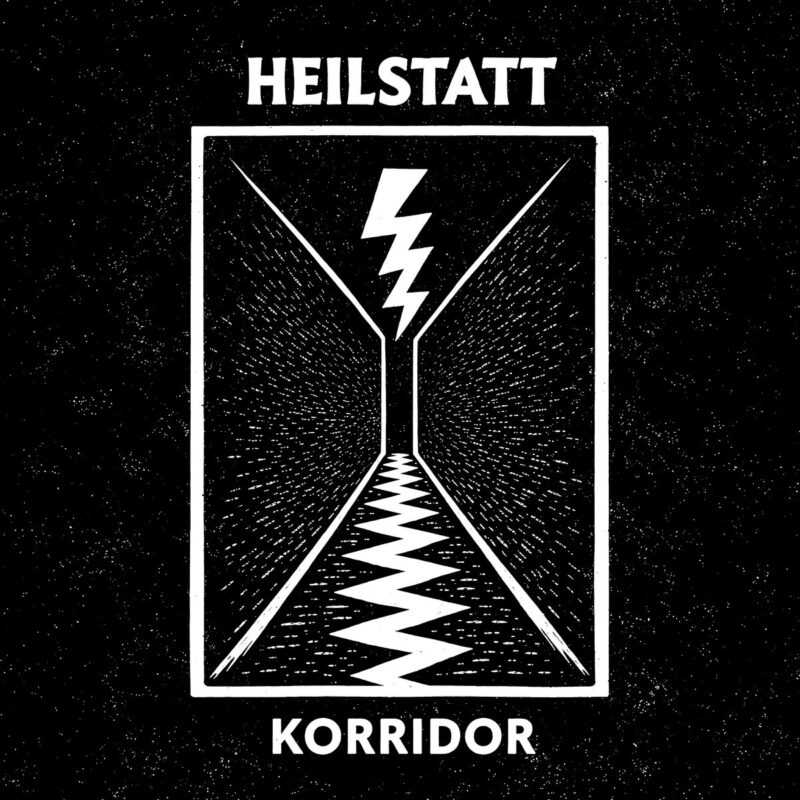
For Martin Falkenstein, whose work with Thuringian black metal project MOSAIC, Sun of the Sleepless, and Empyrium has explored humanity’s ancient relationship with myth and mortality, this predicament provides the intellectual foundation for HEILSTATT. His debut album, Korridor, examines a civilization increasingly estranged from the principles that once made collective existence possible.
“With the debut album, I wanted to capture the spirit of our time: a world moving ever closer to the edge, turning against itself in the digital realm, surrendering its privacy, its individuality and, ultimately, its humanity,” says Falkenstein. “A world that is driving itself towards its own destruction…Nothing about this world seems rational anymore. It has become a vast stage populated by people consumed by their own importance and their pursuit of absolute power. That is what the music represents: the end of the world. Cold, stripped back and uncompromising — repetitive and grinding, much like everyday life itself.”
The closing track, HINAUS, carries this meditation beyond the boundaries of civilization into the oldest uncertainty of our species. An ancient funerary custom held that opening a window following a death permitted the departing soul to escape its earthly dwelling. Falkenstein transforms this modest domestic gesture into a universal image of transition, connecting the final breath of an individual with the immense, unknowable continuation of existence.
The skeletal architecture of early post-punk encounters brittle trip-hop percussion, gothic austerity, and the bruised temperament of depressive punk. Mechanical rhythms advance with the indifference of geological processes, while fragile melodic figures suggest consciousness struggling against an increasingly impersonal environment. The arrangements have an almost mathematical severity, letting repetition measure time’s relentless passage. Beneath their forbidding surfaces resides an extraordinary sensitivity to the precariousness of being alive.
Listen to Hinaus below and order Korridor here.
Consider the billions of human lives that have already concluded, each containing an entire universe of sensations, relationships, memories, and unrealized possibilities. Every consciousness disappears from our immediate experience, leaving behind traces in the lives of others. Within that enormous procession, Korridor finds its deepest emotional resonance. Somewhere between the grinding machinery of modern existence and the quiet opening of a window, Falkenstein considers the astonishing brevity of our allotted time, and the terrible beauty of knowing that it, too, must end.
Follow HEILSTATT:





 Or via: