


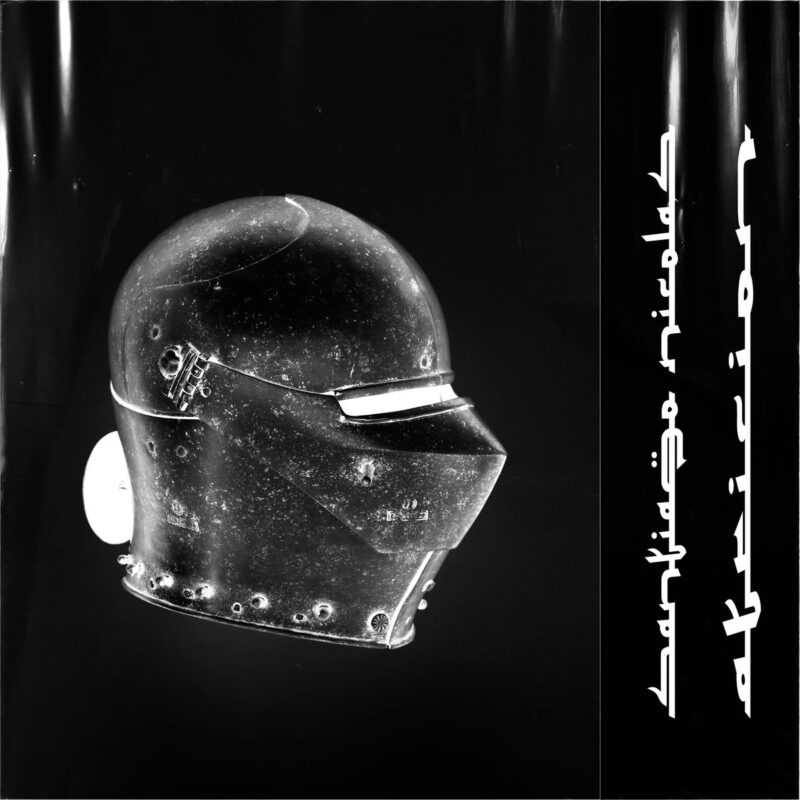
Atrición is the sort of record that seems to have been built under fluorescent light, with the smell of disinfectant somewhere nearby and history banging its head against the walls. Santiago Nicolás wrote much of it in an oncology center, and that circumstance hangs over the album with a terrible physical clarity. The body here is material: cells change, systems fail, pressure accumulates, and time works patiently on everything it touches. Nicolás places that fact beside political violence, invasion, borders, archives, and inherited trauma, finding a shared logic in processes that advance by occupation and erosion rather than spectacle.
That could have produced a record swollen with significance. Instead, Atrición stays severe, compact, and rhythmically exact. Its drums hit with the blunt economy of DAF and Nitzer Ebb, while the synths carry the cold forward motion of contemporary techno. Suicide lurks in the repetition, Cabaret Voltaire in the sense that machinery can become a social instrument, and Schwefelgelb in the clipped, bodily momentum. Nicolás keeps tightening the screws until repetition stops feeling like recurrence and starts behaving like pressure.
This is where the album becomes genuinely nasty in the best sense. A beat returns, a distorted percussion figure acquires another layer, a synthesizer line keeps digging into the same patch of ground, and suddenly you understand accumulation as an experience rather than a concept. Violence, in this framework, survives through systems, habits, documents, buildings, borders, and bodies that continue carrying its consequences after the visible event has passed. Atrición makes persistence feel physical.
The lyrics explore themes of archives, silence, trauma, and accountability without resorting to slogans. Nicolás prefers metaphor, allowing the songs to hover between personal memory and public history. His focus is on transmission—what is passed down through generations, what institutions preserve by omission, and what a body retains despite efforts to erase it. The music responds with persistent repetition, reminiscent of bureaucracy but driven by a punchy kick drum.
By the end, Atrición feels like a controlled study in pressure: biological, political, historical, rhythmic. Catastrophe often advances by degrees, through small permissions and repeated injuries. He builds music for that recognition, and the result is frightening precisely because it moves with such discipline, until pressure itself becomes its own evidence.
Listen to Atrición below and order the EP here.
Nicolás has spent more than a decade moving through electronic music, noise, experimental composition, and post-punk, including work with The Deadly Affair, Access Device, Ángel de la Guarda, and Föllakzoid’s live lineup. Atrición compresses that experience into a language of hard surfaces and accumulating force. The production is clean enough to expose every impact, yet abrasive enough to keep the record from becoming sterile.
Follow Santiago Nicolás:





 Or via: