


I was dreaming and I lost my way
Between the mountains and the waves
And the coldest grey…
And how could I trust the sway of this
Human heart again?
A cataclysm is not merely destruction. It is a break so complete that the world before and the world after no longer recognize one another. It redraws coastlines, collapses systems, and forces adaptation. Over the last few years, that word has felt less symbolic and more atmospheric: pandemic isolation, accelerating climate collapse, techno-feudal drift, genocidal violence scrolling past in real time. The ground feels unstable. The old assurances sound hollow. Collapse is no longer a prophecy; it is an overwhelming present.
Yet a cataclysm also implies transformation. Geological upheaval makes mountains. Forest fires clear space for new growth. Despair, if endured, can temper into resolve. That tension — devastation braided with possibility — drives Cataclysm, the latest album from Zanias. Written and produced between 2020 and 2024 and released October 23, 2025, via Fleisch Records, the record channels post-industrial ethereal wave, trance propulsion, electro precision, and darkwave atmosphere into ten distinct yet interconnected songs. Each inhabits its own aesthetic terrain, yet together they chart a steady ascent: from glacial intimacy and elemental grief to embodied resistance and hard-won radiance.
For those who have followed Zanias since the emergence of Linea Aspera in 2011, through Keluar and her expansive Berlin-based solo evolution, Cataclysm feels both like a culmination and an ignition. Across collaborations, underground raves, festival stages, and four previous LPs, Alison Lewis has consistently used electronic music as a means of examining what it means to be human — psychologically, mythically, politically. Here, that inquiry sharpens. The album grapples directly with collapse — ecological, social, spiritual — while refusing paralysis, urging instead that we “thread the power through the pain.” Even at its glossiest, there’s weight underneath — the sensation of living through collapse while refusing to collapse with it. Written between 2020 and 2024 and released via Fleisch Records, Cataclysm doesn’t drift between genres so much as bend them. Each track occupies its own universe, yet they share a bloodstream: grief, fury, endurance, transformation. Coldwave architecture dissolves into trance ascension; witchhouse murk fractures into hyperpop glint; breakbeats snap through devotional stillness
We begin by moving through the album’s ten-song arc in full — tracing its rise and rupture — before stepping into an in-depth conversation with Zanias about its political ignition, mythic symbolism, and the alchemy that turns private despair into collective force.

The album’s title track and opener arrives like breath on glass: sighing pads, pale ripples, and a voice that sounds soft-spoken but shaken—bruised in a way that feels lived-in rather than performed. There’s an early-’90s glacial hush to the atmosphere, as if the track is lit by winter daylight and old TV snow. Then it lifts. Not with a cheap “drop,” but with a slow emotional swell—her vocal climbing higher, multiplying into layers that surge and crash like weather fronts colliding. Lyrically, it’s intimacy under siege: “When I’m with you / The world can’t touch us here / Let it burn.” The hook repeats like a protective charm, a lover’s bunker built from synth sheen and private panic. It’s one of her strongest opening statements—cinematic without being corny, direct without losing its dream-logic.
“Naiad” shifts the palette into something older and icier—an “’83” kind of chiming synth drone with a cool, wide-screen futurism that nods to Vangelis, early electronica, and a certain cyberpunk-anime melancholy. The beat has that late-’80s/early-’90s glide—steady, spacious, subtly propulsive—while her vocal is treated with reverb and compression that makes it feel both close-up and distant, like a message traveling through fog. The lyric is elemental and empathetic, speaking as water that can’t help but absorb human suffering: “I am the river / Ocean-bound forever / And all I can feel is your pain.” It’s sci-fi in sound, but the emotion is ancient: rainfall as witness, nature as reluctant caretaker, a world that keeps being asked to “stay” while it’s forced to flow.
“Whiteout” begins with metallic percussion and an almost Asian-leaning timbral shimmer—less “industrial clang” than ceremonial metalwork, like struck bronze echoing through a vast interior space. The track feels like altitude: clean air, sharp light, and the thin line between awe and fear. Zanias moves into a call-and-response vocal posture—part invocation, part internal dialogue—while the lyrics spiral around ascent, resistance, surrender: “On the way up I fight… / On the way up… I rise and I fall with it.” The song’s ritualistic tone recalls the wordless power of Lisa Gerrard, but filtered through loops, electronic repetition, and modern movement—devotion with circuitry, trance as a kind of climbing.
“Ghostbird” is one of the record’s most hypnotic constructions: a vocal sample mapped to keys (like a synthetic choir you can play with your hands), synth strings that glide in and out of the drum pattern, and techno flourishes that shimmer at the edges. It’s eerie-pop architecture—sleek, insistent, strangely tender. The spoken-word verses drawn from Jeff VanderMeer’s Annihilation give the track a spellbook quality, as if the song is reading from a sacred text that’s also a warning label. “Come find me in the water, ghostbird” becomes a refrain that feels simultaneously intimate and ominous—an invitation and a dare. The track’s power is how it makes dread danceable: swirling electronica carrying prose that’s all abyss, revelation, and reanimation.
Then the floor disappears. “Ashes” comes into focus from haze with hushed vocals and acoustic guitar—an exposed center that changes the temperature of the whole album. There’s a folk intimacy here, almost Nick Drake in its fragility, if Drake were singing through ethereal pop mist; it also brushes against dreampop in the way the air around the chords seems to glow. But the lyric is where it truly hits: “How can it be human fingers on the triggers? / Flesh and bone with mothers and skin that shivers.” The repeated line “I feel a fistful of ashes in my hands” doesn’t build toward catharsis so much as it circles trauma, returning again and again like a thought you can’t stop touching. It’s stunning in its restraint—an emotional trough that refuses to tidy itself up for the listener.
“Dawn” answers that darkness by turning movement into resolve. It opens with chiming, clicking textures—little shivers of sound—before the beat snaps into place with a crunchy snare that feels late-’80s/early-’90s in the best way: punchy, direct, built for bodies. The melody is immediately strong, and the song carries a transportive, narrative energy, like a montage sequence in some battered-yet-hopeful future. Lyrically, it’s the album’s clearest mission statement, balancing rage with purpose: “Too easy to forget there’s more of us than them / Thread the power through the pain.” That mantra returns like a stitched seam, holding the song together while the production keeps it bright, vivid, and forward-driving. It’s protest music that still remembers pleasure and rhythm are part of survival.
“The Spire” glows with retro synth tones—Kraftwerkian in their clean geometry, but softened into something more mystical and tender. It’s interstellar without being cold: crystalline sighs, high chimes, and a vocal that reaches upward, not in diva theatrics, but in a kind of steady, aching uplift. There’s a faint echo of Curve-era Toni Halliday in the shape of the phrasing—strong but vulnerable, floating above the machinery. The lyric reads like a vow made under pressure: “We’ll survive under a bitter sun / We will rise as we’ve always done.” The track’s central image—“endless spire / always higher”—isn’t triumphal so much as stubborn. Not victory. Continuance.
“Serpentsmile” is one of the album’s sharpest pleasures: ethereal dub shudders at the start, then a retro synth buzz and a propulsive beat that lands somewhere between minimal synth, French coldwave-pop, and a more modern dancefloor snap. It’s immediately catchy—arguably the record’s most “move now” moment—but the lyric is all knives and clarity. “Smiling like a serpent… / Mother-wounded venom surfacing” and “Devastatingly aware” turn the track into a confrontation disguised as a night out. There’s something delicious about how it keeps its sweetness while describing masks falling and betrayal blooming. Pleasure and exposure in the same breath—that tension is the engine, and it runs hot.
“Human” flips back into the world of sampled vocals mapped to keys—repeating phrases that feel pop-forward, Grimes-adjacent in texture, but grounded in a sturdier dance-pop pulse reminiscent of early-’90s club sheen (with a little Ray of Light-era propulsion in the stride). The hook is blunt in the best way—almost like an anti-anthem that becomes an anthem anyway: “You are human / Born and then you feel and then you die.” It’s existential, but not abstract; it lands like a hard truth said gently, a reminder that feeling is the whole point even when it hurts. The verses are self-implicating—fearful, flawed, honest—while the chorus widens the lens to include everyone on the floor.
The aptly titled closer “Happy Endings” is a rapid heartbeat with polish on its pulse: purring vocals, rippling electronics, a snare that hits with a handclap-like snap, and synths that keep pressing forward as if refusing to sit still. About two-thirds in, the track opens into crystal tones—light breaking through—then keeps running until it reaches its final exhale. Lyrically, it’s a mature kind of hope: not the promise of a tidy resolution, but the insistence that love and fear coexist, and nature can still set us free even if we don’t get a storybook finale. “Doesn’t only have to be happy endings,” she repeats, and it lands like permission—permission to keep going without pretending everything will be fine. The final image is simple and strong: “We are the sun / Rising above.” Not denial—rise.§

Zanias on Power, Despair, and Reclaiming the Sword:
If Cataclysm feels expansive, the conversation behind it is sharply focused. Alison Lewis traces the album’s beginning back to the title track, written at the dawn of the pandemic — a first spark that later caught fire into something more politically direct as the world hardened and history accelerated.
She speaks candidly about “Ashes” as the record’s emotional trough, placed deliberately so “Dawn” can rise with meaning rather than mood. Along the way, we discuss the mantra “thread the power through the pain,” the album’s mythic visual language — sword, armor, archetype — and why, for her, activism and art aren’t parallel paths but the same road.
When Cataclysm began taking shape between 2020 and 2024, what was the first song or idea that made you realize this was going to be a fully formed album rather than a loose collection of tracks?
The title track ‘Cataclysm’ was the starting point, and once that track had a title, I knew the rest of the album would flow from this word, though I didn’t know yet just how political the record would become, because global geopolitics were so comparatively peaceful back in 2020. The cataclysmic shift was referring more to the pandemic and the impending-but-not-quite-there-yet threat of climate change, rather than an AI-driven glide into techno-feudalism. Like all my albums, the final tracklist emerged somewhat accidentally when I suddenly had a collection of tracks that said what I needed to say. I never really set out with a super-specific intention with any of my records. They’re the result of my own therapeutic process of working through whatever it is I’m going through at a given point in my life. It just so happens that Cataclysm emerged when I was coming to the realisation that we all have no choice but to participate in building a better future for humanity. Complacency is no longer an option.
I was genuinely surprised—and pleased—to hear an acoustic-led song like “Ashes” on this record. Even stripped back, it still feels deeply ethereal, hovering between folk, dreampop, and ambient space. At moments, it recalls the intimacy of Cocteau Twins, the spectral melancholy of Mellonta Tauta, and even your own more fragile vocal registers. What drew you toward that palette, and did it feel risky placing such a quiet, exposed song at the heart of Cataclysm?
Thank you. Ashes came into being during a particularly tough week of viewing on social media, when Israel’s invasion of Rafah led to the horrific death of the Palestinian toddler Ahmad Al-Najjar. His headless body, held by his devastated father, still haunts me today. The acoustic guitar felt like the most effective way to express that kind of deep, helpless sorrow of bearing witness to such abject cruelty. The vocals weren’t easy to deliver since I couldn’t stop crying.
I almost left it as a standalone single, but when deciding on the final tracklist, I felt like ‘Dawn’ could use a bit of darkness before it, so the rising sun had something to shine on. I don’t consider the concept of risk too much when compiling my releases, though I did purposefully place it at the end of the A side so that even vinyl listeners had the option of skipping it, since I understand tracks like these can be a bit heavy at times. I won’t judge anyone for skipping it if they aren’t in the zone to go into that headspace.
“Ashes” feels almost like the emotional spine of the album. Do you see it that way, or did its importance only reveal itself later, through sequencing and context?
I’d consider it more the emotional trough, the point of deepest despair, and its placement right in the middle feels like an accurate representation of where despair tends to lie in the process of revolution. We notice everything that’s wrong, fall into despair, then little by little climb out of that hole and reclaim our power.
“Dawn” feels like a mission statement for the record, especially with “thread the power through the pain” recurring like a mantra. Did that line arrive early as a guiding compass, or did it emerge later as a distillation of the album’s themes?
It most certainly is a mission statement! I was actually really stumped with what to write in the verses of ‘Dawn’, after the chorus just flowed out as soon as I wrote those opening chords. It was inspired by reading The Dawn of Everything by David Graeber and David Wengrow, which is a book about our history as a species that totally destroys the concept of cultural evolution as some kind of inevitable trajectory, and really sparked some hope in me by laying bare the perpetual flux of our societal structures. The only constant thing truly is change. So this realisation felt necessary to channel into a song that basically stemmed from my rage against the fossil fuel companies and every hideous old white man to ever profit from planetary destruction.
I had the instrumental and choruses of the track finished, but just couldn’t fill those verses, and knew I had to tread very carefully to make sure it maintained the mantra of hope and empowerment without getting cheesy or preachy. It had to be anthemic and poetic.
Months after I initially wrote the demo, I remember I was threading a needle to mend something and as I was doing it that bible quote came to mind: “it is easier for a camel to go through the eye of a needle than for a rich man to enter the kingdom of God” (my grandfather was a Christian theologist so although I’m not religious, there are certain teachings that have stuck with me). And that had me thinking about the demo that I was struggling so hard to finish. So I had this image of threading a needle enter into the subject of the song, and I also had this image of a sword being a symbol of power, and the whole thing just tumbled together as they often do into “thread the power through the pain, anger turns to iron on the flame” to represent our collective power being galvanised by the hardship of enduring all the world’s current crises. I was so excited by the line that I immediately recorded it into the project via my laptop mic since I was on holiday and had no recording setup with me at the time.
This happened about a third of the way into the album-writing process, so I guess it did become somewhat of a guiding compass, especially regarding the imagery I’d use in the videos.
“Serpentsmile” is one of my favorite tracks—it’s immediately danceable, but lyrically it cuts deep into awareness, betrayal, and masks falling. How important is that tension between pleasure and confrontation in your songwriting?
I think that tension is something I seek out quite a lot, and it seems to be rather effective. A lot of my most popular songs contain it: Malarone, Attica, and Follow the Body, for example. It’s my way of processing social disappointment, and I’d much rather transmute my pain into something beautiful and fun than let it fester inside me.
“Whiteout” feels ritualistic and almost devotional, like an ascent that’s both physical and spiritual. Were you consciously drawing on archetypal or ceremonial structures when writing that song?
The song was inspired by my most transcendental spiritual experience, though interestingly, the instrumental for it was written long before the lyrics. For months, it sat gathering dust as a wordless demo I couldn’t quite finish, and then after I smoked 5-meo-DMT, I immediately wrote all the words, and they fit perfectly over the wordless murmurings as if the melodies were just waiting for me to figure out what they were supposed to be. Songwriting can be eerily precognitive like that, but I can’t say much of it was consciously aimed for. This truly was a song that channeled something sacred.
Across the album, each track feels like its own world while still sharing the same emotional bloodstream. If Cataclysm had a mood board, what images, textures, books, films, or events would be pinned to it?
Xena: Warrior Princess, the genocide in Gaza, the rise of global techno-feudalism, climate change, Annihilation by Jeff VanderMeer, The Dawn of Everything by David Wengrow and David Graeber, the white rocks of Sarakiniko in Milos, the rainforest of Queensland, and the rugged beaches of southeastern Australia.
What books, thinkers, or ideas were orbiting the album while you were writing—whether consciously or subconsciously—and did any of them directly shape the lyrical language?
Certainly, the aforementioned Dawn of Everything by David Graeber and David Wengrow and its influence on ‘Dawn’, and then ‘Ghostbird’ was directly inspired by Annihilation by Jeff VanderMeer. I was listening to the audiobook while traveling across Uganda and Rwanda to see wild chimpanzees and gorillas, and the concept of pristine wilderness had me utterly bewitched. Once again, I had a demo gathering dust, and after reading the book, I finally knew what needed to be done. I was super disappointed that the Annihilation film by Alex Garland didn’t include the book’s most chilling scene, so I paid homage to it in the verses of ‘Ghostbird’. I don’t often use spoken word, but I think it worked well in this context to convey prose with such horrifying imagery.
Compared to Chrysalis and Ecdysis, this album feels more outward-facing and politically charged. What has changed for you since those records, both personally and creatively?
I’ve reached the end of my tether regarding the global political trajectory. The only salve to the rage I feel is to actually try and do something about it using the tools I have at hand, and one of those is my music. I’ve also found that in the last few years, my internal struggles have quietened down significantly. I spent my twenties and early thirties really struggling to accept who I am and had a lot to learn about just ‘existing’, and now I can honestly say I feel pretty alright with all that stuff. The internal struggles have largely been resolved, so I can finally focus my attention toward the outward struggle.
You’ve been very open in your political activism—speaking out against racism, bigotry, and hate, and in support of Palestine. How does that activism bleed into the music, if at all?
The activism and the music are inextricably intertwined. I couldn’t consider myself committed to either cause in an authentic way if they weren’t.
Art is inherently a form of activism because it’s the exploration of our collective emotional states and becomes our cultural compass. It’s the mirror through which we see ourselves and the guiding light upon where we could steer humanity’s collective ship. We’re the secret captains of this entire project of civilisation, which is precisely why our work is so devalued by capitalism: we are the ultimate threat to its perpetuity if our voices are truly heard. So if we’re not engaging with pivotal events and contributing positively to humanity’s future, then we really aren’t doing our bloody job.
This is why it’s so disappointing to see people call themselves ‘artists’ yet remain silent on global atrocities. I totally understand that we all feel a bit powerless, and it can be scary speaking out about something that appears to be ‘controversial’ while aiming to provide audiences with a little escapism. But this actually isn’t controversial at all to humans with a conscience; it’s not something any of us can truly escape from, and it’s collective small actions that actually make a difference in situations like these. No single one of us has to make a massive sacrifice if we all are willing to make a tiny one. The overall response from the underground scenes I’m a part of have been a bit pathetic.
I mostly wish everyone understood what’s really at stake here. It’s not just Palestine. It’s our future freedom.
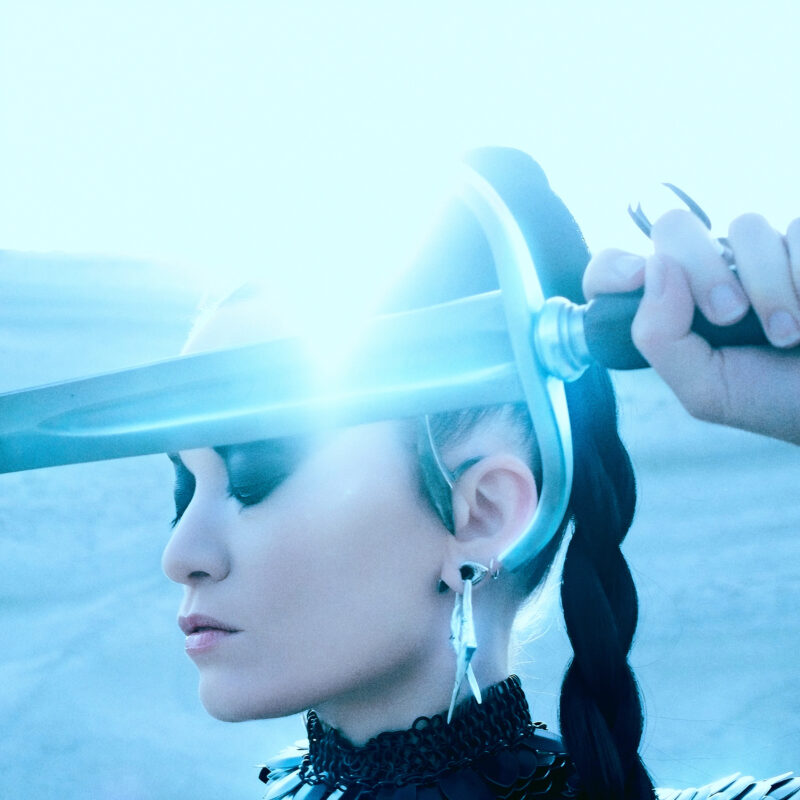
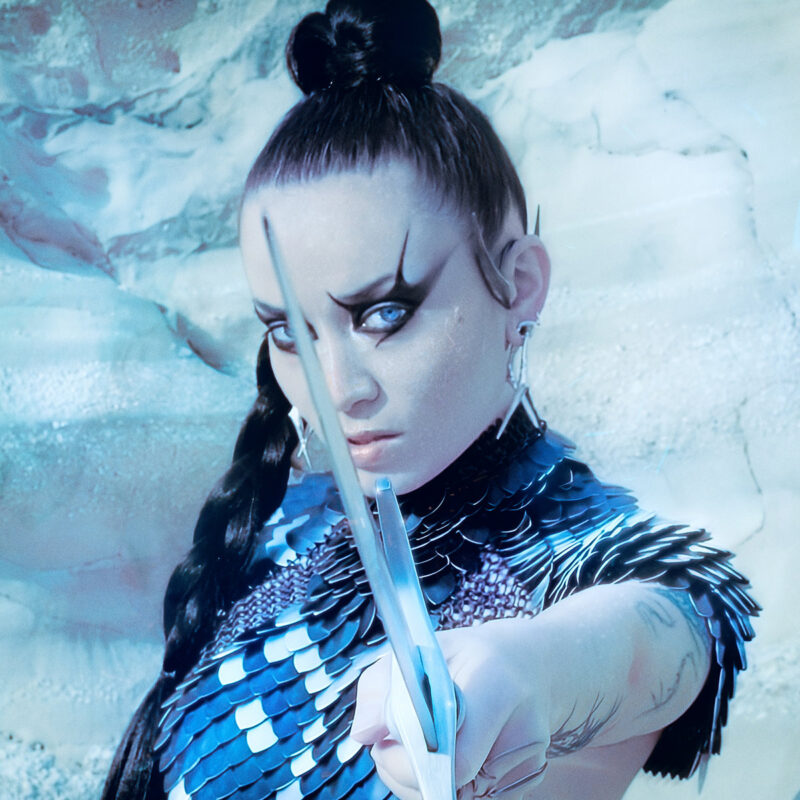
Cataclysm feels genuinely mythic—even in a fantasy sense: blades, ritual, guardianship, endurance, transformation. That feeling is reinforced by the album’s visual language—the armour, the sword, the press imagery—which evokes something almost Valkyrie-like, a feminine figure moving through collapse with resolve rather than conquest. Other women in music have tapped into similar archetypal territory—Grimes is an obvious example—but what feels distinct here is the sense of protection, vigilance, and moral weight. How consciously are you working with fantasy and mythic archetypes—particularly something feminine, perhaps a reworking of the typically male hero’s journey or the “maiden with the sword”—when shaping both the music and the world around Cataclysm?
One of the themes of Cataclysm is the reclamation of power back from oppressors in general, and the original oppression that has allowed all other oppression to occur was the patriarchal oppression of all who are not men. Therefore, the image of a woman holding a sword is a powerful one in this context.
Throughout Cataclysm, there are themes of a desire to return to matriarchy, so the imagery is very consciously chosen to that effect. I grew up watching Xena and that show really was the first thing I ever saw that made me feel like handling a sword was something I could do myself rather than depending on a man to defend me, which was the tiresome standard in most media at the time. So embodying that moment was important to me.
Interestingly, I’m not the only female artist to tap into this recently (Sally Dige also holds a sword in her video for ‘Sow the Path’, which is one of my favourites of 2025), and I think it indicates a cultural shift in this direction of empowerment.

You’ve been incredibly prolific over the years—albums, collaborations, touring, label work. What makes that pace possible for you: discipline, obsession, necessity, or something closer to survival?
I had a lot of pain to process, and work helped alleviate a deep loneliness that set in after the pandemic. My community has somewhat disintegrated, and I’ve struggled to find a stable source of companionship. I have amazing friends and family that I love a lot, but simply don’t get to see them enough. Work fills the empty space and gives me a solid dose of ‘meaning’ to combat general existential malaise.
But I’ve also been through multiple burnout cycles in the last few years and am now making a concerted effort to do less and slow down. In retrospect, I was also really deeply entrenched in that capitalist nonsense equating productivity with self-worth, and that’s something we all desperately need to part with. We all deserve a rest!
How did your collaboration with Trey Frye from Korine first come about? Was it rooted in friendship, mutual admiration, or a specific moment where you realized his sensibility aligned with this album?
We’re mutual fans of one another’s projects, and Trey and I have naturally become friends over the years, bonding over the shared struggle of being fully independent musicians with a sound that doesn’t automatically plug us into any specific scene. There aren’t many people who share our job description so it’s nice to feel like someone out there understands.
I noticed his tracks always sounded extremely well mixed, so I sent him ‘Serpentsmile’ to do a preview mix just out of curiosity, and was blown away with the result. I shed tears of joy during the first car test of the record.
On a practical and emotional level, what did Trey bring to Cataclysm that shifted the final shape of the record—were there moments where his perspective changed how a song felt or functioned?
While his mixing tremendously elevated the final sound of Cataclysm, Trey’s contributions were mostly matters of sonic details like drums and ear candy rather than the content or function of songs. All the songs were totally finished by the time they reached Trey, and he gave them their final sheen. It’s always helpful to have another set of ears doing the final pass of a track that goes a little beyond just mixing them, since after hearing something a thousand times, it can be hard to objectively decide if a kick sounds right.
That said, though, on ‘Human’ he also added a bassline that gave the track a far more Italo vibe than it originally had, and I was thrilled with the result.
As Cataclysm moves from the studio into the world, how do you imagine these songs living on stage? Has the album changed the way you think about embodiment, movement, and collective energy in live performance in 2026?
Yes, it certainly has. The songs have already found their life on stage with the addition of my drummer, Dream Dilate Decay, and it’s truly been a revelation. Even before the album was out, the tracks were going down tremendously well at our shows back in September.
Something was always missing from my live shows in the past, and his fierce thrashing of the drum pads and general cuntiness finally delivered the kind of energy I needed to fully transcend. I always used to feel a little stressed out on stage,but now the music totally envelopes me and nothing else exists. The missing piece was rhythmic embodiment (and an authentic friendship also helps).
Looking ahead with new collaborations and projects on the horizon, do you feel yourself already moving toward another phase—or do you see Cataclysm as something you’ll continue to inhabit and unfold before the next transformation begins?
I don’t feel quite done with ‘Cataclysm’. It was such a huge part of my life for so long, and there’s still other angles I’d like to share. I’m working on some more music and performance videos, and as I enter into the world of podcasting, I’ll be taking some deep dives into the concepts behind the songs. It isn’t over yet!§

Cataclysm is an album built for movement — not just the private kind, but the collective kind: bodies syncing in a room, pressure turning into pulse. With the album now living out loud, Zanias is carrying these songs into 2026 with a run of dates that moves from intimate club floors to festival scale. Expect a setlist designed to hit in the muscles as much as the mind — catharsis, confrontation, and that hard-earned lift when the lights finally break.
Cataclysm is out now. Listen to the album below, and order here.
a
Zanias’ European tour begins April 14th in Leipzig at Heilandskirche (DJ set) before moving through Bratislava’s Pink Whale, Krakow’s Klub RE, Warsaw’s Mechanik, Vilnius’ XI20, Tallinn’s Paavli Kultuurivabrik, Helsinki’s Lepakkomies, and Stockholm’s Hus7 — all with Korine — followed by a Berlin show at Frannz Club on April 26th. In May, she returns to Leipzig for Wave Gotik Treffen on May 25th and closes the tour on May 29th at The Black Heart in London. Expect a live set engineered for impact — ritual electronics, physical percussion, and that surge of communal release when tension finally tips into motion.
April 2026
- 14.04 — Leipzig, Germany — Heilandskirche (DJ set) with Korine
- 15.04 — Bratislava, Slovakia — Pink Whale with Korine
- 16.04 — Krakow, Poland — Klub RE with Korine
- 17.04 — Warsaw, Poland — Mechanik with Korine
- 18.04 — Vilnius, Lithuania — XI20 with Korine
- 21.04 — Tallinn, Estonia — Paavli Kultuurivabrik with Korine
- 22.04 — Helsinki, Finland — Lepakkomies with Korine
- 24.04 — Stockholm, Sweden — Hus7 with Korine
- 26.04 — Berlin, Germany — Frannz Club
May 2026
- 25.05 — Leipzig, Germany — Wave Gotik Treffen
- 29.05 — London, UK — The Black Heart
Follow Zanias:





 Or via: