


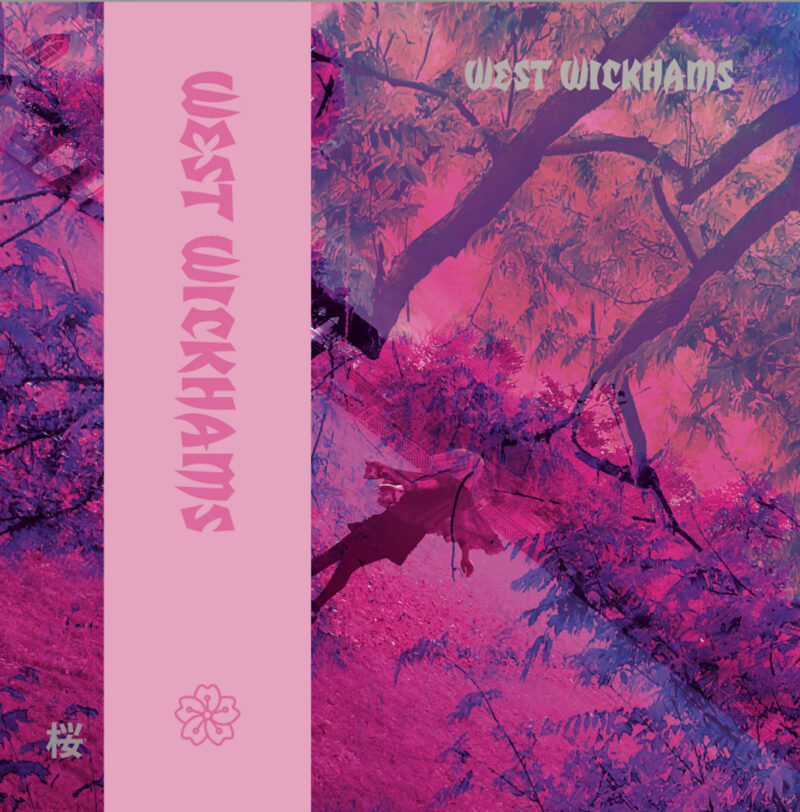
The concept of mono no aware lives in the small surrender of moments already loosening their grip. Magnolia petals spotting the pavement after a brief blaze. A song finishing its ride as the car idles, finger hovering over the key. A laugh carrying more years than the last time you clocked it. There’s a mild ache there, attention sharpened by time’s hand. Meaning gathers speed because nothing sticks around. You watch without grabbing, let the instant move on, understanding that noticing is the act itself. In Japan, sakura (cherry blossoms) carry this charge everywhere: on paper and silk, in poems and patterns, a seasonal reminder that life flashes, then bows out.
West Wickhams (Jon Othello and Elle Flores) operate in that slipstream, stitching England’s salt air to their native Sicilian stone. Their music wanders through old pages and ruined places, part séance, part scribbled manifesto, guided by abbeys, attic organs, and paperback dread. West Wickhams play at being a phantom rival crew to the storied “Bromley Contingent”: bedroom-born, rough-edged, smudged with tape hiss and pop instinct; post-punk filtered through autumn light and late-night reading lists.
Indeed, the band’s influences read like a bookshelf knocked over at midnight: “Mary Shelley, Whitby Abbey, pipe organs, flowers, dark punk, Gothic novels, rock ’n’ roll autobiographies, ancient myths, castles, abstract painting, euphoria, mist, autumn, Halloween, optical illusions, Edgar Allan Poe, Daphne du Maurier, Andy Warhol.” True to their word, these elements creep into their lyrics on little cat feet.
Up To The Old Tricks moves with a sly smile and a light step, a record that understands the power of restraint. Its language is pared back to chant and hook, synth lines kept simple, repetition treated as punctuation rather than emphasis. There’s a wink in the delivery that recalls the dry romanticism of The Magnetic Fields and the theatrical poise of Jim E. Brown, a sense of play that never curdles into clutter.
The accompanying video, garden mischief giving way to a pocket-sized vaudeville stage, leans into a kind of time-slip glamour, a 1960s daydream borrowing the manners of the 1920s. The visual lift from the 1966 Czech classic Daisies sharpens the gesture: spoiled worlds, spoiled girls, and misbehaviour performed as critique.
Ice Block pulls from early-2000s indie instincts, its chant riding spare keys and a drum machine that clangs with domestic insistence, bringing to mind the off-kilter ease of Modest Mouse and Bishop Allen. There’s a mechanical humour at work too, a wink toward Kraftwerk, where precision and quirk coexist without fuss.
As the Camera Shuts pivots the palette entirely. Airy synths, chimes, muffled voices, and guitar open the track before it drifts into colder post-punk air, echoing the poise and poise-adjacent tension associated with Siouxsie and the Banshees. It feels like a side door into the record—quietly distinct, its difference registered through atmosphere rather than announcement.
Later cuts tilt darker and looser. EQ The Viper circles with echo and unease, minimal lines arranged to feel suggestive, almost subliminal, its menace implied rather than declared. Save Yourselves relaxes the grip: a softer groove with a faintly psychedelic sway, vocals submerged like passing thoughts, echoing and gentle. Across the record, economy becomes attitude; small gestures accumulate. Old tricks, but handled with care, timing, and a knowing grin.
Listen to Sakura below and order the album here.
All told, it’s a record unafraid to play with form—five curious art-rock cuts that prize wit over weight, leaving a quiet imprint that tends to surface at the edge of sleep, when the day loosens its grip and small ideas linger longest.
Follow West Wickhams:





 Or via: