


Life arrives without rehearsal and leaves without warning, a sequence of moments already loosening as we try to hold them. Zen Buddhism speaks to this plainly: impermanence as fact, not failure. Attention sharpens, then slips. Feeling rises, then thins. Only traces remain: an afterimage, a breath caught between intention and release. In this space, art becomes an act of noticing rather than control, a way to stay present with what is passing through rather than pinning it down. Maybe Nothing from the UK’s Human Image exists inside that interval, alert to disappearance, alert to the clock.
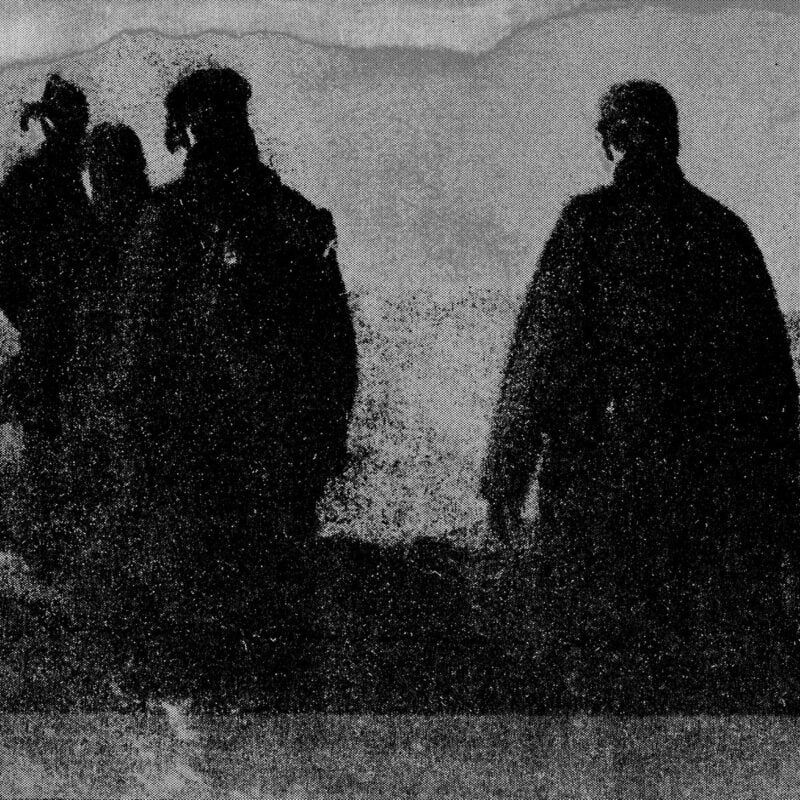
Human Image have slipped their debut seven-track tape like a note left on a kitchen table at dawn. Cut fast and caught mid-thought, the record was born in a docklands basement in East London, where decisions happen by feel rather than plan. Analogue residue clings to everything. The air around these songs feels handled, smudged, slightly bruised. This is music that moves quickly because it knows it has to.
The project binds multidisciplinary visual artist and classical composer Luca Bailey, and Outlander’s Joe House, both shaped by Birmingham’s DIY churn before reuniting years later in East London. Their method is blunt and bare: “first thought, best thought.” Each piece written and recorded in a single intuitive session, a hard line drawn at the end of the night. That pressure leaves fingerprints. Tracks such as Again circle shoegaze guitar haze and fuzzy bass, vocals pushed down into the mix. Harsh edges scrape against softer melodic debris. Slowcore drag, lo-fi murk, cloud-rock drift: all present, all slightly eroded.
“The music touches on grief, loss, and the fleeting nature of everything we hold close,” Bailey explains. “When Joe and I began writing, it felt less like composing and more like documenting something that was already disappearing. The songs arrived quickly, almost unconsciously, forming within minutes, as though they already existed somewhere and were simply passing through us. That immediacy, that sense of rushing to keep up with a feeling before it fades, is what defines the record.”
Those instincts trace back through Felt’s restraint, Broadcast’s blurred warmth, the skeletal grace of The Durutti Column, the hushed gravity of Duster, and the azure dreams of Slowdive. Human Image works with erosion rather than excess. Loss, isolation, and disconnection seep into the gaps, never announced, always implied.
House frames the sessions as a sealed pocket, insulated from the rest of life. “These songs came to be during a really transitional phase of life…there’s an intimacy present that I think we were only able to capture because of the insular nature of the recording sessions. Because of this, we were able to be creatively free with each other, following each thread to its natural end, consciously avoiding deliberation and always drawing a line under a piece of music at the end of each late evening, resulting in what feels like a direct and honest document of a place and time.”
A 20-minute visualiser accompanies the tape, extending its emotional and lyrical themes into abstract analogue film: a slow, tactile collage shaped by decay, absence, and half-formed memory.
Watch below:
Maybe Nothing stands as an opening gesture rather than a declaration: imperfect by choice, guided by instinct, weighted with feeling. Sound and image loosen their grip, drift apart, and leave behind something unfinished but true—an awareness held briefly, then gone.
Listen to Maybe Nothing below and order the album here.
Follow Human Image:






 Or via: