


Fear rarely arrives all at once. More often it creeps in by degrees: a crack in the air, a wrong note in a familiar room, a laugh stretched too long until it starts to sound like a warning. On F.I.V.E. Fear Increases Violent Emotions, Italian goth rockers Christine Plays Viola turn that slow internal corrosion into a full-length fever vision, one where guilt, self-division, dread, desire, and the fantasy of redemption keep changing masks beneath cathedral-sized guitars, ritual drums, metallic synths, and vocals that move between accusation, confession, and collapse. Out now via Cleopatra Records, the band’s fifth album does not present fear as a passing state, but as a force that distorts the mind from within, tightening each song like another turn of the screw.
That idea is not incidental. As the band explains in the interview later in the article, F.I.V.E. began as a marker for their fifth album, then evolved into an acronym: Fear Increases Violent Emotions. What emerged from that long writing process was what they describe as a ‘psychological document’: a sequence of inner thresholds where identity splinters, tension accumulates, and release never comes clean. The album’s architecture matters. Each track feels like another chamber in the same crumbling structure, with different shades of dread gathering in the corners.
Taken song by song, F.I.V.E. reveals just how many forms Christine Plays Viola can give to dread and unease. The band moves from deathrock severity to waltzing despair, from dubby post-punk swerve to slow-burning psychic collapse, always keeping the record’s emotional gravity intact.
The album begins with “Sprout of Disharmony,” opening on dirgeful organ, ghosted voices, and a sense that something has already gone wrong. When the guitars arrive, they do so with a stately gothic sweep, while the vocal carries more bruised humanity than sepulchral bluster. The song introduces the record’s central instability by withholding the obvious. As the band notes in the interview, they wanted this opener to feel like the first hairline fracture, the beginning of awareness before full recognition sets in. It is the seed from which the rest of the album’s psychic damage grows.
“My Redemption” widens the album’s sound, signaling the contrast to come with each track. Metallic textures give way to huge synth chords and late-’80s-style guitar lines that lend the song a cinematic grandeur without sanding down its hostility. Chosen as the lead single, it makes sense as an entry point: it carries enough lift to draw the listener in, while still preserving the record’s ambiguity. The title promises deliverance, but the music keeps that promise at arm’s length. It hangs in suspension, caught between vengeance, self-recognition, and the faint suggestion of escape. One hears why the band describes it as a threshold rather than a resolution.
Factory noise, warped metal, and anxious electronics usher in “You Don’t Fool Me,” before the song kicks into propulsive goth-rock motion with brooding bass and motorik insistence. Lyrically, it is one of the album’s sharpest confrontations, a song of recognition and recoil aimed at duplicity, performance, and manipulation. Musically, it balances menace with momentum as it moves with melodic precision while still sounding spiritually corroded.
One of the album’s strongest turns, “Desolate Moments” drifts in on Vangelis-like synths and guitar figures. There is a faint Joy Division kinship in its emotional weather, but the song has its own glacial poise. It moves like a slow dance with extinction, tracing a line between regret, spiritual vacancy, and the sickly afterglow of promises already broken. The arrangement gives the impression of a world being built and then quietly abandoned within the same five minutes.
“Confession” boasts a deathrock snarl in its guitar work, deep bass movement, and macabre harmonies that lend the whole thing the feel of a vampiric tribunal. Thematically, it sits at the core of the album: guilt, punishment, self-exposure, and self-annihilation all converge here. In the interview, the band describes confession as a stripping away of protection until the self becomes both accused and witness.
With eerie buzzing, whispered invocations, and icy sweeps of batcave guitar, “There’s No Going Back” sounds exactly like its title: a command to shed old restraints and step fully into annihilating self-knowledge; landing with a sense of ceremony.
One of the record’s most striking left turns, “Black Noise” folds dub, ska-inflected post-punk, and sleazy sax into the album’s otherwise severe landscape. The call-and-response structure, the stabbing rhythm guitar, and the sense of bodily dislocation in the lyrics all help the song feel like a manifestation of psychic unrest. Even when the band loosens the groove, they never loosen the vise.
The album’s deepest descent comes with “The Crypt of Misery,” a long, deliberate crawl into shame, chaos, and self-loathing. It opens on resonant synth motion and metallic low-end before sinking into a dark, slow-breathing churn that feels almost progressive in scale. In the interview, the band calls it the deepest point of the record. Everything about it suggests collapse without release. The repeated fall in the lyrics is mirrored by the structure itself, as though the song were spiraling through successive floors of the same nightmare.
“Jackie’s Curse” brings the album’s tension into a more bodily register. The guitars bite harder, the drums hit with greater immediacy, and the vocals lean into a rougher theatricality. Already released ahead of the album cycle, the track was remixed and remastered to sit inside F.I.V.E.’s larger arc, and it earns its place. Where some of the surrounding songs hover in symbolic or interior states, this one feels tactile, fevered, and close to the skin. The band describes it as one of the record’s sharpest edges, where internal pressure takes physical form.
Closing the record, “Blood Calls Blood” sounds like an end procession through smoke and iron. Cathedral drones, martial stops and starts, and an icy guitar line give the song the gait of a war march staged inside a moral reckoning. The vocal carries something of Killing Joke’s incantatory severity, and the lyrics drive home the album’s sense of irreversible consequence. By this point, F.I.V.E. has made its argument in full: fear distorts, guilt accumulates, and the self that emerges on the other side may be too altered to recognize. The album ends with judgment still echoing.
F.I.V.E. has a formidable command of goth, deathrock, and post-punk language, though Christine Plays Viola have that in abundance. If earlier Christine Plays Viola records explored darkness through concept, image, or memory, this one stays inside the chamber and reports from there. That psychological coherence is no accident. In speaking with the band, it becomes clear that F.I.V.E. was shaped as a sustained emotional environment: a place where fear alters identity. Below, Christine Plays Viola discusses the origins of the album’s title, the visual language behind tracks like Confession and Jackie’s Curse, the role of cinema and literature in shaping the record’s uneasy poise, and why this fifth album feels both like a return to their roots and their most inward statement yet.
The title F.I.V.E. – Fear Increases Violent Emotions reads almost like a spiritual maxim or psychological diagnosis. When did that phrase first appear, and how did it come to define the emotional core of the album?
On the surface, the title started from something very concrete: F.I.V.E. is our fifth album, and we wanted to acknowledge that milestone. This record required a long and intense process — almost two years of writing, developing, and recording — so it felt important to mark that effort in a direct way.
At the same time, we didn’t want the title to remain something merely descriptive or literal. Calling the album simply Five would have felt too neutral for music that comes from such a psychologically charged place. So we kept the word FIVE, but transformed it into an acronym — something that could carry a deeper meaning and reflect the conceptual nature of the record.
The phrase appeared quite early during the writing process. At first, it felt like a fragment — almost a sentence overheard inside the mind —, but gradually it became the key to everything.
Fear is not just an emotion; it is a force that reshapes perception. It compresses identity, distorts memory, and pushes emotions toward extremes. The title F.I.V.E. became almost a diagnosis — the point where inner tension transforms into something irreversible.
It is not a slogan or a concept invented afterward — it is the psychological axis around which the entire record turns.
Fear, identity, tension, and redemption run through the record. Do you see these ideas unfolding as a deliberate arc across the album, or as recurring states the songs move in and out of?
In a way, it is both a progression and a return.
There is a subtle narrative arc across the album a movement from the first signs of imbalance toward a deeper confrontation but it is not a linear story with a clear beginning and resolution. It feels more like entering a psychological landscape where different emotional states appear, dissolve, and reappear in new forms.
Each song can be seen as a chapter, but also as a room inside the same structure. The listener moves through different intensities: uncertainty, tension, recognition, resistance, and sometimes a fragile sense of redemption. Yet nothing is ever completely resolved. The emotions remain suspended, influencing one another.
Fear, identity, and redemption are not stages that replace each other; they coexist constantly. Fear reshapes identity, identity seeks meaning, and redemption becomes less a solution than a temporary glimpse of clarity before the tension returns.
That is why F.I.V.E. works less as a traditional narrative and more as a psychological document, the portrait of a mind under pressure rather than a story unfolding. The songs are connected not by events, but by emotional gravity.
You’ve described this album as being written between isolation and confrontation. What did “confrontation” mean for you during the writing process—internally, creatively, or in relation to the outside world?
Isolation was the condition, confrontation was the choice.
After the years surrounding the pandemic, we found ourselves in a quieter place, both publicly and personally. From the outside, it might have looked like a pause, but internally, it was a period of accumulation. We needed time to recover our energy, rediscover our motivation, and understand who we still were as a band and as individuals.
Confrontation began when we realized that returning meant facing those questions honestly. It meant asking ourselves whether we still had something real to say and refusing to move forward until the answer felt true.
Creatively, confrontation meant rejecting comfort. Not repeating what had worked before simply because it was safe. Some songs required time to find their direction, and we allowed that process to unfold without forcing it. If something didn’t feel necessary, we left it behind.
There was also a confrontation between past and present between the band we had been and the band we were becoming. In some ways F.I.V.E. is the result of that tension, a record born from the need to rebuild meaning rather than simply continue.
Sometimes it is better to stop and recover strength than to keep moving without conviction. When we finally decided to return, it had to be with something honest and fully realized.
So isolation shaped the silence, but confrontation gave it a voice.
F.I.V.E. often feels like one continuous psychological space rather than a collection of tracks. Did you approach this as a concept album from the beginning, or did that cohesion emerge later?
It wasn’t conceived as a traditional concept album with a defined storyline. There was no script or predetermined narrative at the beginning.
The cohesion emerged gradually, almost unconsciously. As the songs took shape, we realized they all belonged to the same emotional territory — like different fragments of the same fracture. Each track seemed to illuminate a different angle of the same internal tension.
At a certain point, it became clear that the album could not work as a simple collection of songs. It needed to be experienced as a whole — almost like entering a room and staying inside long enough to understand its atmosphere.
The sequence of the tracks became fundamental. We spent a long time deciding the order because we wanted the tension to grow naturally, almost imperceptibly, until the listener finds themselves completely inside that psychological space.
In that sense, the concept was discovered rather than designed.
F.I.V.E. is not a story with characters and events — it is closer to a mental landscape under pressure, where emotions move in cycles rather than in straight lines.
Each song is a different threshold, but they all lead to the same place.
“Sprout of Disharmony” opens the record at an unhurried pace, gradually building tension. Why was that the right way to introduce the album’s emotional landscape?
Because tension rarely begins with an explosion.
It usually starts as something almost invisible — a slight imbalance, a small shift in perception. Sprout of Disharmony represents that first crack, the moment when something begins to move beneath the surface without being fully understood.
The title itself suggests a beginning — not a collapse, but the quiet birth of instability. A seed of disorder that continues to grow throughout the album.
We wanted the listener to enter F.I.V.E. slowly, almost without realizing it. There is no immediate impact — only a gradual accumulation of weight. By the time the tension becomes visible, the listener is already inside it.
There is also a small detail at the beginning of the track that hints at this idea. The song opens with the sound of people laughing — something that might suggest a moment of lightness or even humor. But the laughter is deliberately artificial. We treated it with long reverbs and ghost-like delays to make it feel distant and unsettling.
The real contrast comes from the synth layer underneath those voices. The two elements together create a subtle sense of unease — a feeling that something is already wrong beneath the surface.
In a way, that atmosphere was inspired by cinema. The opening reminded us of the beginning of The Shining — the aerial shot following Jack Torrance’s car as it moves toward the hotel. At first, it feels like a simple family journey, almost peaceful, but the music already suggests the descent into something darker.
That contrast between apparent calm and hidden tension was exactly what we wanted to evoke.
Cinema has always been inside our music, and in many ways, Sprout of Disharmony is where the visual dimension of F.I.V.E. begins to take shape.
It is the moment before awareness.
The beginning of the fracture.
“My Redemption” was chosen as the lead single to introduce F.I.V.E. Its cinematic, late-’80s new-wave atmosphere feels like a direct gateway into the album’s emotional universe—was that a conscious decision?
Yes, very much.
My Redemption felt like a natural threshold into the world of F.I.V.E. It carries a balance between clarity and depth — a song that opens a door without revealing everything behind it. We felt it could introduce the emotional language of the record in a direct but not simplistic way.
There is something suspended in that song — a tension between fall and release. The title suggests redemption, but the music never offers it as something certain or complete. It feels more like a possibility than a resolution.
Choosing it as the first single was a conscious decision because it represents one of the most accessible entry points into the album’s psychological space, but it still preserves the ambiguity that runs through the entire record.
The late-80s atmosphere wasn’t nostalgic by intention. That period produced music capable of combining darkness and melody in a very human way — something fragile but also expansive. We have always been drawn to that emotional scale, where sound creates space rather than simply impact.
In many ways, My Redemption is like a first light inside a dark room.
That song carries an expansive emotional quality associated with that era. What draws you to that kind of expansive emotional expression, both musically and aesthetically?
We have always been drawn to music that creates space — not only sonic space, but emotional space as well.
An expansive sound allows tension to breathe. It gives emotions time to develop instead of compressing them into immediate impact. We are interested in that slow growth — the feeling that something is forming beneath the surface before it becomes visible.
Many late-80s records had this quality: the sense that sound could open a horizon rather than close a statement. The listener doesn’t simply hear the music — they enter it. This immersive dimension has always been essential for us.
We often think about sound in almost architectural terms — layers, distances, light and shadow. A song is not only a structure of chords and rhythms, but a space where emotional forces move and interact.
Many songs on F.I.V.E., including My Redemption, were born in this way: from long sessions dedicated to building soundscapes. Sometimes we start from synthesizers, other times from heavily processed guitars treated almost like sonic pads. At that stage, we are not yet searching for a song — we are searching for an atmosphere, a moment, a direction.
Only after we have found that emotional space do we begin to build the songwriting: structure, movement, and tension. The final form slowly emerges from that initial atmosphere until it becomes the version that is eventually recorded.
This is probably why the cinematic dimension comes naturally to us.
Before a song becomes music, it often exists as an atmosphere — almost like a suspended scene.
What draws us to this kind of expression is its humanity.
It leaves space for ambiguity, fragility, and silence. It doesn’t try to explain emotions — it allows them to exist.
And within that space, listeners can recognize something of their own inner world.
The video for “Confession” is dense with symbolic imagery—shadowed corridors, fractured mirrors, doubled figures, submerged bodies, and explicit religious references such as a crown of thorns and bleeding eyes. How did these images take shape, and what role does religious symbolism play in expressing themes of guilt, confession, martyrdom, and self-punishment across F.I.V.E.?
The images in Confession were not conceived as illustrations of the lyrics, but as another language telling the same inner story.
Music and visuals grew together, coming from the same emotional territory.
Religious symbolism felt natural because it speaks directly about guilt, sacrifice, and redemption in a very physical way. These are not abstract ideas — they leave marks on the body and on the mind. The crown of thorns, the bleeding eyes, the mirrored figures — they all represent the idea of inner judgment, the feeling of being both the accused and the witness at the same time.
In F.I.V.E., confession is never a clean act. It is not liberation, but exposure. To confess means to remove protection and face what remains underneath.
We were interested in the moment when a person turns inward and becomes their own tribunal — when the voice that judges is the same voice that suffers. That tension between guilt and the desire for redemption runs through the entire album.
The doubled figures and reflections suggest fragmentation — the sense that identity is no longer stable but divided into different selves. The submerged bodies represent emotional suffocation — the weight of things that remain unspoken.
Religious imagery was never used in a literal sense. It functions more like a symbolic vocabulary — a way to express inner struggle through archetypal forms that people instinctively recognize.
In that sense, Confession becomes almost a ritual space — not a narrative, but an emotional state where vulnerability and self-punishment coexist.
Visually, “Confession” avoids linear narrative in favor of repetition, confinement, and distortion. What emotional or psychological state were you hoping to place the viewer in through this visual language?
We wanted the viewer to feel suspended inside a psychological space rather than guided through a story.
David Lynch has been one of the directors who influenced us the most, and in Confession, we tried to approach the visual language in a similar spirit — stimulating the viewer on a psychological and sensory level rather than simply presenting a narrative. We were not interested in telling a clear story. We wanted to lead the viewer toward an emotional abyss, where images sometimes raise questions rather than provide answers.
At times, the viewer might ask: “Why this image?” — and that question is part of the experience. Ideally, the video invites repeated viewing, allowing new details and meanings to emerge each time, as if trying to give shape to a dream — or more precisely, to a nightmare.
Often in dreams, we remember fragments that seem disconnected from each other, yet we instinctively try to build a meaning out of them. Confession works in a similar way. The images are not always logically connected, but they belong to the same emotional current.
In a sense, this video can be seen through the eyes of a dreamer of nightmares — someone trying to reconstruct meaning from unstable memories and inner visions.
The goal was not explanation but immersion. Not certainty, but disturbance.
“The Crypt Of Misery” is the longest track on the album, unfolding with slow, deliberate intensity. It evokes elements of proto-goth and early post-punk—even progressive rock lineage—with powerful vocals and heart-pulsing basslines. What were you aiming to express emotionally with this song, and how did you approach its structure and momentum?
The Crypt Of Misery is probably the deepest descent within F.I.V.E. — the point where the album reaches its darkest core.
Musically, it feels less like a song and more like a journey downward — a slow fall into the pulsating heart of the record. The deep, almost tribal drums and the persistent bass groove create a cavernous structure that holds everything together, like the walls of an underground space. But the song does not remain static — it keeps evolving, searching for different tensions, touching areas close to death rock before descending even further.
The voice changes register several times throughout the track. It becomes more desperate as the song sinks deeper, following the psychological collapse described in the lyrics. Lines like “And so I fall… then I fall” are not only words — they are the movement of the song itself.
The lyrics describe a mind trapped inside its own darkness — a slow acceptance of shame, guilt and inner chaos. The “crypt of misery” is not a physical place but a mental state, a space where memory, fear, and self-destruction merge together.
In the booklet of F.I.V.E., there is an image of a man falling into the void next to the lyrics. That image perfectly represents the spirit of the song. You don’t know if he will hit the ground — or if the fall is actually a passage into another dimension, another self.
If F.I.V.E. is a psychological landscape, The Crypt Of Misery is its deepest point — the moment where resistance disappears and the descent becomes inevitable.
“Jackie’s Curse” existed visually before this album cycle and now appears on F.I.V.E. Did you revisit or recontextualize the song for the album, and what role does it play in the record’s overall psychological arc?
Jackie’s Curse existed before the F.I.V.E. sessions, but emotionally, it already belonged to that world.
When we decided to include it on the album, it didn’t feel like inserting an older track — it felt more like placing an existing fragment into its natural context. The themes of tension, inevitability, and inner pressure were already there, waiting to become part of a larger psychological space.
As mentioned earlier, the path that led F.I.V.E. to its final form was long — almost two years — and during that time, Jackie’s Curse and Blood Calls Blood had already been planned and released in advance. At that stage, we were still deep in the evolution of the other songs, and we knew the album would need more time to be completed. At the same time, we felt the need to share something with our audience — a first sign that the project was alive and moving.
In the end, keeping those tracks on F.I.V.E. was a very natural decision. They were part of the journey from the beginning, and leaving them out would have felt almost disrespectful to the original vision of the record.
The only real change we made was technical: together with our long-time sound engineer and friend Salvatore Carducci, we remixed and remastered the track from scratch so it would sit naturally within the final sonic identity of the album.
There is also a small anecdote behind its release. When we decided to publish Jackie’s Curse, Confession was already completed — in fact it was the very first track finished during the F.I.V.E. sessions back in 2023. But we chose Jackie’s Curse for the video because we wanted something sharper and more raw — a more physical introduction to the new phase of the band.
Compared to some of the more atmospheric tracks on the record, Jackie’s Curse represents a more physical and instinctive side of Christine Plays Viola. The song grew from rehearsal-room energy, from a direct guitar-driven impulse that developed collectively. There is something raw and immediate in it — less reflective, more visceral.
Within the psychological arc of F.I.V.E., Jackie’s Curse feels like a moment where tension becomes almost tangible — no longer internalized but exposed, almost erupting through the surface.
If the album is a descent into the mind, Jackie’s Curse is one of the points where that tension takes a physical form.
It is not the deepest point — but it is one of the sharpest edges.
The video for “Jackie’s Curse” is intense and intimate—shot in stark black-and-white with close framing and physical tension. Can you talk about the ideas behind its production and how they connect to the song’s themes?
The visual concept for Jackie’s Curse was built around psychological captivity.
The song already described a descent into a private nightmare — a space where desire, guilt, and punishment become indistinguishable. The video translates that inner tension into physical form: a man imprisoned in a dark room, forced to confront images of betrayal and violence while being judged by someone he once loved.
We wanted the camera to feel close and oppressive, almost invasive. The tight framing and stark black and white aesthetic remove any sense of comfort and focus entirely on gestures, faces, and reactions. Everything becomes exposed and unavoidable.
The story unfolds like a nightmare rather than a narrative. The protagonist is captured, beaten, humiliated, and suffocated by the woman he betrayed — only to wake up and believe it was just a dream. But when he finds the same photographs in reality and sees the expression on her face, the boundary between dream and truth collapses.
That ambiguity is essential. The real horror is not the violence itself but the feeling that fate has already been written. The line “You had just drawn my fate” is central to the whole piece.
Emotionally, the video explores guilt and punishment as something intimate and inescapable. The violence is not spectacular — it is personal, almost ritualistic. It is the sense of being trapped inside a consequence that cannot be undone.
Unlike Confession, which moves through symbolic imagery and psychological abstraction, Jackie’s Curse is grounded in a more physical and human nightmare. It is immediate and claustrophobic.
Titles like “Confession,” “There’s No Going Back,” and “Blood Calls Blood” feel like points of no return. Are these songs written from a single narrator’s perspective, multiple characters, or a more abstract voice that moves through different states?
It is closer to an abstract voice than to a single narrator.
We never imagined F.I.V.E. as the story of one character or a sequence of defined roles. The album feels more like a fragmented consciousness — different emotional states speaking from within the same psychological space.
Sometimes the voice sounds personal and intimate, almost confessional. Other times it becomes distant, ritualistic, or even cold, as if observing itself from outside. But beneath these shifts, there is always the sense of a single inner world.
You could say that the album is spoken by one mind seen through different mirrors.
Songs like Confession, There’s No Going Back, and Blood Calls Blood feel like points of no return because they describe moments where something irreversible has already happened — decisions taken, boundaries crossed, identities transformed.
The voice moves through these states without fully explaining them. We are not interested in telling a story step by step, but in capturing the emotional truth of those moments — the instant when a person realizes that there is no way back to who they were before.
In that sense, the narrator is not a character but a condition — a consciousness under pressure.
Several songs deal with confession, guilt, inheritance, and irreversible choices. Are these lyrics rooted in personal experience, imagined characters, or a shifting perspective that travels across the album?
The lyrics are written entirely by Massimo, our singer, and they emerge from fragments of personal experience mixed with dreamlike and nightmarish elements.
Many of the images and situations come from states he has genuinely lived or felt — fears, constraints, inner tensions — but they are never presented as direct autobiography. Instead, they are transformed into symbolic landscapes where reality and imagination merge. There is always a movement between lived experience and inner vision.
Massimo has always brought to the band a rare kind of emotional contribution — the ability to observe life from a perspective that feels almost suspended outside ordinary time. His words often seem to belong to a place where memory, intuition, and subconscious images overlap.
The lyrics become a vehicle to express what human beings usually keep hidden inside themselves. In a way, writing becomes a form of release — almost a form of therapy — a way to give shape to emotions that otherwise would remain unspoken.
So while the perspective shifts across the album, the emotional core remains deeply personal. The songs are not literal confessions, but they are born from real inner experiences.
F.I.V.E. is not a diary — it is a psychological landscape shaped through personal fragments, dreams, and inner tensions.
In past interviews, you’ve described a process that often begins with guitar riffs or synth ideas and avoids canonical song structures. On F.I.V.E., did anything change in arranging, pacing, or the balance between electronics and heavier instrumentation?
On F.I.V.E., the process became more conscious and layered than in the past.
Many songs were born from long sessions of sound exploration — synth soundscapes or heavily effected guitars treated almost like pads. We often started by searching for an atmosphere rather than a structure. Once the emotional tone emerged, the song slowly took shape around it: guitars defining tension, bass and drums building the physical dimension, and finally voice and lyrics completing the emotional direction.
In that sense, the atmosphere came first, and the songwriting followed.
Tracks like Desolate Moments, You Don’t Fool Me, and even My Redemption began from these kinds of sonic environments before evolving into their final form.
At the same time, there were also more instinctive moments. Songs like Jackie’s Curse were born almost in one gesture during rehearsals — starting from a guitar idea and developing organically with the band in the room. Those tracks carry a more direct and physical energy.
Compared to previous albums, we paid much more attention to pacing and transitions. Silence and space became structural elements rather than empty moments.
The balance between electronics and guitars also shifted. Electronics helped shape the atmosphere, but guitars became the main physical voice of the album. We wanted something tactile — something that felt alive and immediate.
Another key element was time.
This album took almost two years to complete, and the time we were able to dedicate to it made a real difference. We never felt forced to close a song before it was ready. When something didn’t work, we stepped back and allowed it to mature.
That patience shaped the final sound of the record.
In a way, F.I.V.E. is the point where atmosphere and instinct finally found a stable equilibrium.
There’s a strong sense of control and patience across the album. Did your approach to editing or refining songs shift compared to earlier releases?
Yes, definitely. The approach to editing and refining songs changed a lot compared to our earlier releases.
In the past, we often worked with a stronger sense of urgency. Songs were captured in the moment, sometimes following instinct more than reflection. That energy was important, but with F.I.V.E., we felt the need for a deeper level of awareness.
This time, we allowed the songs to mature naturally. When something didn’t feel right, we didn’t force a solution — we stepped back and waited until the direction became clear. That patience became part of the creative process itself.
Working with our sound engineer and friend Salvatore Carducci was essential. He gave us the freedom to experiment without pressure, and the studio became a place where ideas could evolve over time rather than being fixed too quickly.
The album took nearly two years to complete, and that time allowed us to refine every detail — not only the sounds, but also the emotional balance between the songs. Editing was no longer just about removing excess, but about revealing what really mattered.
In a way, control on this record does not mean rigidity. It means listening carefully to what each song needed, and respecting its natural development.
That balance between patience and precision is probably one of the defining characteristics of F.I.V.E.
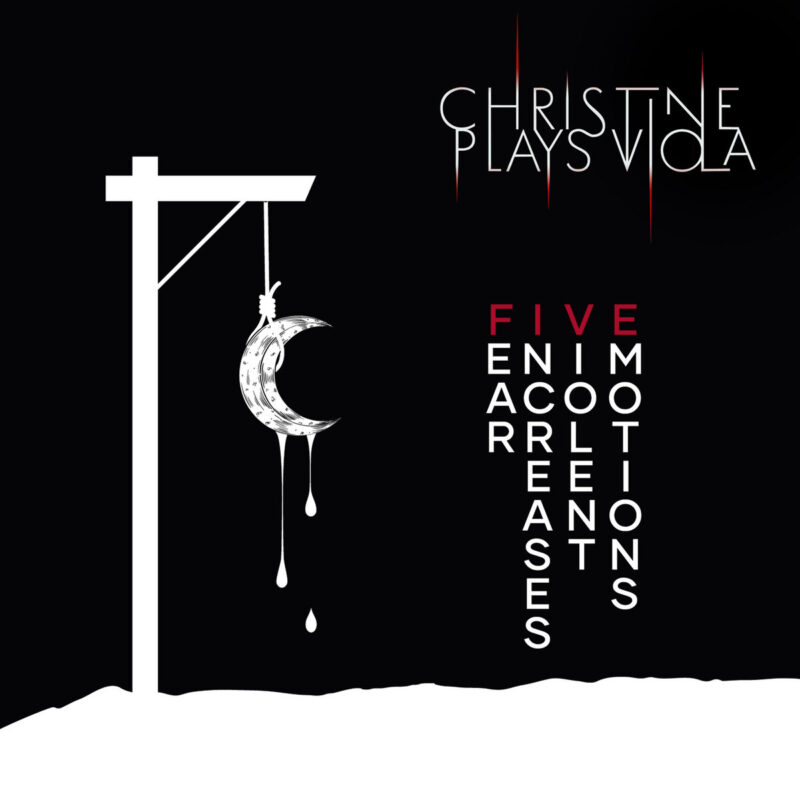
The cover art for F.I.V.E. is stark and symbolic—a suspended crescent form, dripping and weighted, set against emptiness, with the title fractured vertically beside it. How did the collaboration with the artist come together, and what conversations shaped this imagery in relation to the album’s emotional and conceptual themes?
The artwork for F.I.V.E. was conceived as a symbolic image rather than a literal representation of the music.
From the beginning, we wanted something minimal and essential — an image that could exist in silence and still carry emotional weight. The empty space around the central figure was important: it suggests isolation, suspension, and the feeling of being held between states.
The hanging crescent is an ambiguous object. It can be read as a moon, but also as something wounded or unfinished. Suspended in mid-air, it feels trapped between falling and remaining — a visual metaphor for the psychological tension that runs through the album. The dripping shapes suggest erosion and transformation at the same time, as if something solid were slowly dissolving.
The vertical fragmentation of the title reinforces the idea of fracture — which is central to F.I.V.E.. Even the typography feels unstable, like a structure under pressure.
We were interested in creating an image that would function like a symbol rather than an illustration. Something that doesn’t explain the music, but opens a psychological space around it.
In a way, the cover represents the same moment described in the album: suspension before the fall — or perhaps before a transformation.
Do you tend to think visually while writing music, or do images and concepts emerge later once the songs are complete?
Images and music usually grow together.
Very often, we perceive a song first as a place rather than as a composition — a space with its own light, tension, and emotional gravity. While working on F.I.V.E., we often had the sensation of entering different psychological environments and trying to translate their atmosphere into sound.
Cinema has always influenced the way we think about music. We are fascinated by works that suggest rather than explain — where meaning emerges slowly through sensation. That approach shaped not only the music but also the visual language surrounding the album.
Sometimes an image appears before the music, sometimes after, but eventually the two become inseparable. When a piece is finished, we tend to see it almost like a sequence of scenes rather than a series of musical parts.
The artwork of F.I.V.E. follows the same logic: it is not a literal representation of the songs, but another door into the same inner landscape.
For us, music is never only sound. It is always also space, shadow, and movement — something that exists halfway between what you hear and what you imagine.
Christine Plays Viola has existed for many years now. Looking back, how does F.I.V.E. reflect who you are today compared to your earlier releases?
Looking back, F.I.V.E. feels like a point of convergence.
Our earlier records were driven more by instinct — sometimes raw, sometimes impulsive — guided by the urgency of expression. Over the years, we have changed as people before changing as musicians, and the music has grown together with us through long journeys, silences, interruptions, and new beginnings.
With F.I.V.E., we feel we have reached a deeper level of awareness. The emotions are still intense, but they are shaped with greater clarity and intention. Nothing in this record feels accidental — every sound, every silence, every transition belongs to a precise emotional direction.
In some ways, it feels like a return to our origins — the darker and more guitar-driven atmosphere that defined the early days — but it is a return that comes after a long journey. We came back carrying experiences, disappointments, encounters, and personal transformations that inevitably shaped the music.
What remains unchanged is the need to create something honest — something that gives us the same inner shiver that made us start this band in the first place. We have always tried to follow what felt true in that specific moment of our lives, sometimes succeeding more than others, but always without compromise.
If our previous albums explored different territories, F.I.V.E. feels like a place where those paths meet. It is probably our most conscious record — not louder, not more ambitious, but more necessary.
You’ve previously worked with large thematic frameworks—Vacua translating Goya’s Black Paintings, and Spooky Obsessions drawing from end-of-life memories and trauma. Where does F.I.V.E. sit in that lineage: your most inward record, or your most confrontational?
Probably both — inward and confrontational at the same time.
Vacua looked outward through images and symbolism. The inspiration from Goya’s Black Paintings gave that album a strong visual and historical dimension. It was a record built around the idea of observing darkness — almost like standing in front of a painting and trying to understand what lived inside it.
Spooky Obsessions moved closer to memory and disappearance. It was a more fragile and introspective work, rooted in the idea that identity slowly dissolves through time, trauma and loss. That record lived in the territory between presence and absence.
F.I.V.E. is different. It does not observe from a distance — it stays inside.
If previous albums described landscapes, F.I.V.E. describes a mind. It is less narrative and more psychological. The confrontation in this record is not directed toward the outside world first, but toward oneself — toward fear, identity, and the tension between who we were and who we have become.
In that sense, F.I.V.E. may be our most inward record, but also our most direct. There is less metaphor and more exposure. The emotions are not hidden behind images — they are closer to the surface.
It feels like the point where the journey that began with earlier records becomes more personal and more conscious. Not a conclusion, but a moment of clarity along the way.
Are there specific literary, philosophical, or cinematic influences feeding into this album—books, films, or visual worlds that helped shape its tone or emotional vocabulary?
Cinema has always been one of the deepest influences on our music, and F.I.V.E. is probably the album where this connection becomes most evident.
Directors like David Lynch, Stanley Kubrick, Andrei Tarkovsky, and Pascal Laugier shaped our perception of atmosphere and psychological tension. What we admire in their work is the ability to create emotional states rather than simply tell stories. Their films often feel like inner journeys — spaces where time stretches, meanings shift, and images linger long after they disappear.
Lynch especially has been important for us: the idea that a work can operate on a psychological and sensory level rather than through linear explanation resonates deeply with how we think about music. Sometimes what matters is not understanding immediately, but feeling that something is moving underneath the surface.
Kubrick’s sense of cold precision and controlled tension, Tarkovsky’s spiritual stillness and sense of time, and the emotional violence and intimacy found in Pascal Laugier’s cinema all contributed to the emotional vocabulary of the album. Even small details — like the distant sense of unease in The Shining — became part of the atmosphere we were searching for.
Literature has also played a quiet but essential role. Writers like Dostoevsky, Kafka, Camus, and Edgar Allan Poe helped shape the emotional dimension of our work. Their exploration of guilt, identity, alienation, and inner conflict resonates strongly with F.I.V.E.’s themes.
We are drawn to works where beauty and discomfort coexist — where the human mind is not explained but revealed. In that sense, these influences are not references we consciously quote, but landscapes we have lived inside for a long time.
Christine Plays Viola has always balanced intimacy with confrontation. Do you approach songwriting more as self-analysis, storytelling, or emotional release—or does that shift from track to track?
It shifts from track to track, but intimacy and confrontation are always present at the same time.
Songwriting for us is not a single process. Sometimes it feels like self-analysis — an attempt to understand emotions that are difficult to name. Other times, it becomes closer to storytelling, where images and situations take shape almost independently from us.
The emotional core often comes from very personal places, especially through Massimo’s lyrics, but the goal is never simple confession. What begins as something intimate is gradually transformed into a shared emotional space where listeners can recognize something of their own.
In that sense, songwriting is also a form of release. Music allows tensions to surface and find a shape instead of remaining silent. It is a way of translating inner pressure into sound and atmosphere.
Some songs feel like visions, others like fragments of memory, others like states of mind suspended between reality and imagination. The approach changes, but the intention remains the same: to give form to something that would otherwise remain unspoken.
Did the broader social or political climate seep into F.I.V.E. in any way, even indirectly, through mood, tension, or lyrical subtext?
Not in a direct or literal way, but inevitably yes.
Even when we don’t write explicitly about politics or social issues, the emotional climate of the time always finds its way into the music. We live in an era of constant tension — psychological pressure, instability, uncertainty — and these elements naturally become part of the atmosphere we create.
F.I.V.E. reflects a world where the boundary between inner and outer conflict feels increasingly blurred. Personal anxiety and collective unease seem to feed each other. Fear is no longer only individual — it becomes something shared, almost environmental.
In that sense, the album absorbs the mood of the time rather than describing events. It is less a commentary on reality and more a reaction to the invisible pressure people live under today.
Sometimes the violence suggested in the title is not physical but emotional — a slow accumulation of tension that shapes behavior, relationships and identity.
F.I.V.E. is not a political record, but it exists inside this historical moment, and that tension inevitably left its mark on the music.
Fear is framed here as something that escalates into violence. Is that violence inward, outward, or systemic in the world you’re describing?
Primarily inward.
The violence in F.I.V.E. begins inside the individual long before it appears in the outside world. It is a psychological pressure that builds slowly, almost silently, until it becomes something that can no longer be contained.
Fear accumulates tension, and tension inevitably seeks release. Sometimes that energy turns outward, but more often it collapses inward, becoming unrest, obsession, or self-destruction.
We were interested in exploring that suspended moment before the final break — when something inside you is already changing irreversibly but the outside world has not yet noticed.
In this sense, the violence in F.I.V.E. is not necessarily physical. It is mostly psychological and emotional. It is the feeling of living in a permanent state of tension where every choice feels definitive and every mistake leaves a mark.
Perhaps the deepest form of violence is precisely this — the invisible conflict that each person carries within.
With F.I.V.E. marking your release with Cleopatra Records, do you see this as an opportunity to reach broader international audiences, and how do you hope listeners outside your core scene will connect with this album?
Yes, absolutely.
Working with Cleopatra Records represents an important step for us because it allows F.I.V.E. to travel further than before. Cleopatra has a long history within dark and alternative music, and it felt natural for us to align with a label that has supported this kind of sound for decades.
But beyond distribution and visibility, what matters most to us is the kind of connection the record can create with listeners.
We don’t see F.I.V.E. as an album limited to the darkwave or post-punk scene. The themes that run through the record — fear, identity, tension, transformation — belong to the broader human experience. You don’t need to belong to a specific scene to recognize those emotions.
If someone far from our musical world listens to the album and recognizes a part of themselves inside it, then the journey has reached its destination.
For us, music truly works only when it becomes a shared space.
Finally, after someone has lived with F.I.V.E. from beginning to end, what do you hope stays with them—unease, clarity, recognition, or a sense of release?
Perhaps above all, recognition.
The feeling that something inside them has been named — even if only partially. Not necessarily fully understood, but at least recognized.
F.I.V.E. was not created to comfort. It is not nostalgia, and it is not revival. It is a psychological document of where we stand today — as musicians and as human beings.
We hope listeners enter the album the way one enters a room — slowly — and remain there long enough to feel something real.
If, after listening, even a small trace remains — an image, a sensation, an unanswered question — then the music has found its place.§
Christine Plays Viola’s new album, F.I.V.E. Fear Increases Violent Emotions, is out now. Listen to the album below, and order here.
Follow Christine Plays Viola:






 Or via: