


ever captured
in her mournful call
Amália steals our sorrow…
In the long, low hum of Portuguese history, no voice cuts quite as cleanly as Amália Rodrigues, the singer who carried fado, Portugal’s mournful urban song tradition of cracked hearts, night streets, and the slow burn of saudade, to the rest of the world. Her music became a national compass and a quiet form of emotional resistance. But Amália’s reach didn’t end in Lisbon’s bars and back-alley taverns; it travelled with the immigrant wave that reshaped Toronto in the 1950s, threading itself into the storefronts, basements, and bakeries of what would become Little Portugal.
For a community labouring through long shifts and building new lives from the ground up, her voice became an inheritance and a lifeline; a map of feeling when language faltered. Even now, you can hear her echo in Toronto’s festivals and small fado circles, a reminder that distance bends, but never breaks, the coordinates of home.
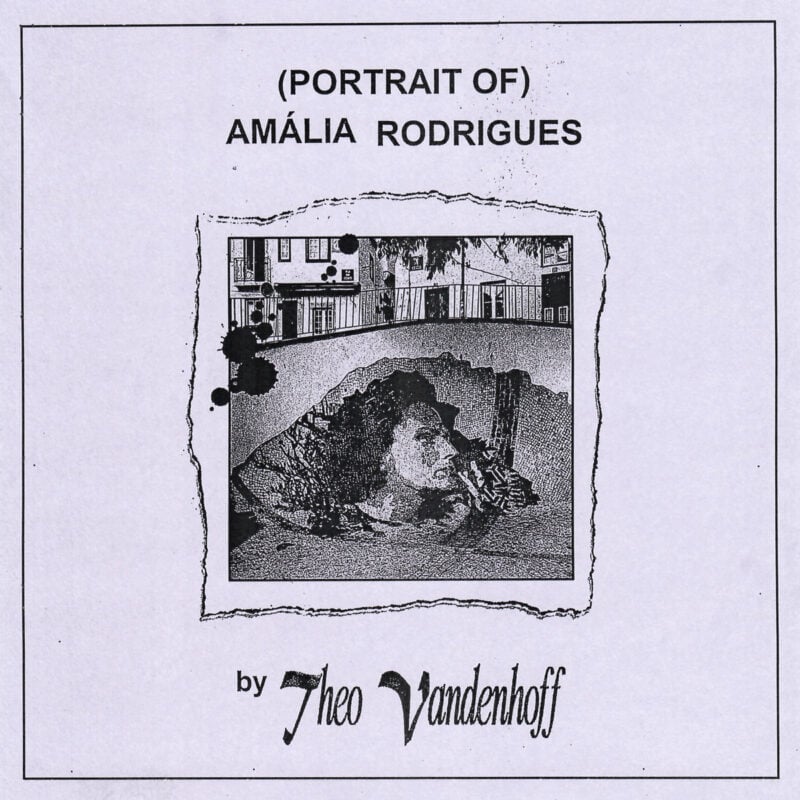
So when Theo Vandenhoff steps forward with (Portrait Of) Amália Rodrigues, the gesture lands with the weight of a city’s memory behind it. The track frames fado’s mournful contour through a colder century: modern tension stitched into old-world longing, the tremour of paranoia moving beneath each phrase like a pulse under floorboards.
One of Toronto’s most exciting live acts, the sullen yet danceable post-punk of Theo Vandenhoff is as much a pseudonymous outlet for frontman/auteur Theo Klaver as it is a sonic chopping block at the hands of guitarist Callum Crombie and bassist Tom Nixon. Their sound lends itself to the sardonic European synthpop of Klaver’s heritage and the metallic Northern English cacophony of where Crombie and Nixon grew up. These influences fuse to form their own brand of goth-adjacent music that is equal parts nostalgic and contemporary, all while maintaining a staunchly DIY process where each step from conception to completion is conducted by the members of the band.
Released on Artoffact Records, the single arrives with the kind of quiet confidence that once marked late-night European art bars – music that recalls the crooked grace of Nick Cave, the angular moods of Tuxedomoon, and the restless drift of Crime & The City Solution. Nothing feels borrowed; instead, everything is bent to the band’s own sense of pressure and place.
The song addresses the spirit of Amália, whose presence watches, consoles, and guides; binding love, longing, and loss. Through vows of devotion and resilience, the speaker pledges to protect the woman they cherish, even as outside forces wound her. Desire becomes the final light that endures.
The accompanying video settles into a dim, half-forgotten bar: the sort of room where decades blur, darts thump into cork, and the lights buzz with their own fatigue. The band perform in a tight semicircle as a dancer cloaked in a hooded shroud twists through the air before them. Her movements slip between ritual and apparition. The question lingers like smoke: is she flesh and breath, or the ghost of Amália herself drifting through the boards and the body heat?
The band hint at an answer when speaking about the song’s origins:
“All three of us spend most of our time together in Little Portugal,” says Klaver. “Toronto has a massive Portuguese population and there are all these ‘relics of the old world’ scattered through the streets. One of these is a massive mural of an incredibly forlorn Amália Rodrigues. I wanted to pay tribute to her as an omnipotent presence in my life. It’s a story of her watching over us.”
That watchfulness permeates the track. Theo Vandenhoff summon something steadfast and devotional—a portrait not frozen in oil or tile, but moving, drifting, glancing across eras. Amália rises here less as a saint or memory and more as a witness, leaning in from the mural’s painted sorrow to survey her adopted streets, listening as new voices carry her old ache into a changed world.
Watch the video for (Portrait Of) Amália Rodrigues below:
Listen to (Portrait of) Amália Rodrigues below and order the single here.
Follow Theo Vandenhoff:





 Or via: