


Steer clear of the sunPancake, sandpaper skinThey have no reflectionsDrink blood but pierce no veins
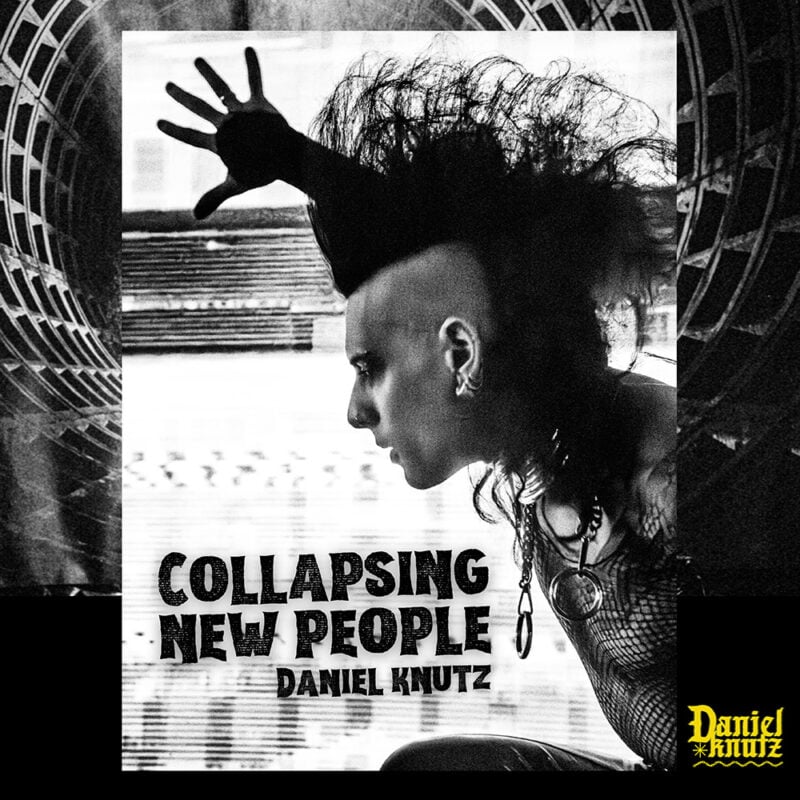
Released at the tail end of 1983, Collapsing New People marked a pressure point at which a decade began to fold in on itself. That persistence becomes clear immediately in its afterlife: on December 25, 2025, German musician Daniel Knutz issues a reinterpretation of the song, offered quietly as a gift and set loose for new listeners. This gesture frames the original song as a living report; one that keeps finding fresh ground on which to stand.
In the brief, volatile arc of Fad Gadget (Francis John Tovey by birth), the track lands with uncommon clarity. Berlin breathes through it: divided streets, iron air, work rhythms repeating until meaning thins. Social strain, architectural stress, and psychological fatigue gather here, compressed into a few unblinking minutes.
Seen from a distance, the song reads as an early signal flare for where the music styles of the 1980s would go: synth-driven pop would soon smooth its surfaces; industrial music would harden its stance. Collapsing New People lives in the brief overlap. Earlier Fad Gadget recordings leaned toward shock or satire; this one settles into something cooler, after emotion processes into numb familiarity. The title carries its own blunt intelligence. It bends the language toward Tovey’s contemporaries Einstürzende Neubauten, whose name translates as “collapsing new buildings.” This was alignment by instinct rather than mimicry; where Neubauten turned attention outward – to steel, concrete, demolition – Tovey traced the fault line inward, following what happens to people shaped inside systems that prize efficiency over endurance. (And, to be fair, Tovey was also poking a bit of fun at the goth subculture, particularly in places like The Batcave.)
Recorded at the legendary Hansa Tonstudio, the original song captured Berlin at a hinge moment as the city stood suspended between histories, restless with creative friction. Echoing that, Tovey and drummer Nick Cash’s mechanical patterns marched forward, looping industrial textures ticking with factory logic. Movement arrives stiffly; any dance moves to this particular number respond in short, angular gestures.
Tovey’s lyrics abandon plot for assessment. The “new people” carry no promise of renewal; they arrive manufactured, sorted, fed back into systems that reward constant adjustment and offer little shelter. Repetition does the work of explanation, as the lines circle, return, repeat: language mirroring industrial labour and broadcast messaging until identity begins to fray through overuse. The phrase new people stays unsettled, hinting at progress, redesign, and technological faith…but paired with collapsing, it turns diagnostic. These figures inherit new tools, new economies, new doctrines, yet receive no protection from their consequences. The future stands present tense, already misfiring.
That continuity sharpens in Daniel Knutz’s 2025 reinterpretation, viewed now through contemporary darkwave space. He preserves the skeleton of Fad Gadget’s original, including the unmistakable glass bottle percussion and stark synthesizer figures, while thickening the atmosphere around it. Textures deepen, low-end weight settles in. Industrial accents arrive with restraint. Knutz’s vocals keep a measured distance, ritual in tone, allowing the song’s emotional compression to expand (without collapse!).
The single is issued as a personal gift in memory of his grandmother, Olga Caetano, who was supposed to celebrate her birthday on 25 December, and for the underground subculture and future generations to keep the Fad Gadget home fires burning.
“I offer this as a gift — a small torch to keep Fad Gadget, to keep Frank Tovey, breathing for new generations,” says Knutz. “This song struck me in the chest like a revelation; I remade it so that dark pulse may find new hearts. I release it on December 25th for Olga – for the afternoons in her studio and the quiet lessons she left me.”
Listen to Collapsing New People below and order the single here.
Time bends here, rather than closes. A Berlin document from 1983 passes through new hands, carrying its weight intact, still speaking in the same measured language of systems, bodies, and the cost of progress.
The single appears on streaming platforms December 25, released without a fixed price and open to listener donations. It also gestures forward: multiple releases slated for 2026, anticipated European live dates, and forthcoming label collaborations.
Follow Daniel Knutz:








 Or via: