
Too many people to mend
And we’re not close to the end
We never make that time
until it’s too late
There are lies that arrive like sirens, obvious and brutal, and there are lies that move more quietly: through a bad signal, an unfinished sentence, a headline built to agitate, a message stripped of tone, a memory softened by need. The present tense has become a hall of mirrors where truth is no longer simply hidden, but negotiated, branded, distorted, and sometimes abandoned altogether. What happens after that is not only political. It is emotional. It enters friendships, grief, love, self-image, and the ways people fail to reach one another, even when they are standing close enough to touch.
That is the wounded terrain Mesh explores on The Truth Doesn’t Matter, a dark, elegant, and emotionally charged return from the Bristol electronic alternative duo. Released March 27, 2026, via Dependent, the album arrives in standard and deluxe editions, with the deluxe edition expanding the record to 25 tracks and including a nine-track bonus disc of instrumentals, alternate versions, and additional material.
For Mesh, the title is not an empty provocation. It is the keyhole through which the record peers at the age of collapsing communication. Across the album, Mark Hockings and Rich Silverthorn turn their familiar architecture of sequenced electronics, muscular synth bass, guitars, samples, widescreen choruses, and wounded vocals toward a world where empathy has become fragile and connection increasingly difficult to maintain. The album is not a slogan record, nor is it a retreat into private despair. It is something more unsettling: a record about how public untruth and private damage begin to resemble each other.
Mark Hockings and Rich Silverthorn formed Mesh in Bristol in 1991 after meeting through the city’s live music scene and discovering a shared passion for electronic music, alternative culture, and melody-driven songwriting. From the beginning, the band occupied a space far broader than synthpop, building an alternative electronic identity where emotional immediacy, mechanical precision, and widescreen atmosphere coexist. Over the past three decades, Mesh have drawn from electronic pop, industrial textures, goth and darkwave club culture, and the dramatic sweep of alternative rock, cultivating a devoted international audience that stretches across scenes. Whether embraced by goths, industrial music fans, synth enthusiasts, or alternative rock listeners, Mesh have defined themselves by songs that treat vulnerability not as a weakness, but as a source of momentum.
Across albums such as In This Place Forever, The Point at Which It Falls Apart, Who Watches Over Me?, We Collide, A Perfect Solution, Automation Baby, and Looking Skyward, they have refined a sound that is instantly recognizable as their own. On The Truth Doesn’t Matter, that identity feels sharper than ever, turning its attention toward a world where communication is constant, connection is increasingly fragile, and truth itself has become contested terrain.
Before our interview with Rich Silverthorn, here is a track-by-track look at The Truth Doesn’t Matter.
The album opens with its title track, which unfolds like a broadcast from a civilization already deep into prosecuting the song’s bleak argument. It begins with low electronic pressure, a darkened synth bed, and the feeling of machinery warming behind glass before the rhythm sharpens into a driving electronic framework. The track moves with midtempo weight, but its programmed pulse gives it a restless, double-time charge. Vocally, it does not arrive as a grand proclamation so much as a controlled indictment, with Mark’s voice cutting through the circuitry in a grave, accusatory tone. Lyrically, the song circles manipulation, public performance, moral compromise, and the strange conditional logic of truth when nobody wants to be wounded by it. Musically, it is classic Mesh in its balance of polish and unease: thick electronic bass, bright synth edges, sequenced drums, and a chorus that expands without releasing the tension.
“A Storm Is Coming” enters as a continuation of that tension, all dark, synthetic weather and nervous forward motion. Distorted dial tones, warbling guitar accents, dense layers of synth melody, and a vocal rhythm that feels almost chanson-like in its melodic delivery give the track its strange, uneasy, yet anthemic shape. Opening on eerie synth tones, the EBM-electro beat turns the song from atmosphere into pursuit, with clipped electronic percussion, tense bass programming, and synths flashing like warning lights through rain. It is one of the album’s more urgent pieces, fast-moving without becoming frantic, and Mark’s vocal sits between warning and resolve. The lyrics imagine catastrophe not only as something approaching, but as something humanity must decide how to face: flee it, bend with it, ride it, or be swallowed by it. Images of walls, wolves, crowds, ghosts, and waves give the song a collective panic, while the chorus opens into dark-pop drama. It sounds like a stormfront seen from inside a lit city: sleek, propulsive, compassionate, and deeply uneasy.
“I Lost A Friend Today” begins in grief’s half-light, with slow, bubbly, pulsing, electro-pop synth tones, icy pads, mournful melodic lines, and a sense of suspended shock before the rhythm fully gathers. The vocal is close and exposed, laced with a cinematic chill, delivered as though Mark is still trying to understand the sentence he has just been forced to say. The fuller drums and bass arrive gradually, giving grief a physical body without turning the song into melodrama. Lyrically, it frames friendship as light, protection, debt, and irreplaceable presence, then lets the emptiness of loss sit in the room. The song’s later image of life continuing like a book that cannot be put down becomes one of the album’s most devastating ideas: grief is not only pain, but the forced continuation of a story after one of its essential characters has disappeared. The track remains midtempo, but emotionally it walks slowly through a familiar place made unrecognizable.
“Polygraph” feels like an industrial-scored crime drama, all distorted percussive noise, melodic piano, and gothic noir pressure. One of the album’s wordless transmissions, it still speaks fluently in the record’s language of signal, suspicion, and failed certainty. Built from electronic pulses, low-end unease, and cold procedural textures, it feels like a machine being switched on in a dark interrogation room — a clinical chill that lands sharply after the human grief of “I Lost A Friend Today.”
“Trying To Save You” continues the noir atmosphere, opening with a murky, old Victrola-sounding staccato piano introduction before locking into a quick, purposeful dark-pop drive. The almost organ-like synth bass pushes the track towards a gothic romance, while bright melodic lines cut through the arrangement like attempts at contact. The vocal moves from controlled concern to a more urgent melodic push, augmented by the bravado of Mark’s romantic chanson, giving the song more than just the feeling of an intervention unfolding in real time. Lyrically, it is about someone who has been given an opening, a chance to escape a cage, but cannot recognize either the danger or the possibility of freedom. The repeated attempt to rescue them becomes increasingly unstable because both people are standing on shifting ground.
“Bury Me Again” is the album’s grand slow-burn, opening in a mournful cinematic space of soft synths, piano-like tones, and patient atmosphere. The first synth lines feel almost giallo, or John Carpenter-style, with a hint of vintage noir, subtle and ominous, before the track gives way to an almost trip-hop rhythm. Bass pressure and programmed percussion begin to gather beneath it, while the spaces between vocals fill with cinematic drones and a simple, icy, organ-like synth melody that continues the album’s gothic noir motifs. The lead vocal is intimate and grave, while Mari Kattman’s presence turns the song from confession into confrontation, giving it the feeling of two emotional forces occupying the same room. Lyrically, it is one of the album’s most psychologically loaded pieces, moving through surveillance, hunger, impossible standards, withheld trust, and the demand to choose sides. The central image is burial, not as death, but as the repeated suffocation of a relationship where one person digs, climbs, reaches, and is covered over again. By the final stretch, orchestral layers and vocal intensity push the song into full tragic grandeur, rising like a funeral procession before breaking like a thundercloud.
“I Bleed Through You” begins with a jarring sample of a British woman remarking that television is the eighth wonder of the world, a strange fragment of broadcast-era awe before the track snaps into motion. Rippling synths and a mechanized hi-hat pattern give way to a thick, bass-driven dance beat, settling the song into a dark, physical stride while cold synth lines drag light across its surface. The song sits in a midtempo pocket, but it carries itself with the pressure of something far more volatile. The vocal arrives bruised and self-interrogating, caught between confession and accusation. Lyrically, the narrator is trapped in degrading mirrors, trying to understand how he is seen by another person and how much damage has been absorbed through that gaze. The title image suggests emotional permeability: pain does not stay contained, but passes through the person who caused it, the person who witnesses it, and the bond between them. The anthemic chorus lands with Mesh’s uncanny gift for big, emotionally immediate songwriting. It lifts without offering release, making freedom sound possible but costly.
“Kill Us With Silence” starts with immediate tension, opening on an eerie industrial trip-hop noir drone that repeats with cold insistence before the track snaps into a harder electronic alt-rock identity. From there, it unfolds into a dark, unsettling rhythm, driven less by club mechanics than by pressure, atmosphere, and melodic force. Subtle synth stabs ripple like springy, sci-fi steel, while the beat stays sharp and aggressive beneath a cinematic melodic line that gradually rises through the machinery. Mark’s vocal cuts through in a stern, confrontational register. Lyrically, this is one of the album’s most outward-facing tracks, attacking the collapse of empathy, the spectacle of suffering, the cruelty of political theater, and the ease with which people become spectators to violence, poverty, displacement, corruption, and environmental destruction. The song enumerates rather than merely raging. Its repetition becomes a roll call of ignored suffering, while the music turns silence into impact. It is built for clenched jaws, hard light, and the sick realization that inaction has a sound.
“1031030” is another non-sung transmission, short and coded, functioning like an encrypted corridor between the album’s larger statements. The numbers are recited like a police officer calling dispatch, lending the piece a procedural menace before the music settles into an overtly industrial EBM shape, closer to the Wax Trax! era of the late 80s. A slow bass groove moves underneath percussive crackles and glitchy electronic movement, creating a numerical, data-stream atmosphere that feels functional, eerie, and deliberately stripped of warmth. The title reads like a code, a file name, a frequency, or a message severed from human explanation; it may even suggest a stop-transmitting command, though the ambiguity is more powerful than any fixed translation.
“This World” opens in a more exposed space, with low synth atmosphere and a patient melodic build before the rhythm and bass begin to frame the song. It develops into a widescreen Mesh anthem, steady rather than rushed, with drums that support rather than dominate and synths that widen with warmth. The vocal is compassionate and grounded, less a lecture than a hand on the shoulder. Lyrically, the song is written to someone struggling against pressure, comparison, alienation, and the false promise of fitting into someone else’s design. It acknowledges the void, the pain, the undertow, and the feeling of being locked out of the world others seem to inhabit, but it refuses to treat unhappiness as proof of failure. It is midtempo in motion but anthemic in spirit, a song for anyone trying to remain intact inside a system that keeps telling them they are wrong.
“Exile” announces itself with immediate authority, sleek and tense from the first seconds, before the beat hits and the bass begins moving with real purpose. The track is up-tempo, club-ready, and emotionally wounded, combining polished electronics with a guitar-like abrasion that gives the rhythm a post-punk and alt-rock edge. The vocal cuts cleanly through the propulsive surface, delivering one of the album’s most immediate melodic hooks with the familiar Mesh mixture of control and damage. Lyrically, “Exile” turns estrangement inward: the narrator is not only excluded from another person, but from himself, made foreign inside his own head and home. The plea for return feels romantic, psychological, and spiritual all at once. It is instantly recognizable as Mesh because it has the melody, the wound, and the forward thrust of a classic single.
“Everything As It Should Be” begins with soft pulses of synth lapping like waves, joined by jazz-tinged drum percussion before giving way to a rhythmic electro buzz with an almost’ late 80s, early 90s-industrial dance-funk groove. From there, the arrangement gathers low-end detail and nervous momentum, tightening around crisp drums, bright synths, and a restless midtempo pulse. Mark’s vocals are measured but stylishly charged, delivering the title phrase with Mesh’s trademark anthemic gift, making the song’s underlying doubt feel immediate and enormous. Lyrically, the song questions contentment, routine, and the stories people tell themselves to survive their own compromises. The title phrase is no comfort; it feels suspicious, like a mantra repeated to avoid looking too closely. Images of settled paths, photographs, ordinary lives, and lifelines give the track a quietly devastating domestic realism.
“Hey Stranger” is one of the album’s most patient and wounded songs, opening in a suspended, shadowed space where soft electronics and distance are built into the production. The rhythm does not crash in; it slowly materializes, allowing Mark’s vocal to carry the drama through restraint. The delivery is intimate, bruised, and uncertain, as though the song is circling an old wound rather than naming it directly. Lyrically, it is built around recognition after damage: someone familiar has become strange, memory cannot be trusted, and the past returns not as comfort but as uncertainty. Unlike “Exile,” which pushes forward, “Hey Stranger” waits. It lets silence and hesitation become part of the architecture, turning loneliness, guilt, memory, and possible reconnection into a dark room where neither person knows what will happen if they speak first.
With “Cipher,” there is a clear kinship with the second side of David Bowie’s Low in the track’s subterranean mystery. The instrumental opens like a hidden message being decoded, beginning with a repeated gasp or sigh sample that hangs in the air, a hushed, unsettling human presence amid the machinery. Low computer-like tones pulse in a dull, melodic cycle, spare and secretive, before a dark guitar riff deepens the track’s dark, mysterious mood. Melodic synth-bell tones enter like signals from another room, while a Morse-code transmission adds to the sense of communication arriving in fragments. Inaudible murmuring hovers beneath the code, as if voices were trying to break through the machinery but could not fully surface. From there, the sound shifts into heavier industrial-gothic gear before concluding, making the piece feel less like an interlude and more like a corrupted transmission with its own private logic.
“Not Everyone Is Lonely” begins with synth buzzing and a wistful keyboard melody, setting a reflective tone before the acoustic guitar slips into the frame. That fragile opening is quickly caught in a cinematic swell of the same keyboard theme, pulling the song into a dense arrangement full of layered synths, melodic touches, and careful emotional shading. Mark’s vocal here is inward-looking, but the chorus carries a communal ache that feels earned rather than sentimental. Lyrically, it is one of the album’s more complicated statements about survival. It does not deny pain; it acknowledges wounds, resentment, loyalty, misuse, and the hard work of moving on. But it also insists that love is not exhausted just because someone has been hurt. The title carries an almost defiant paradox: loneliness is everywhere on the record, but it is neither destiny nor evenly distributed. The song becomes dark pop, a quiet encouragement, bruised yet still searching for connection.
“Be Kind” closes the album not with escape, but with an instruction so simple it almost feels radical after everything that has come before. The song opens with a hopeful synth buzz and ripple, its melody warm and rising before the drums charge forward with a big new-wave immediacy. That optimism stands in sharp contrast to much of the album’s grief, suspicion, and fractured communication, gradually giving way to broader synth layers, stronger percussion, and a generous melodic sweep. Mark’s vocals are earnest without becoming sentimental, carrying the directness of the title as a form of exhausted wisdom, while the layered harmonies drive the song’s central message with a sense of catharsis and release. Lyrically, after an album filled with broken communication, loneliness, grief, political cruelty, and distorted truth, “Be Kind” reduces the answer to basic human responsibility: look after one another, feel another person’s pain without judgment, celebrate others even when you are struggling, and say what needs to be said before time disappears. As a closer, it feels like Mesh are choosing both compassion and grace regardless of whether the world has earned either.

I was introduced to Mesh first by dancing and singing along to the club favorite “Trust You,” then through a recommendation from my older sister, and later by seeing the band at a US show in 2001. With In This Place Forever reaching its 30th anniversary, and the Mesh Legacy 2024 tour celebrating 25 years of The Point At Which It Falls Apart, did revisiting those eras make you think about your past selves, the world those songs existed in, and where Mesh are now mentally, emotionally, and in terms of worldview?
Rich: Yes, of course. Every so often, I revisit these albums when we are looking for tracks to do live, and it instantly takes you back to that period in time. It does seem like a lifetime away, especially when I listen to those early albums. Everything was exciting back then, and as people, we were very eager to make a name for ourselves. Fast forward to today, I’m not sure we are the same people. The excitement for the music is still there, but the disappointment in the music industry plays a part. It’s energy-zapping.
Coming from Bristol, a city whose electronic music has often been linked to political tension and the human condition, do you feel that history is in Mesh’s DNA? Did it influence the themes or emotional temperature of The Truth Doesn’t Matter, even if Mesh have often expressed those pressures through personal rather than explicitly political songs?
Rich: Not necessarily from our hometown, but I think as you get older, you become more aware of political issues. I mean, perhaps the world has always been a mess, but you become more engaged and interested in it. There are a few songs on the album that are just observational views of “what the hell are we doing?” kind of questions. We have never really been a political band with any agenda, just people being spectators and watching the madness unfold.
The Truth Doesn’t Matter is a blunt, provocative title because it can sound resigned, accusatory, or even despairing. What did that phrase mean to you when it first became the album’s title?
Rich: The title came from the lyric/song with the same name.
It just resonated with us.
In a world where we rely so much on the media and social media for our information, it’s so hard, especially with the explosion of AI, to work out what is real and unreal. We have to question things. If I see or read something, I find myself googling and doing my own research to see if it’s real. Crazy. Certainly, in the political landscape, it seems it’s okay to just completely lie these days. This acceptance is what led to the title The Truth Doesn’t Matter.
The album seems to move between public truth and private truth: social fracture, memory, relationships, communication, self-deception, and emotional survival. Were you trying to connect those inner and outer worlds?
Rich: The whole concept of the album was “communication” and how we, as people, do that. The fragile nature of how this can be misunderstood or misread. A poor signal, a punctuation error, or a misheard piece of information can all have catastrophic consequences. The album touches on this in various situations. Relationships, friendships, and even political debates are susceptible to human error when it comes to communication.
Do you see this as a political record, or as a record about human behavior under the immense loneliness and pressures of today?
Rich: Definitely the latter. I would say we are all under a subconscious pressure created by the media. I, for one, have found myself watching less and less TV and news coverage. It may be burying my head in the sand, but sometimes ignorance is bliss. Constant bad news has an effect on your well-being. Maybe the downside of detaching yourself from society is loneliness. There are a few tracks on the album that explore the effect of loneliness.
“Synthpop” is useful shorthand, but it can flatten a band’s personality — as reductive for Mesh, perhaps, as it is for Depeche Mode, who similarly have a broader sound that touches upon industrial and alt-rock influences. When you think about what makes Mesh sound like Mesh, what are the stranger or less expected sources of inspiration sitting beneath the electronics?
Rich: We have always hated the term “Synthpop.” It’s such a dismissive phrase. Pop music made with a synth. It always conjured up the lighter pop acts for me.
We have always seen ourselves as an “Alternative” act that uses a lot of electronic instruments to create our music. There is also a shitload of guitars and audio samples in there too.
Mesh sounds like we do because of the combination of both of us. Like the ingredients of a cake. If you take one ingredient away, it’s going to taste different. The same with us. I think we have kind of perfected our sound, and people say it’s instantly recognisable as Mesh, which is quite flattering. Mark and I have different musical tastes but also some common ground. Growing up, I think I was influenced by my parents’ music, which was often very melodic: Simon and Garfunkel, Elvis, Bee Gees, etc. I’m sure this is where my quest for a big melodic chorus comes from. My own eclectic music taste of all different styles of music is a mixing pot of what comes out. Mark is very similar.
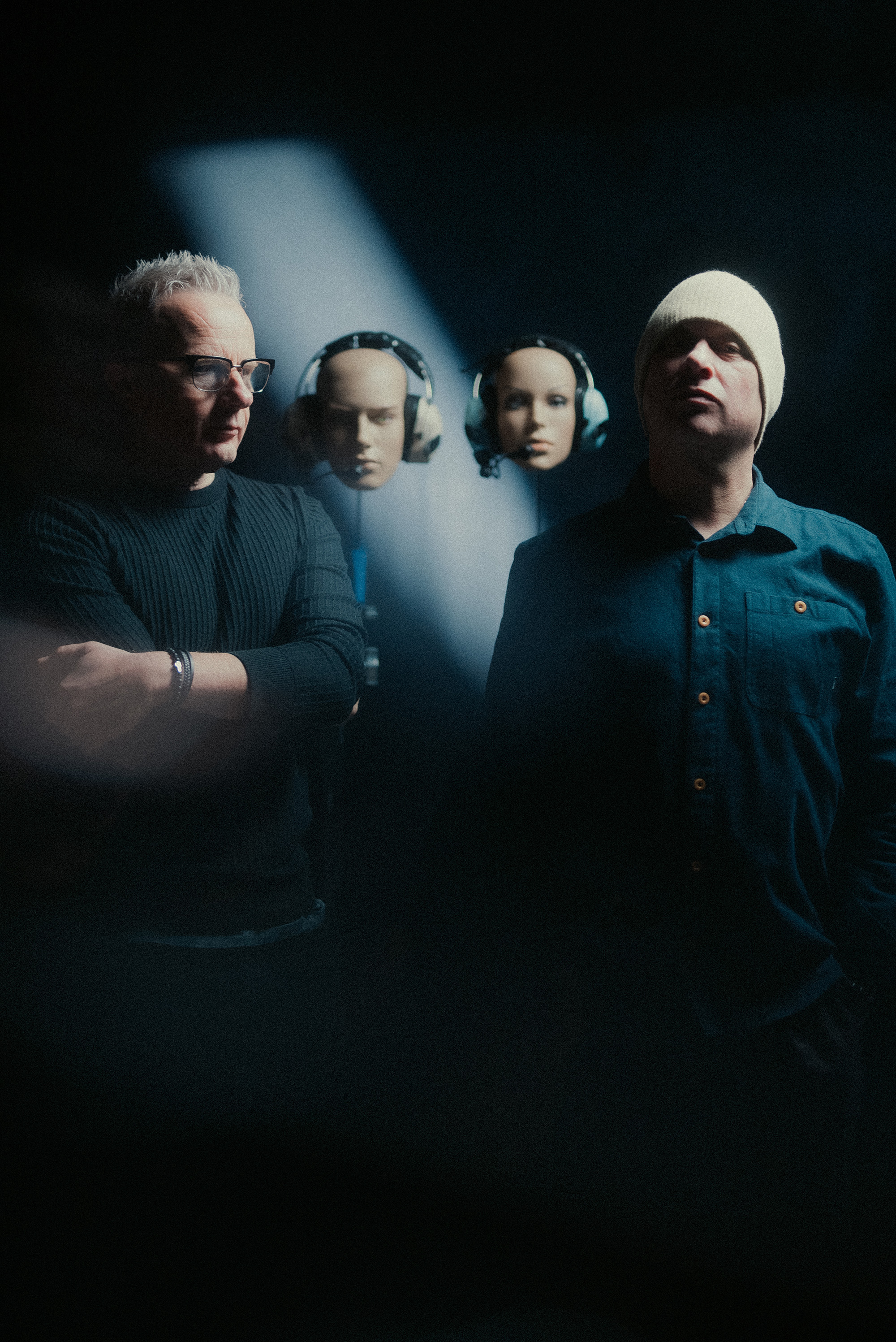
Your work with Olaf on production and arrangement work is described as key to the record’s shape. How did that collaborative process affect the album’s emotional architecture?
Rich: This is our fourth album working with Olaf.
His contribution to our albums is quite unique in as much as it’s quite transparent but essential. What I mean by that is if you were to hear the demos, they are pretty much to a finished standard that Mark and myself are happy with. Then we send them to Olaf, who then dissects them and takes them to another level of perfection. He painstakingly goes through every single line/sound and EQs and processes everything. So the overall song pretty much stays the same but has this amazing level of presence. There are times when he suggests chord changes and small musical things. He is very much in tune with what we are trying to achieve.
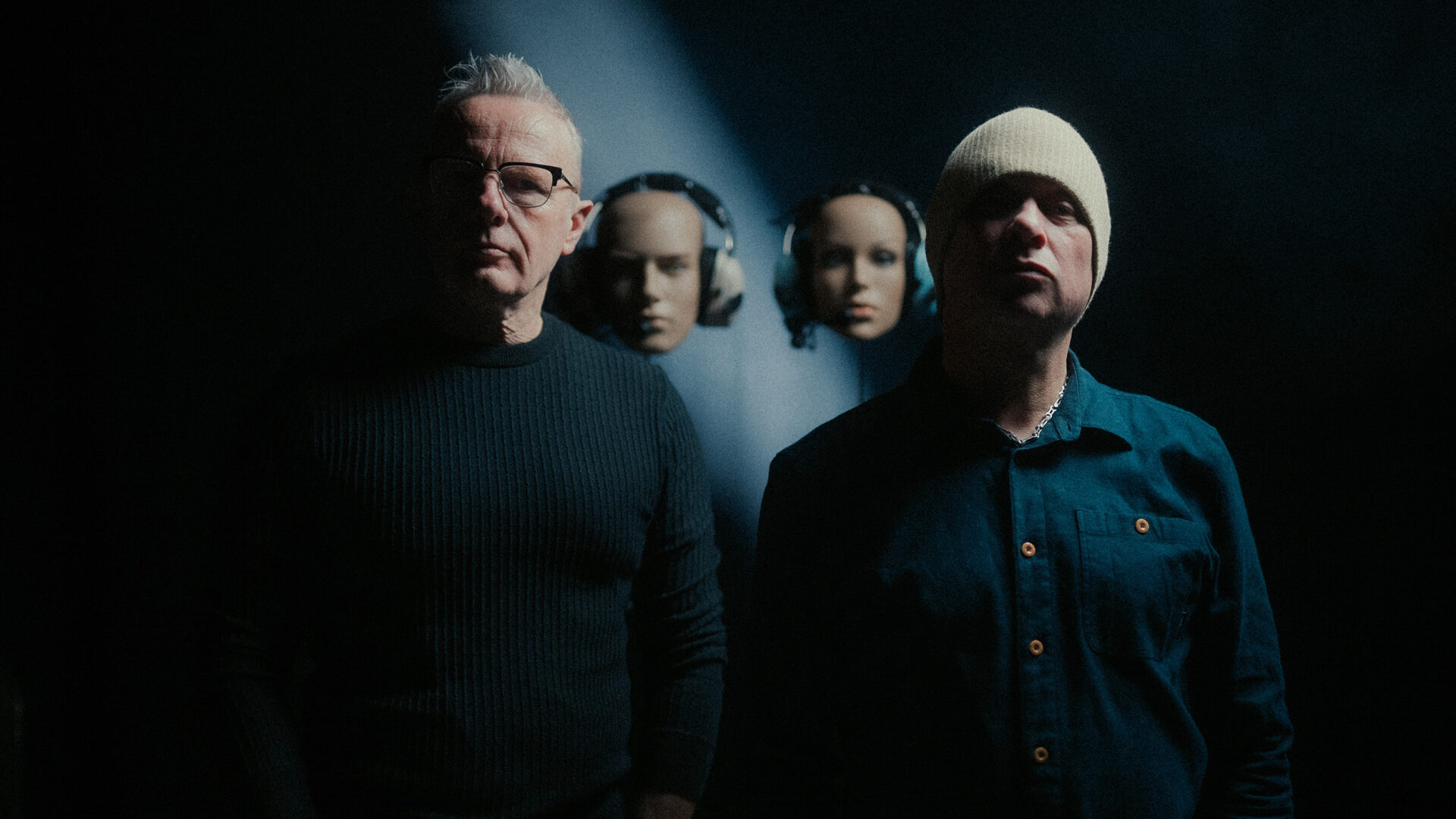
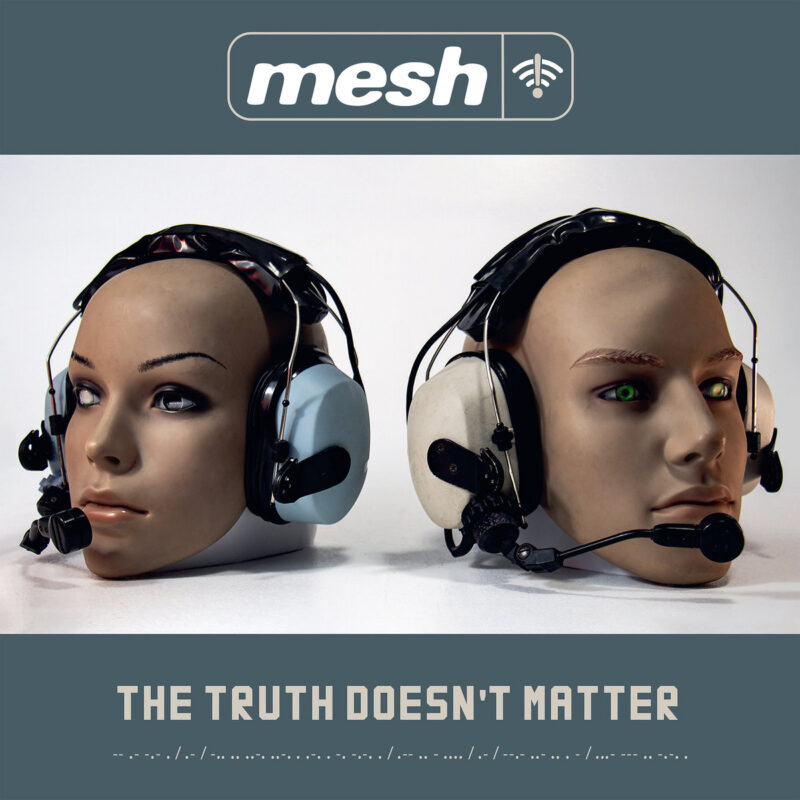
The cover artwork features mannequin heads with headsets — artificial operators, listeners, broadcasters, maybe witnesses, seemingly referencing Kraftwerk. What did you want that image to say before viewers encountered them in two of the videos?
Rich: Mark was responsible for the artwork.
When we came up with the concept/theme for the album, we searched eBay looking for a whole host of shit for the imagery. The theme being communication, we were looking for old radios, walkie-talkies, Morse keys, etc. The heads Mark found and thought would be a striking image. To be honest, I at first wasn’t sure, but as time has gone on, I think it does have this instantly recognisable look about it. When it came to the videos, I knew a young videographer, Kieran Gallop, who I thought could do a good job. We had a few vague ideas and concepts of how we wanted it to look. We then offloaded all the radios and crap we bought on him and asked him to incorporate it in the videos, giving it a coherent feel. Haha.
“Exile” feels like one of Mesh’s best singles: wounded, melodic, propulsive, emotionally direct, club-ready, and unmistakably yours, but with a post-punk/alt-rock edge cutting through the electronic rhythm. What was the starting point for the song, both lyrically and sonically, and why did it feel like the right piece to introduce The Truth Doesn’t Matter?
Rich: Exile has an interesting story. I initially wrote the music about 18 months ago and sent it to Mark. In amongst all the other writing that was going on, it got lost and sat on a hard drive just waiting to be worked on. We were literally at the final mixing stages of the album when Mark sat on Olaf’s balcony working on it. When we arrived home after completing the album, Mark sent me the track with his added lyrics. I instantly knew this was the first single. It had all the required elements. Then we had the mad panic of mixing it and including it on the album. So it so nearly never happened.
The “Exile” video extends the cover’s mannequin imagery into a retro-noir world of phones, typewriters, microphones, recording devices, switches, and cables. Were you using older communication technology to speak about modern disconnection?
Rich: Yes. Again, the concept was communication and its failings.
There is something very cool/scary with all the imagery around the Cold War of the late ’50s/’60s. This is the look and feel we were trying to create in a modern setting.
Isolation was another idea we tried to convey in the videos.
“Exile” announces itself immediately as a Mesh single, but “Hey Stranger” seems to work more slowly: it asks the listener to sit with uncertainty, memory, and recognition. Was there something risky about letting such a restrained song represent the album?
Rich: Most definitely. Our record company pushed for this to be a single. Both Mark and myself were very unsure of it being a single. We both loved the track, and it certainly had its place on the album, but to highlight it as a single felt like a gamble to us.
Maybe you have to take a gamble every so often. After its release, we were pleasantly surprised at the reaction it got. People connected with it. We have probably all found ourselves in a situation that is depicted in the sentiment of the song.
The “Hey Stranger” video places two blindfolded people face-to-face, with a rotary phone connected to an emergency help line between them. They’re close enough to touch, but unable to truly see each other until the end. What was that image meant to capture? Loneliness inside intimacy? Or how technology separates us?
Rich: You are good at this, aren’t you? Haha.
Yes, that was pretty much the brief for the video. The blindfolds show that these people are there all along, but we are too blind to see. Trying to convey the resignation of feelings for someone in your past. Both parties feeling the same without saying anything. The video leaves the viewer with so many questions about what they are watching: who’s to blame? What’s the story? Where are they going after? etc.
Because “Hey Stranger” uses some of the same visual grammar as “Exile” — the phone, the dark room, the mannequin heads — the shift from cold mediation to cautious reconnection is striking. Through these elements, were you trying to have these songs in conversation with each other?
Rich: We really liked the idea of keeping the videos’ overall feel and colour the same. There was an uneasy tension about them that we really liked. Subtle lighting effects carried through both, subliminally connecting them together. Although there was no real connection, you feel there is.
“This World” feels almost like a letter to someone who is struggling — not a lecture, but a hand on the shoulder. Were you writing to a specific person, or to anyone who feels out of step with the world?
Rich: This World is one of my favourite songs from this album. When I initially wrote the music, I had a specific melody in my head of how I wanted the lyrics to go. When I got the song back from Mark, I was “uhh no, this isn’t what I imagined.” It took me a while to accept it. Then Olaf made a few changes, and again I was “wait, this isn’t right,” but it just came together in such a way I personally think it sounds epic, worthy of a film title track or whatever.
The lyrics and overall feel are a helping hand or guidance to making things work without relying on others. Maybe step outside your comfort zone and go for it.
After the enclosed, symbolic spaces of “Exile” and “Hey Stranger,” the “This World” video moves outside into streets, buildings, passersby, and eventually open landscape. Was that shift meant to make the song feel exposed or vulnerable?
Rich: Again, we wanted to carry on with the colour scheme and the feeling of loneliness, but trying to reach out. Trying to contact the world on a personal level. A cry for help or a wanting for recognition. The video concept was simple but powerful.
The ending of “This World,” with a lone figure carrying a device into a misty open landscape, may make some viewers think of “Enjoy the Silence.” Was that echo intentional, or does that solitary journey belong more broadly to the visual language of electronic music?
Rich: Yes, the radio was a visual metaphor for a device of contacting the world. A vehicle for getting your thoughts and emotions across. The radio itself was an old military radio which we had bought. This caused a few issues with the police whilst filming the video.
Walking around a busy populated area looking lost with a military radio is not a good idea. Haha.
I’m not sure “Enjoy The Silence” ever entered our heads, but yes, maybe the message we were trying to put across has its similarities.
Beyond the singles, which songs feel most important to the album’s thesis? Are there tracks that unlock what The Truth Doesn’t Matter is really about?
Rich: Obviously, the title track “The Truth Doesn’t Matter” pretty much sums up the ideology or concept of the album, but a combination of all the songs strengthens that. It’s a body of work that emphasises and highlights the overall picture.
The non-singles have stark, evocative titles — “I Lost A Friend Today,” “Kill Us With Silence,” “Not Everyone Is Lonely,” “Be Kind.” Were those titles meant to make the record’s arguments more explicit, or do they open up more private stories?
Rich: I Lost A Friend Today is a heartfelt narration of someone from Mark’s life.
Kill Us With Silence is a scream of “wake up” to everyone watching all the shit that’s going on in the world. A casual bystander watching all this happen without doing anything.
Be Kind is a naive but simple offering of what would make the world a better place.
“Bury Me Again” is one of the most beautiful moments on The Truth Doesn’t Matter, and Mari Kattman’s voice feels like much more than a guest feature — almost like a second emotional perspective inside the song, especially towards the end. Mark mentioned before that he had worked with Mari on an unreleased version of that track and that it had turned out unusually well. Now that it’s finally out in the world, can you take us back to how that collaboration came about? What made Mari the right voice for it, and/or did her performance change the way you heard or understood the song?
Rich: Mark initially met Mari back when we played a show in Calgary, Canada, and asked her to contribute on a track which was to become Bury Me Again. This was another song that didn’t see the light of day for many years. When we started compiling songs for this album, Mark put it on the table again. He re-recorded his vocal again, but Mari’s was the original one she did back then. When I listened to it, I just felt it needed to go to an epic crescendo at the end. The song was very strong, and both vocals fit perfectly, but I just wanted to take it a step higher. I painstakingly added layer after layer of orchestral instruments to the end of the song, trying to create an emotional finale. The song has become one of the standout songs on the album, and in a live situation, it has a heightened tension.
Personally, I wanted to ask about “I Lost a Friend Today.” Working in the music industry, I’ve lost a number of friends tragically — people who struggled, struggling more and more in today’s AI and reel-driven world, but who also shone very brightly through their art, and were kind, sweet, and deeply supportive. One loss happened very recently, so the song hit me hard. Was it written as an outlet for a particular grief? And with the closing image of life as a book you can’t put down, I read that as being about the painful inventory grief forces us to take — the wish to turn back the pages, while knowing life only moves forward. Is that close to what you intended?
Rich: Sorry, answering for Mark here, but yes, the song is about a friend in Mark’s life.
I think we can all relate to the sentiment of the song regardless of who it’s specifically about. Grief is a horrible thing to deal with, but part of life. I think we all question things we have done or should have done. People come and go in our lives, leaving an emotional scar on us. Life goes on, but perhaps it should be seen as a reminder to live our lives to the full.
Now that the new songs have been performed live, which tracks from The Truth Doesn’t Matter have taken on a new energy onstage? Are there any album cuts that surprised you once the full band started playing them?
Rich: It’s a great testing ground playing them live. Songs you expect to do well sometimes don’t reach that level of expectation, and others surpass what you expected.
Exile is a surefire winner. The crowd singing along is immense.
Everything As It Should Be surprised us. It has an uneasy energy but is well-received.
This World has felt so strong. A feeling of unity with the audience has been quite emotional.
Bury Me Again worked so well, too.
You have more 2026 dates ahead, including shows in Scandinavia, the UK, Germany, Poland, and the Czech Republic. What can fans expect from this version of Mesh live — in the lineup, the arrangements, and the way the new album sits alongside the older songs?
Rich: We have taken the live shows to the next level. The visuals and energy are the best they’ve ever been. Maybe that comes with experience and the excitement of presenting new material, but we feel the shows have been outstanding on this tour.
Mesh’s audience has always stretched beyond the places you can easily tour, including U.S. fans who found the band through clubs, imports, word of mouth, and rare shows. Is returning to North America still part of the conversation for this album cycle?
Rich: To be honest, we would love to come back to the States. We had such a good time when we came over in 2011. The biggest problem is the logistics and finances.
If we could possibly do it again, we would. Maybe in conjunction with another band or whatever. It’s always on the table for consideration.
The Truth Doesn’t Matter has been described as exploring how modern communication disassembles social empathy. After making the album, did you come away more pessimistic about people, or more convinced that truth only begins to matter again when people actually connect with each other?
Rich: We, as people, are generally grounded, lighthearted people. The album is an observational overview of what we feel is going wrong. The madmen rule the world, and we are just part of that.
Make a difference with a quiet voice 😉
§
The Truth Doesn’t Matter is available now through Dependant Records, with a deluxe edition expanding the album to 25 tracks. Alongside the full album, the set includes a nine-track bonus disc featuring “This World (Redux Instrumental),” “Hey Stranger (Radio Version),” “Lone Wolf,” “Exile (Single Version),” “Michelle,” “Hey Stranger (Straight Mix),” “Take Sides With Me,” “Exile (Extended Version),” and “This World (Redux).” The limited hardcover Artbook 2-CD edition pairs the album with a 48-page booklet and is scheduled for release on June 19, 2026.
Listen to the album below, and order The Truth Doesn’t Matter Art Book 2-CD Deluxe Edition via Bandcamp here, or through SPKR:
- worldwide: spkr.store
- worldwide: en.spkr.media
- US/Canada: us.spkr.media
Also out on June 19th, there is a Gatefold 2LP pressing on a Limited Edition Blue Curacao Vinyl available here.
Mesh 2026 Tour Dates:
- August 30, 2026 — Taunton, UK — Electric Summer
- October 1, 2026 — Krefeld, Germany — Kulturfabrik
- October 2, 2026 — Braunschweig, Germany — Westand
- October 3, 2026 — Dresden, Germany — Reithalle Strasse E
- November 5, 2026 — Łódź, Poland — Klub Scenografia
- November 6, 2026 — Halle/Saale, Germany — Capitol
- November 7, 2026 — Liberec, Czechia — Sever Synth Festival, Dům Kultury Liberec
Follow Mesh






 Or via: