

But I’m drained white and shellshocked and going blind
From staring at this funeral pyre
But I’m by your side to burn
If that’s what it comes to in the end
Billy Sigil, the restless force behind Seattle’s Hot Hail!, writes like a kid who stole the keys to the apocalypse and tore down the hillside in eyeliner, heels, and a heap of chrome with the radio jammed forever on 1985. On Hope In Hell, Sigil blows the doors off the claustrophobic dread of All The Blood You Wanted and lets in more color, more chorus, more plastic fantastic pop heat, while keeping the fear underneath like a knife taped beneath the dashboard. This is synthpop as emergency broadcast, queer survival manual, glitter-bombed panic attack, political séance, breakup autopsy, and back-alley joke told while the sirens get closer. Sigil calls the record a desperate act of survival, which sounds about right: a search for light, humour, community, and kindness while fascism, tech-capitalist rot, and general psychic garbage pile up outside the club door like bad weather with a badge.
In this wide-ranging interview, Billy Sigil gets into the blood, wires, jokes, and bad dreams behind Hope In Hell, a record that pushes glossy synthpop until it becomes a flare fired from the edge of collapse. Sigil talks about chasing bigger hooks and brighter 80s pop gestures after All The Blood You Wanted, while still dragging fascism, queer fear, burnout, grief, and the sorry old question of what art can do when the world starts chewing through its own leash. The conversation moves track by track through AI desire, vampire camp, breakup wreckage, magical practice, Seattle’s tech-capitalist corrosion, and the stubborn little candle of hope that keeps burning in spite of itself. Sigil also opens up about collaboration, guest vocals, Patrick Nagel-inspired visuals, gender presentation, formative influences, and why joy, for Hot Hail!, can feel less like comfort than a kiss blown at oblivion with one hand on the detonator.
Hope In Hell feels bigger, brighter, and more openly anthemic than All The Blood You Wanted, but the dread hasn’t gone anywhere. What changed in you between those two records that made this new shape feel necessary? The gaze seems wider and more social, even civic. Did the outside world start crowding the inside world more aggressively this time?
It’s funny, I had basically two entire albums’ worth of material finished, pretty quickly after All The Blood came out. One was an even darker, more experimental / industrial concept album thing, and the other was this, and it was really down to the wire which one I was going to do first.
There are a number of reasons why I went in this direction right now – one is that I think I simply get bored easily with the music I make, and so doing something that was too close to ‘All The Blood’ wouldn’t have felt interesting or challenging. I joke that I’m basically speed-running the pipeline from 30 Frames A Second Simple Minds to Don’t You Forget About Me Simple Minds in the space of two albums.
But more than that, this album is really a desperate attempt at survival. The album is called Hope In Hell, but I do not know what hope is right now. Hope may be an illusory thing, like the near death experiences manufactured by the dying synapses of our last moments.
I am old enough to know better than to think that Art is going to save us. At a certain point, the art of revolutionary posturing becomes a placebo against actual action. Hope, without strategy and hard work, can easily become magical thinking handwaving that keeps us from seeing reality. Joy, on its own, is not a revolutionary act if it’s not backed up by actual actions that, at this point, are probably going to have to be pretty damn ugly and unjoyful if they’re going to have any chance of fighting what is happening. So I have mixed feelings right now about making art about Everything That Is Happening. But at the same time, we make what we make because we are compelled to make it, so I don’t feel like I have much of a choice. All I know is that the idea of making an album of “fist in the air revolutionary slogans” right now makes me literally want to vomit. We’re so far past that. It’s just self-aggrandizing nonsense.
But I also don’t want to wallow in self-obsessed gloomdark or ultrahorny skronk. Those things have their moments, for me, but right now it feels just utterly empty. And if I had to make an entire album of Horrifics or My Own Private Weimars, just hitting people over the head with “The Fascists are Coming! The Fascists Are Here! The World Is Fucked”, which they already know, it wouldn’t help anything, and the process of making it would just drag me down with it. In some ways, this album feels like a somewhat frantic act of oppositional defiance – like I’m backward-leaping out the window, just double middle finger blasting towards all of it.
I also think I wanted to write something that was musically comforting to me in some way. I’m old enough that the first albums I owned and listened to obsessively were Cyndi Lauper, WHAM!, and Weird Al Yankovic. The pensive or triumphant songs that played during training or thinking or driving montages during 80s movies were formative parts of my musical education. The pre-90s equivalent of ‘mainstream alternative’ New Wave bands like Tears For Fears, Simple Minds, New Order, and even The Replacements (which all make appearances here) are loaded into the DNA of me hearing music on the radio that made me feel something for the first time. Nostalgia can be a very dangerous thing, but there’s been a lot of comfort in finding the sonic palette of that formative stuff.
There’s also a kind of glee in making an entire album that would probably run completely counter to where anyone professionally guiding my career would point me right now. I’ve often felt, in the past year, like I’m maybe a bit Too Much for the world of Darkwave / EBM – it’s currently a very reserved genre, in a lot ways, and I just don’t know what else to do as a musician or a singer or a lyricist other than sort of slice myself open and dump everything out, on album or on stage. And I’ve got a bad feeling that this album is going to be too over the top pop for the Darkwave scene and too dark and weird for everyone else, but we’ll see I guess.
But my overall hope, on this album, is that I create at least some moments of even the faintest light and joy and humor, something real and relatable, and a feeling of those things that we are fighting for, or at least surviving for.
There’s a fascinating contrast between the sweetness of the hooks and the bitterness of the subject matter on this album. Do you think pop is sometimes the best disguise for rage?
I am, at my absolute core, a pop fan, and a pop musician. I’ve been a musician for 30 years, and in every iteration of my musical existence, I’ve ultimately been making pop music. For me, what makes any genre interesting, from punk to goth to industrial, is how it weds intelligent songcraft and hooks to overdrive and discord. I can find musicians with no connection to pop intellectually interesting and admirable, but I’ll never find them viscerally compelling in the same way.
And I think, in particular, that pop is absolutely necessary for effectively transmitting sociopolitical rage. When you can sort of slide the bitter pill under the cultural door in this candy-flavored envelope of hooks and melodies, it’s much more dangerous in a lot of ways. One of my favorite songwriters of all time is Elvis Costello, and that was always what appealed there – you think you’re listening to this sort of classic pop song, and then you read the lyrics and it’s just this brutal, acidic, gut-wrenching socioeconomic commentary.
I think, also, that when you are dealing with these incredibly huge, looming, dark things, which are particularly looming right now, you’ve got to leaven that kind of heaviness somehow, with some degree of sweetness or the ability to move to it.
(The title track, Hope In Hell, is probably the best example of this – That’s basically the music for an ‘End of third act walking around / thinking’ montage from an 80s teen movie under lyrics about the collapse of democratic society which is so ridiculously incongruous it gives me a small measure of joy just in and of itself.)
Article of Faith reflects a harrowing reality for those in the LGTBQ community. It reminds of how little has changed between the bigotry of Anita Bryant during the 80s, and the MAGA movement now. And you can even compare those two to the Nazis’ response to the Weimar culture in Germany. I also see some of these ideas throughout the album and your work. Is this something you considered when writing the song and album?
I hesitated in writing that song, because in some ways it’s just the most obvious thing, you know? I still feel like I couldn’t articulate everything I wanted to in writing that. That song, and the title track…are really just kind of laying it out.
This country has been overtaken by a significant number of people who will literally watch us being shot in the street and come up with a reason why it is excusable. They will watch us march off to camps or just be shot by drones, and they will pretend it isn’t happening. The real problem is that Trump is just the oozing white head on the huge sebaceous cyst that these people represent. We will never win their hearts and minds, and they will happily exterminate all of us if given the chance. They will start with Trans people, but they won’t end there. We won’t vote our way out of that. We won’t march our way out of that. We won’t cleverly meme our way out of that. We certainly won’t write clever, heartfelt pop songs our way out of that. That’s a reality that we should probably really start thinking about. I don’t have a solution to this. It is not impossible that this reality will eventually kill me and the people I love. Writing a song is somewhat useless, but it’s really the only thing I’m gifted at in any kind of unusual way.
So if I’m going to make art about it, all I can really do is make something honest. And the honest truth is that I’m scared and I’m tired and I do not know the way out of this, and I can’t seem to see anybody who does. I’ve been a leftist my entire adult life. The functional, compassionate world I dreamed of in my twenties has always felt very far away, but now even the deeply flawed world I thought I would have to settle for has been stomped into dust. So neither song is a fist-pumper of defiant slogans. But I hope it captures something that a great many of us feel in a way that helps us feel less alone, at least. Maybe the kindness and patience and grace we are still able to show each other is the best hope we have.
Are there any other songs on the album that reflect an important part of the queer experience in 2026?
You know, oddly not really, in any sort of specific sense. I’m a queer person, so that’s baked into a certain degree, but it didn’t end up as big a part of the lyrics on this album as it did on the last one, on songs like Wyrd, etc. If we survive past November, though, I have no doubt I’ll get back to it!
“Flesh” is one of those titles that immediately opens up questions of eroticism, embodiment, rot, and power. What kind of body were you writing about on that song — personal, political, gendered, digitized?
It’s interesting, because that’s one of my very few sort of ‘fictional narrative’ songs, in that it’s about the idea of a world in which humanity has died and our only legacy is AI pornbots, who are the POV of the song, and they are just realizing nobody is gonna log in, and realizing that they’ve been built to be these fantasies of the flesh, but flesh doesn’t exist anymore and they’ll never have it, and also ohmygod humanity completely fucked up. So there is a lot there. But one element I’ve thought about since the song came out, in conversation with other people who’ve listened to it, is just the overall way that our development and experience of desire has become so intrinsically wrapped up in technology at this point.
Not to be grandma, but I’m 46 years old, and I feel extremely lucky to have had some years of emotional and sexual development before the ever-present Internet. For anyone born after, you know, 1995 or so, there has not been a single moment of their sexuality that hasn’t been at least partly shaped by the pretty easy availability of literally every kind of sexual material imaginable. More than that, though, so many people’s ideas and presentation of their own sexuality have been shaped from a frighteningly young age by the demands and reinforcement of this faceless audience on the internet.
And I’m not counting myself out of that! I mean, obviously, I am out here milking every pretty year I’ve got left, and I enjoy the positive reinforcement! But I’m also very glad I had some period of my life where that wasn’t really a thing.
But I think there is this aspect of that where, especially if you are femme, you are sort of expected to present yourself as a sex doll to get anywhere, especially in any part of the entertainment industry – and, like, don’t get me wrong, that can be fun as hell, that can absolutely be something that someone chooses to do and works that for what it is worth – but there’s an exhaustion that comes with that over time, and I’ve seen that in people I love who do sex work or sexualized performance, and I think in some ways that song is about that too, without me realizing it consciously. Just the burnout and exhaustion of having to perform your sexuality for people constantly, until you’re just left sitting there thinking, “Is this even fun anymore? Do I want something more than this? Do I want to rip my skin off and become terrifying so that no one sexualizes me again so I can, like, write or draw or bake a fucking cake without it having to make it sexy somehow?”
“Silver Sliver” sounds like it belongs to a glamorous, dangerous tradition of pop surrealism. Was that track a release valve for camp, seduction, and style?
Part of the therapeutic quality of this album was allowing myself to just kind of give myself over to a ‘just vibes’ approach a bit more, but also have a bit more fun. I think I may have been attempting something Cyndi Lauper-ish here, musically, but that probably got away from me.
Lyrically speaking, it’s sort of the oldest trick in the book to write a “vampirism as metaphor” song, but here we are. I feel like the interesting thing that this one ended up being about is the way that the idea of vampirism extends to people who sort of willfully victimize themselves to it. Like, there are people who just seem to be absolutely, transparently dysfunctional in so many walks of life, but the number of people running to latch on to them is just unsettling. It’s like a daisy chain of vampirism.
But also, I’ll admit something extremely dorky: part of what I had in mind when I wrote this was a book series called Anno Dracula by Kim Newman, which is a favorite of mine. I kind of wanted to write a song that would be a #1 hit in 1985 of that reality. These are the bizarre thought experiments I subject myself and the listeners to.
The outro nod to Material Girl started as a bit of an inside joke, but at a certain point, I just said, “Fuck it. Why not?” I genuinely believe that we need to take ourselves a bit less seriously in this genre, especially since the world is literally collapsing. Also, Weird Al is a massive influence on me, and I am not in any way joking.
So, it’s kind of hilarious – it’s this very sinuous, sexy, glamorous-sounding song, but good god, every square inch of it is just hosed down in dorkiness, in reality. Shh. Don’t tell anyone.
“Needle” suggests precision, pain, medicine, fixation, maybe intimacy. What emotional terrain did that song open up that the more overtly political songs couldn’t?
This is probably the only song on the album that doesn’t have any political dimension to it. Ultimately, it’s just a breakup song, but it sort of reflects something positive along with emotional pain.
We have this unfortunate tendency to pathologize the end of romantic relationships. We need somebody to be the villain. We have all of these cultural forces telling us that it’s our right to villainize; if we’re hurting, it must be somebody’s fault, and due to some malicious defect in them. As somebody with BPD, I see this as particularly dangerous, because it sort of enables the worst aspects of that.
But sometimes things just don’t align. It doesn’t erase the good of something. But it is also, in some ways, more difficult: when something was full of joy, growth, and goodness, yet it still ended, there isn’t that place of anger or accusation to run to in order to erase what we loved and paper over the hurt of its loss. So there is a heart of this song that’s really about the idea that if something wasn’t as good as it was, and didn’t matter as much as it did, then its loss wouldn’t hurt so much. And the hurt is worth it for the connection to someone, and being able to move through it in order to keep that connection in a new form.
Hand in hand with that, though, I am old enough to have gone through so many relationships that ended for one reason or another, that, after a while, it’s put a sizeable dent in my ability to fully trust – both that other people will stick around, and also trust myself that I’m not somehow repellent to lasting, stable partnership. So it’s also about the exhaustion of that – the feeling that the happiest, most loving moments of our life become tainted with the pain of loss, like a hundred tiny needles sticking into us, but if we remove them, we might bleed out.
(Musically, meanwhile, this is very much me trying to write a soundtrack for a non-existent Michael Mann film, circa 1986.)
“Joy” is an almost provocative title in a time like this. Did writing a song with that name feel sincere, difficult, embarrassing, defiant, or all of the above?
Yeah, I don’t think Joy is a revolutionary act, but it is kind of a “fuck you” right now, isn’t it? There is a sort of feral defiance to it. At the very least, it’s me being defiant of my own apocalyptic mindset. I have a mind that can see every angle of how things are going to go bad, even in good times, and at the moment, it’s having a very difficult time seeing how things will unfold in any way other than disaster. But I can only write so many songs about how fascism is coming, and we’re all fucked before, at a certain point, it becomes repetitive and even harmful. So this is kind of an attempt to break free of that, both personally and as a songwriter.
I’ve also written very few straightforward love songs in my life. I’m an expressively loving person, but something about my brain seizes up when I try to distill that into lyrics. This is very definitely a love song, in part, but it’s also, in a larger sense, a song about trying not to be pulled down into the mire of miserabilism, personally and creatively. And when you are in a loving relationship, that becomes even more important, so that the emotional openness with someone doesn’t just become dragging them into the depths of your fear and anxiety all the time.
And while a romantic relationship can’t codependently be the One Good Thing that we go on struggling for, it does mean a lot to have someone who is your partner, in the truest sense of that word, through difficult times.
Also, I don’t have anywhere near enough fans to have what might be called a ‘fan base’, but I feel like this song and ‘In Time’ are the two tracks on this album that represent a possibly self-destructive tendency on my part to alienate any fans I might have made on the previously released material. It’s kind of an unholy mashup of Modern English covering New Order covering The Replacements.
“In Time” sounds like it might hold some kind of reckoning or reconciliation. Is that one of the emotional hinge points of the record?
I very nearly didn’t put this on the album, but it really encapsulates that idea of hope in some ways. This song is a magical ritual. That’s not a joke. In magical practice, there’s an idea of a guardian angel that has nothing to do with some external celestial being. Instead, it’s the idea that we, in our times of happiness and strength, reach back to ourselves in our worst moments to keep us alive and pull us toward a better time. We don’t even realize that we are doing this, but we can also put intentional thought into it. When we are at our best, we can think back to our lowest moments and extend ourselves love and grace. When we are at our nadir, we can imagine a version of ourselves who has lived through it, keeping us alive and pulling us forward. We are our own guardian angel. I really love this idea. I’m not a big fan of supernatural literalism in my magical practice, and this feels like something much more grounded.
Roughly a decade ago, I went through a complete collapse of the life I’d built up to that point, for a number of reasons. I came very close to doing something very stupid and very permanent. I luckily did not, and instead started the long journey of mental health treatment and sobriety that allowed me to rebuild a better and more functional life.
Around that time, I experienced something that I’ve very rarely actually been able to pull off – I brought a piece of music back from a dream. Most of the time, if I dream of music, I don’t remember it. It’s gone or gobbledygook when I wake up. But in this particular instance, I heard a little melody in my dream, and remembered it when I woke up and hummed it into my phone. That melody is the main lead synth line that opens In Time. For a very long time, it felt so familiar that I was convinced I had unintentionally stolen it from another song.
I’ve built the music out in different versions over the years, but when I was recommitting myself to writing music again, this was the first song I wrote. And it’s a song I’m singing, now, in this place where my life is good, on a personal level, and I get to make art for people, and there are people who know me and love me; I’m singing it back through my own life to the me at that moment when I was about to take one step too many that couldn’t ever be taken back. This song is a spell to keep that me alive and keep them going. I actually realized recently I was maybe hearing the song on this album, from this moment, in that dream, and I’ve closed that loop. I like that idea quite a lot, from a storytelling perspective.
I thought for a long time that this song could never fit within the confines of Hot Hail!, but, as the themes of this album came together, I realized that this is exactly the place for it. It is the brightest, most hopeful light in the midst of the darkness. It’s a personal thing, but I hope that it tells anyone listening to it, in the midst of this absolute nadir of horror and darkness we’re all in, that we are all so much stronger than we think we are.
“Enough To Run” is such a loaded title. Is that a song about escape, stamina, burnout, survival, or the moment where you realize all of those things are tangled together?
In a way, it’s a song that knows it’s wrong, that’s just hoping against hope. “Maybe it’s enough to run.” Of course, it’s not enough. Is anywhere far enough away to be safe? But it’s also partly about the desire to run away from Seattle, specifically. There is a fantastic visual artist named John Criscitello who used to be based in Seattle, and my favorite piece of work by him was just a blank white wall with text that said: “We Came Here To Get Away From You.”
I’ve lived in Seattle since 1998. I came here largely to be in a place that was queer and artist-oriented and safer for people like us. Since then, I’ve watched the tech industry overtake the entire cultural and economic ecosystem that made Seattle a “Quirky Artsy City,” and dredge it like a wetland. They commodified the signifiers of that to sell it to hollow tech bros and woo girls who live in dorm-like studios, drink in bars that look like cafeterias, and work on “campuses” while they clutch their pearls about homeless people (as opposed to homelessness), stealth vote for fascism because it’s good for their capitalism, and desperately try to make AI do all the shit they promised the shareholders it could before the bubble bursts or the water runs out.
There are massive, overpriced apartment buildings in Seattle that are built directly over the graves of venues and other places that used to actually contribute to the cultural life of the city. If you look through the windows of many of them, you can see things like photos of Charles Peterson or artsy prints of Kurt Cobain’s guitar hanging in their pristine, ultra-modernist lobbies. THAT sums up current Seattle, right there. And these basic beige blank spaces with lanyards have the fucking gall to say shit like “Well, if you don’t like it, why don’t you move?”
Unfortunately, part of what this song is about is how it’s not possible to run from it anymore. It’s everywhere. This is the metastasizing cancer of late-stage tech capitalism. Every major city in America is dealing with some version of this. Even before we were dealing with the active resurgence of unvarnished Fascism in the West, tech capitalism was already smilingly trying to starve us out of even a tiny space to exist. Now it just feels like there is this massive ball of atrocity rolling through the world, picking up steam, and there’s not going to be anywhere safe from it, ultimately. In a weird way, there’s a sort of manic sense of freedom in all this collapse. I feel like that sort of seeps into the feeling of the album as a whole. If all the things we were told all our lives were the stable baseline of reality, that we needed to align ourselves with and settle for in order to survive, if all of that is now collapsing completely, maybe it was all an illusion in the first place, and we don’t owe it anything? But this is also another song about falling in love in the midst of all this, and the strangeness of finding this very stable and healthy thing in the midst of all of this collapse and dysfunction. And kind of clinging to the idea that maybe if we can just run far enough away together, that will somehow be enough to survive this.
Ultimately, I’m just wondering how long it takes for somebody to notice that this is a country song pretending to be synthpop.
You close the album with “Something Good,” the Paul Haig song. Why did ending on a cover feel like the truest final gesture for this record? What did Paul Haig mean to you in the context of this album specifically? Was that cover chosen for its melody, its emotional argument, its synthpop lineage, or its sense of wounded optimism?
In a way, it’s there because it’s the song I can’t write. If you look at the arc of the album, you start with Commitment, which is this intensely complicated, lyrically dense, weary song about the absurdity of reality, that essentially boils down to “Best I can promise you is ‘not gonna die,’ or at least not hurry that along myself.”
Even the most outwardly upbeat song on the album, In Time, really comes down to “Don’t jump off a building.” In a way, I had to turn to someone else’s song to bring this thing home, and there is just such an irrepressible quality to that song – it’s just a blast of unabashed joy and positivity that is still somehow wistful.
A former partner I’m still friends with introduced me to this song back in 2019, right before the darkness of Covid set in, and it ended up being a really meaningful piece of art for me through that time. Paul Haig’s lyrics are direct and straightforward in a way that I can’t ever seem to get at myself, but they are also deceptively simple. That central idea – Take something bad, and make it into something good. Good god, that’s what we’re all trying to figure out, every day right now, right?
It’s the simplest thing that has the most complicated thing imaginable hiding inside of it, even in good times. But especially right now, it feels like a call to arms, both personally and in the world. If something is broken, don’t just give up on it and discard it because it’s difficult, but do what you have to do to fix it. Live and fight for it and fix it however you can.
This album is about Joy and Hope, but not as some sort of wispy noncommittal thing, but more like a feral, twitching-eyed, chain-smoking goblin that we hitch ourselves to out of pure spite so that they can help drag us across this fucking ice flow.
So in some ways it is perfect to end on a song that marries its energy and hooks and pure pop to a hope and joy that just kind of punches you in the face.
The guest voices on Hope In Hell make the album feel less solitary than the debut. Did bringing in Kim West, Henry Mansfield, Sammy Skidmore, Frankie Champagne, and Butch Avery Kanode influence the emotional architecture of the record?
I think the tone of both albums is so defined by their guest vocals, in some ways. On All The Blood, you’ve got that sort of feral snarl of Lerin Huntley (Repulsur) on Justice, and then Christianna Crabbe (Sprig) just absolutely completes all 3 of the songs they’re on; there’s this quality to their voice that is so simultaneously icy and impassioned and none of those songs would truly work without them.
On Hope In Hell, I think there is a sort of light and brightness that everyone brings to it that I couldn’t have ever done on my own. I very specifically reached outside of the scene I’ve primarily been in for vocalists on this, and brought in more people who create work in that brighter world of Indierock / pop. Kim West (Smokey Brights / Megacat) is actually an old friend going back over a decade to the old Cafe Racer community, and when I needed femme vocals on ‘Flesh’ that had a kind of ‘Blondie meets Donna Summer’ quality in my head, I thought of her immediately.
But the real surprise in some ways was what she added to the song Hope In Hell – the first time I heard her vocals mixed into that, I just burst into tears. There’s this grit and weariness and grandeur to it that makes that song what it is, and I didn’t even know it was missing. I enjoy what I do in Hot Hail!, but there is a lifeforce from collaboration that you’ll never entirely get working alone. She has an extensive discography at this point, but I greatly recommend anyone who enjoyed her voice to go look up the song “Different Windows” by Smokey Brights. It’s like the greatest disco song that Fleetwood Mac never wrote.
…Henry Mansfield’s voice just has this quality of pure joy to it. I don’t know how else to describe it. He is an absolutely amazing songwriter and performer in his own right, and seeing him live is like getting hit in the heart with this beautiful beam of light, so, you know, I immediately thought, “Oh, this would be a REALLY interesting contrast.” And what he adds to In Time, in particular… again, that is exactly what that song needs. I may be singing about the idea of a guardian angel on that song, but Henry actually sounds like one.
Sammy Skidmore (Dining Dead) also has a voice that is just so tonally different that it adds a whole different dimension. It’s interesting, from a process standpoint, because on many songs, I had multiple people sing the same harmonies, and then it was a matter, in mixing, of finding where each voice fit best and how they stacked. On Silver Sliver there’s this really interesting quality to the backing vocals because they all kind of ended up merged into one instrument – Sammy’s is on top of the stack there, but Frankie and Avery end up making it sound like this one, big weird vampire choir..
Frankie and Avery are both in Seaside Tryst, and their voices in that are just this beautiful, soothing, funny, sexy energy together, so I wanted to make sure there was one song that highlighted the two of them, which ended up being Enough To Run.
Both the opener, Commitment, and the closer, Something Good, had everyone but Kim on them, and I really love the way that adds to the message and energy of the songs and the album. When you hear all of them doing that big, ‘Tears For Fears’ “WE COMMIT!” or singing “Take something bad and make it into something good,” it both sounds better and means so much more than if it were just a Wall Of Billy doing it.
If the hope in Hope In Hell is the way we are kind and present for each other through this, then the backup vocals on this album really become an expression of this lovely community of artistic weirdos that exists here.
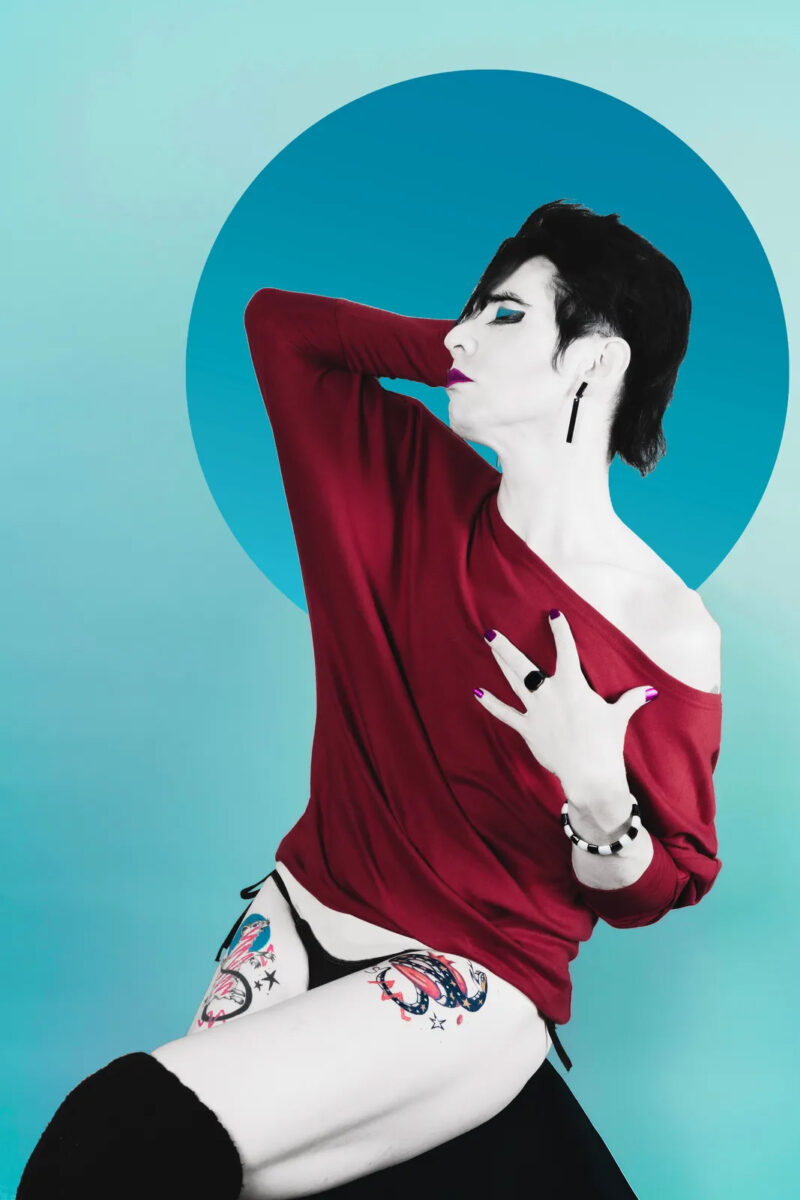
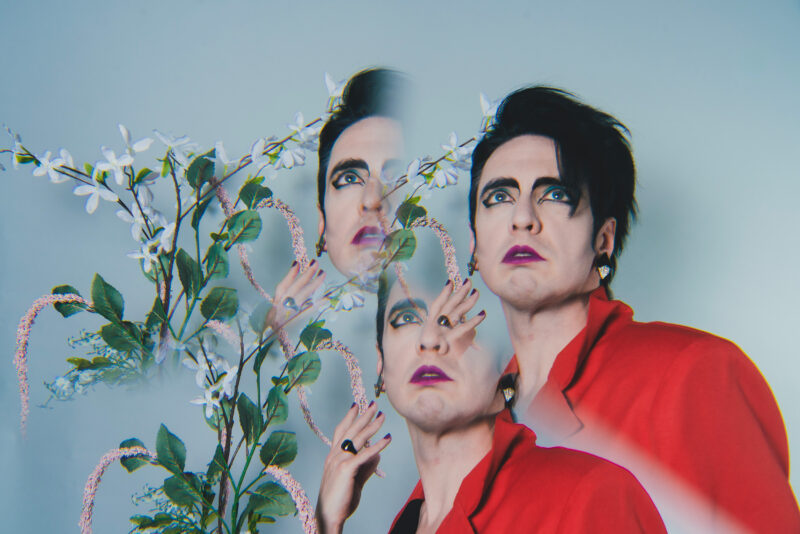
How did the visual world of Hope In Hell take shape with Lain, especially the Patrick Nagel-inspired styling and imagery? Were you building a character, an alter ego, a heightened version of yourself, or something that revealed parts of the album’s meaning the songs alone could not?
In some ways, the photoshoot with Lain made the album happen. I had the choice between 2 directions for this second album, and was trying to decide which. I did the photoshoot with Lain initially as just a “Wouldn’t it be fun to do a Nagel photoshoot?” I had a vague idea that I might use it for the more synth-poppy album, but nothing definite.
Lain has been a massive part of the aesthetic of Hot Hail! from the get-go – they did my first promo photoshoot, and those photos were on the singles from the first album. They are just a delight to work with, and they have this quiet way of seeing little angles of things that make the final picture really pop.
A lot of what we did was trying to emulate poses and outfits from specific Nagel pieces, but then doing some with our own spin on them. The hardest part was trying to get that Nagel face right – I tend to be very expressive, so the neutral face look was hard.
After Lain sent me the photos, though, it was like “There is no way I can do anything but the project that these are for.” Especially as I started figuring out how to do the retouching to make the photos look more like Nagel, there was just no question.
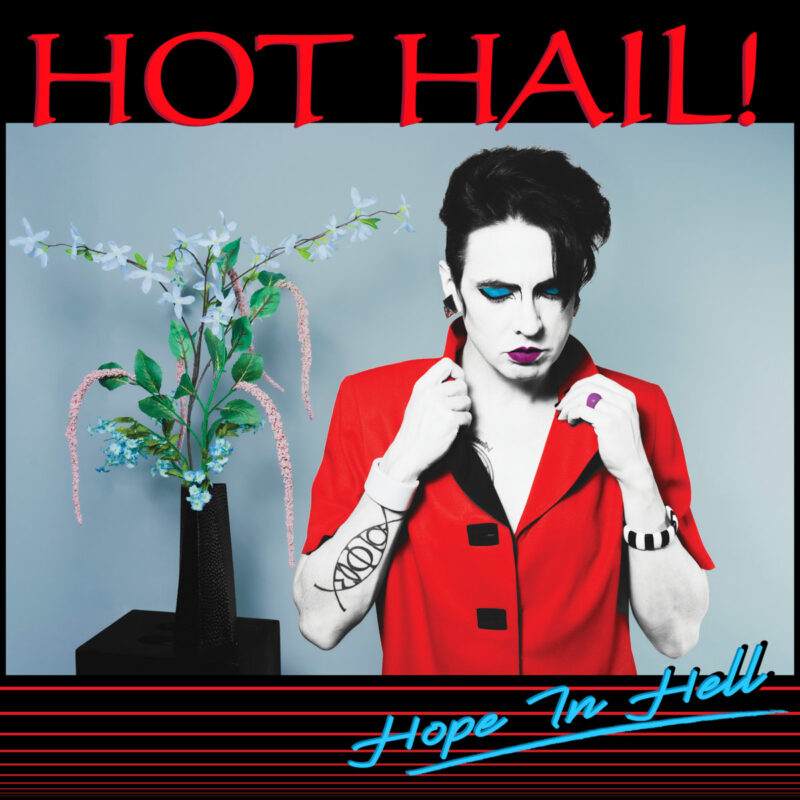
The photo that is the album cover, in particular, doesn’t emulate any particular Nagel, but it immediately grabbed me as the cover photo. It just looks like the title track should be playing over it. And when Lain started making the illustrated versions, I had the idea to use them as the single covers, which in some ways affected which songs I chose as singles – I feel like each of those illustrations matches the song it goes with perfectly.
In some ways, the album’s aesthetic mirrors the idea of pop music as a carrier wave for a political message. I love the idea of making an album that looks like it should be all clean lines and vibes and no substance, but then getting into it and realizing it’s this kind of bleak, messy commentary on the emotional landscape of a society buckling under fascism.
As for why the affinity for Nagel in the first place … I grew up in the 80s. I can literally remember sitting on the floor at the salon while my mom got her hair done, listening to Cyndi Lauper on the radio, and looking at reproduction Patrick Nagel prints on the wall. The Nagel I based the cover art for the ‘Article Of Faith’ single on was the first one I remember seeing in that context as a kid.
And when I looked at that print, with all its androgyny and glamour, I think it is one of the first times I remember thinking “That is something I’m attracted to,” but with this simultaneous, barely acknowledged thing under that of “That is something I want to be.”
So Nagel is this incredibly intrinsic part of my gender and sexuality. Which is, you know, also HUGELY problematic. Let’s not fail to acknowledge that Nagel’s art represents a literally impossible physical standard of beauty, as well as privileging quite literal whiteness. So, along with its encouragement of my gender fluidity, I also absolutely internalized those issues in ways that I’m still struggling with as far as my concept of my own attractiveness.
But, that being said, the idea of fully embodying my own ideal of that sort of genderqueer, high-Themme glamour for this album just felt like the perfect convergence. Especially given the fact that what the album is about is a situation in which, not too long from now, presenting oneself in that way, even if the parts of this country we like to tell ourselves are “safe,” might feasibly be a very dangerous thing to do.
And to be entirely honest, it also felt like the sort of culmination of a phase of my own journey with gender. I am trans and nonbinary. I joke that the nature of my nonbinary is like “Schroedinger’s Gender” – even I don’t know what’s going to be in the box until I open it. And for the last two years or so, I have run as hard as I can toward my femme aspect, both in my musical persona and my private life.
But, having done that, I’ve found that I’ve become more comfortable presenting more masc because it feels like one of many choices, rather than a presumptive expectation. So I’m finding myself in a place where my gender presentation is shifting. Like, I’ll always be Gina Gershon on the inside, but sometimes I’m Gina Gershon in ‘Bound,’ and sometimes I’m Gina Gershon in Showgirls. Lately, I’m feeling more like ‘Bound.’
So committing to this extremely hard femme Nagel aesthetic felt like a kind of a lovely capstone of my Showgirls period. And, in some ways, this whole album kind of represents the culmination of the journey of that little kid sitting on the floor, listening to Cyndi Lauper, and staring at a Nagel print.
Biographically, what were the records, books, films, clubs, or scenes that made Billy Sigil, Hot Hail!, and Hope in Hell, possible in the first place?
The name ‘Hot Hail!’ itself is a reference to Emperor Ming’s world-destroying weather machine in the 1980 Flash Gordon movie. I remember seeing that when I was maybe 5 years old, and there was some kind of brainstem understanding of “Oh! This is camp!,” and the idea that something doesn’t have to be “good” to be amazing. But also, the idea of burning hail as a sci-fi weapon of mass destruction kind of encapsulates the ethos of this project – it’s something unnatural and apocalyptic that still retains a certain quality of glamour and also absurdity. It’s winking at itself in the midst of all the horror. The “!” on the end of it serves both to render it all the more ridiculous, and also to make it legally distinct from the, like, 6 other bands called ‘Hot Hail’ floating around out there.
Hedwig and the Angry Inch will always be a massive influence, personally and artistically. That’s one of the few films I can say I went into a different person than I came out as. And Stephen Trask’s songwriting in that is also kind of the gold standard for something that’s catchy and cheeky and emotionally devastating, and it has remained a huge influence since then.
Ladies And Gentlemen, The Fabulous Stains – that’s a flawed movie in many ways, but it is jaw-droppingly complex and prescient in how it portrays the way that capitalism co-opts subcultural rebellion. Also, the exchange between Diane Lane and Ray Winston in that, where she says “You’re so jealous of me. I’m everything you ever wanted to be.” And he just barks back, “A cunt?” and she says “Exactly.” is one of the single most devastating, insightful, actually punk rock things ever put on film. The first time I saw that, I literally gasped. I wasn’t able to clear the rights for the sample on the album, but I always play that at the beginning of live performances of WYRD.
Cabaret is so obvious, it almost doesn’t warrant comment at this point. But it’s still heartbreakingly effective. I think there’s a certain degree of overall cinematic aesthetic to the albums so far – All The Blood You Wanted feels very German Expressionist to me, both in direct ways like ‘Caligari Dance Party’ but also just the overall vibe is this kind of sweeping, high-contrast grand guignol. I wanted that album to sound like Chernobog’s shadow spreading down over the valley in Fantasia.
Hope In Hell feels simultaneously lighter, but also more grounded. There’s a large influence from those 80s movies like Less Than Zero, where the synth score has both this lightness and crushing sadness at the same time. It presents as a teen movie, but it’s actually a study of dysfunction, both individually and societally. Both the songs Hope In Hell and Needle have music that you could put under scenes in those kinds of movies, and that’s very intentional. Honestly, if I could move in any direction as a musician, it would be soundtracks, but it’s very hard to break into that world right now.
Musical influences include:
- Tears for Fears. I remember hearing “Shout!” as a kid and being, like, transfixed. There’s such an aching, angry quality to it. I think it was the darkest music I’d ever heard at 5 years old and I became obsessed with it. And their other work also has that quality of just being so laden with hooks, but also having this weariness and complexity.
- Cyndi Lauper. My sister got “She’s So Unusual” on cassette when I was maybe 4 years old, and that’s the first album I remember listening to front to back, over and over. When I hear the opening of “All Through The Night” or “Time After Time,” I still get this, like, blood-deep sense of comfort and safety. I don’t know if anything on this album exactly sounds like her, but it’s deep in the DNA.
- Millionaire by Mekons. This is kind of their piss-take on 80s pop, but I adore it. They are still one of my favorite punk bands, and Sally Timms is one of my favorite vocalists of all time.
- Simple Minds. Obviously ‘Once Upon A Time,’ though I love their first 3 albums best. I think, in some ways, the jump from something like “Changeling” to “Don’t You Forget About Me” was an influence more than any specific song.
- Siouxsie & The Banshees. Always an influence. Seeing the “Face To Face” video from Batman Returns as a 12-year-old almost certainly infected me with Goth. On this album in particular, the feel of songs from Tinderbox, Peepshow, and Superstition were in my heart, even if the sound isn’t the same.
- Roxette. No shit. Again, just a band whose music sparks joy, and fuck anyone who’s too cool for it.
- Sparks. Again, nothing specific, but I don’t think I could possibly write an album of synthpop without the ever-presence of “Angst In My Pants,” “When I’m With You,” or “Tryouts For The Human Race” in my brain having an effect.
- New Order. I mean, what needs be said? ‘Power, Corruption and Lies’ era was probably the most present.
- The Replacements. It’s not an insistent presence, but I was listening to “Tim’ a lot while I was working on this, and I think it’s more the raw, wrung out humanity of the general vibe than anything specific in the music. Except for maybe in one spot, which I’ll let listeners see if they can pick up on.
- Bowie, Scary Monsters. Always my favorite album overall. Always an influence on Hot Hail!, and songs like Teenage Wildlife have the grandiosity I’m going for on this.
- Weird Al. Honest to God, I think I learned more about songwriting from him than almost anyone, especially his deconstructionist “stylistic parodies” like “Dare to Be Stupid.” To be brutally honest, I often feel like I could point to a lot of my songs and tell you which bands each one is the “Weird Al Stylistic Parody” of. I mean, I’ve got at least 4 Depeche Mode ones at this point.
Books … Honestly, nothing very specifically literary in this album. I could give a HUGE section on this for All The Blood, but for some reason, nothing I was reading really feels like it bled into this.
Looking back now, what does All The Blood You Wanted understand about you that Hope In Hell no longer does?
Oddly enough, even though Hope In Hell is so informed by anxiety around where we are and where we are heading, I think, in some ways, that the person who wrote All The Blood You Wanted was more afraid. Hot Hail! is the first project I’ve made art and performed really publicly with for a very long time, and that in and of itself was quite terrifying, for a number of reasons. And I think that, while everything on that album is coming from a very genuine place, I still had this underlying feeling that I needed to keep it stylistically in a place that would be more likely to be enjoyed by a certain scene or certain people
To be clear, there’s some fun in that. I’m someone who could run off in so many directions, genre-wise, that it’s helpful to have a reason to keep focus – it’s an interesting intellectual exercise.
But now, with everything heading in the direction that it’s heading in the world, I just can’t be arsed not to do whatever I feel like doing. I don’t have time not to be slightly ridiculous, or to try to predict what most people are going to gravitate towards. I mean, I do NOT have a large fanbase. I just crossed 1000 followers on Instagram. My listener numbers on the various platforms are lovely to me, but they’re not anything that would impress anyone. I’m probably not supposed to say any of this out loud, but good god, how could I possibly give a fuck at this juncture in history, you know? What the fuck are we doing still curating our expression down to its last inch when every aspect of the world we live in is about to collapse?
So it’s slightly freeing to just go, “The likelihood of this being hugely popular is just about nil anyway, so I’m going to haul up whatever is genuine in me at the moment and dump it out musically in whatever form feels right for it. If that resonates with people, then those are the people who needed it, and if it doesn’t, then I don’t need to convince them.”
Ultimately, I’ve felt like I’m on borrowed time in all this, for a lot of reasons. Every moment I get to make this music and put it out into the world and have that mean something or resonate with even a few people, that’s my reason to keep going.
I’m just happy and lucky to be here at all. I think that’s a feeling I’ve very keenly developed since I made the last album, and I think it informs a lot of Hope In Hell.
Was there anything you were afraid to say on this record and said anyway?
The fears I had were less around any lyrical statements, and more around just the sheer scope of the Big Shiny Pop quality of it all. Which is kind of hilarious, because we may be entering an era in this country where making anti-Fascist art might actually get you put on some kind of list, but here I am, just blithely slinging that out while I’m worried about whether “Joy” or “In Time” will be too poppy for the Goths. That realization in and of itself was probably enough to get me over any fear around that.
Did any song feel dangerous to finish?
Somewhat. I wanted to go in some lyrical directions with Article Of Faith that ultimately felt too complex to tackle effectively in a ‘2 Verses, 2 Choruses, 1 Outro’ pop song.
And there was one more original song that I intended for the album, but I just couldn’t crack. It was called Immateria, named after an idea in Alan Moore’s Promethea comic series, and it was about that idea of human creativity and the intangible worlds of art, literature, and music as the thing that makes our species special, and that truly endures. Kind of the bright twin to ‘Flesh’s narrative.
Musically, kind of fittingly, the thing was operating on the same wavelength, as, like, The Neverending Story theme by fucking Limahl. It was just an absolute, high-key, ultra-positive, inspirational 80s movie music to a point that was almost self-satirical. And again, I just couldn’t crack the lyrics. Because that subject is actually massively important to me on an incredibly formative level. It’s, like, the baseline of a lot of my approach to spirituality and other stuff. And I couldn’t find the way into it that didn’t feel sort of forced or like a statement of philosophy rather than a human-scale thing. I finally was like, if this thing is going to be this ridiculous, musically, then the lyrics have to absolutely crush, and if I can’t crack that right now, then now isn’t the time for it. That was actually when I decided to add Something Good to the album instead, and that really suddenly brought everything together.
What does “hope” sound like to Hot Hail!, if it isn’t softness in the face of cruelty?
In some ways, I’m still not sure. In some ways, the album is more about the question of Hope than the answer of Hope. The song came before the album title, and really what that song is about is, “I don’t know. I don’t know if there’s any hope, I don’t know what it looks like right now.”
I think, for me, that softness and grace and compassion and kindness are definitely a large part of Hope, though. Which is also part of that song – all of the lyrics that are reaching for hope are identifying it with connection, community, emotional intimacy, even if we’re doomed. If we burn, we’ll burn together. The thing that kills my hope most isn’t the halfwitted, venal cruelty of the people who are obviously out to get us. They’ve always been there; they’ve just been given license to be their unvarnished, authentic selves. What kills my hope is the way that those of us who are over here in this sort of amorphous blob of people – the Left, or Progressives, or whatever you want to call us – we are … SO MUCH BETTER … at hurting each other than we are at hurting the thing coming at us with a mouth full of butcher knives. We’re like the children of abusive parents who can’t fathom the possibility of actually attacking the parent, and so instead they abuse each other, or, like, their pets or something. We’re just hitting what we can reach half the time, and grabbing on to anything that gives us the opportunity to do that, that lets us feel righteous about it. We have no strategy. We have no overarching tactical approach. We’re fractious and laughably infiltratable. I feel like the French Resistance wouldn’t have even trusted any of us with washing their dishes. If we burn, we’ll all burn separately in our highly proscribed categories.
On the macro level, when dealing with the people who are living with the same horror as us, then the ability to be kind, to give grace and room for growth, and room to identify the overlap of our Venn diagrams, rather than viciously attacking the variances, when I see that, that gives me hope, though sometimes it seems rare. The horror itself, to be clear, deserves no softness at all. My greatest hope is that we are able to get our shit together on this end of things and do some stuff that I definitely shouldn’t put in print because I’m pretty sure that’s our only way out of this. Barring that happening, there is still the micro level, which is all I can really have any faith in right now, and is really more of what the Hope on this album is about – that we can still be kind, and patient, and thoughtful, and present, even in the face of this thing bearing down on us. It’s the hope that we’ll be there for each other, whatever that means for each of us.§
Listen to Hope In Hell below and order the album here.
Follow Hot Hail!:




 Or via: