

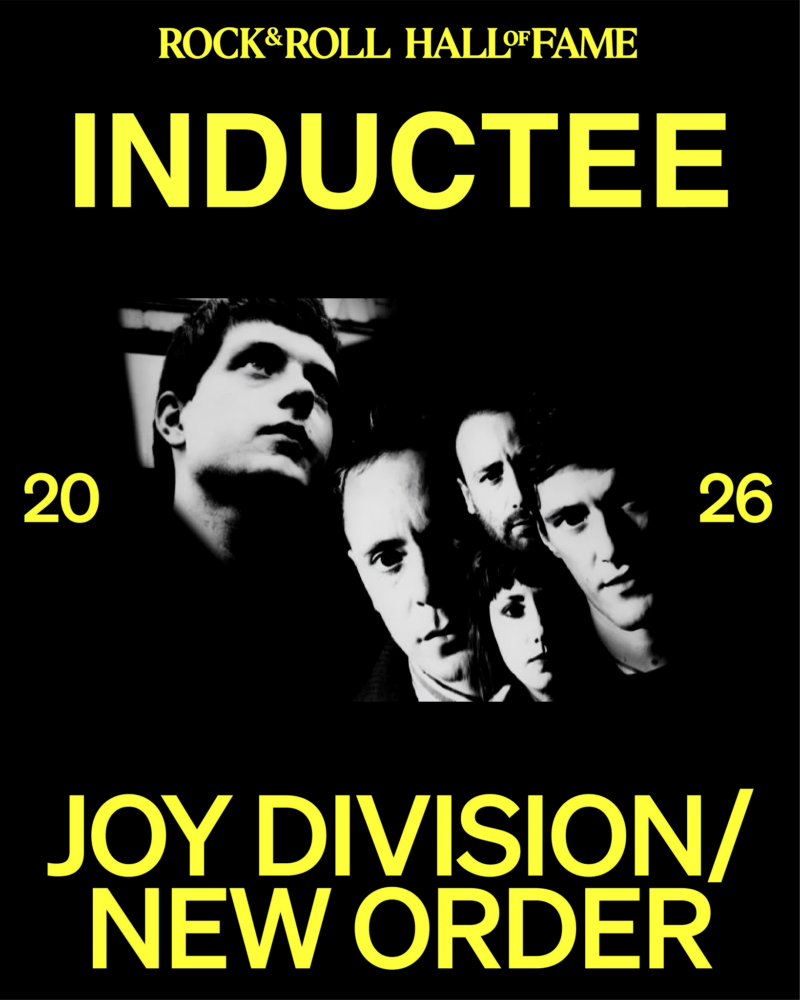
Heaven knows it’s got to be this time. After years of waiting, near-misses, and a long shadow cast over modern music by two of Manchester’s most important bands, linked by their common history, the Rock & Roll Hall of Fame has finally made good: Joy Division / New Order are part of the Class of 2026. Call it a belated Ceremony, call it overdue recognition, call it simple justice — but after three trips to the ballot, third time’s the charm. They join Billy Idol, Oasis, Sade, Iron Maiden, Phil Collins, Luther Vandross, and Wu-Tang Clan in this year’s Performer class.
For post-punk and new wave fans, the most notable inclusion in the Rock and Roll Hall of Fame Class of 2026 is plainly Joy Division/New Order, whose combined entry recognizes one of the most significant continuums in modern music. First came Joy Division’s brief, devastating run: the stark architecture of Unknown Pleasures, the dread and sepulcher experimentation of Closer, the sense that rock music had suddenly found a colder, more haunted vocabulary. Then came New Order, transforming grief and forward motion into something unprecedented: pop with circuitry in its veins, club music with emotional afterburn, a body of work that helped redraw the map for alternative music in the 1980s and far beyond.
With Oasis also entering this year, the announcement makes for an unusually strong day for Manchester. Few cities have exerted such sustained influence on modern British music, and this year’s class reflects two very different but equally defining strands of that history: the austere invention and dancefloor reinvention of Joy Division / New Order, and the mass-scale singalong swagger of Oasis.
There is also some useful perspective in the nomination history for bands of the post-punk era. The Cure were first nominated in 2011 for the Class of 2012, missed that year, and were later inducted into the Class of 2019. Joy Division / New Order, meanwhile, had an even longer run of defeats on the ballot, having been nominated in 2023, 2025, and 2026 before finally being inducted this year. So both cases convey the sense of an institution arriving late to artists whose influence had long since been established.
Sade, another welcome addition to this year’s class, brings a different kind of gravitas. Her induction recognizes one of the most singular catalogues in modern popular music: elegant, restrained, instantly recognizable, and never in any hurry to chase fashion. Her presence also gives the 2026 class a broader and more interesting shape than the Hall’s usual classic-rock center of gravity might suggest.
Billy Idol is also among this year’s Performer inductees. Best known for his work with Generation X and for solo hits such as “White Wedding,” ‘Eyes Without a Face,” and “Rebel Yell,” Idol helped carry punk attitude into the MTV era, turning peroxide snarl and fist-raised hooks into mainstream currency.
Beyond the Performer category, the Hall’s 2026 class also includes Celia Cruz and Fela Kuti in Musical Influence, Queen Latifah, MC Lyte, and Gram Parsons in Musical Excellence, and Linda Creed, Arif Mardin, Jimmy Miller, Rick Rubin, and Ed Sullivan with the Ahmet Ertegun Award. But for readers here, the center of gravity is clear enough: one of the most important and transformative bodies of work in post-punk, alternative dance, and modern guitar music has finally been recognized where it should have been long ago.
Follow New Order:
Follow Joy Division:




 Or via: