

History has a way of arriving late, wearing a better coat than expected, speaking more clearly than it ever did the first time around. Post-punk had to persist through an era that preferred certainties, big choruses, tidy myths, and the reassuring repetition of power. It waited while innovation was treated as an inconvenience, while openness shrank under the long shadow of Thatcher and Reagan. The genre’s sharp ideas survived anyway, underground, uncredited, misfiled. Time did its quiet work. The record racks rearranged themselves. Former underdogs rewrote the syllabus. Suddenly, nobody remembers when Styx towered over The Cure…and that’s being polite.
You would think the excavation was finished by now, the maps redrawn, the vaults emptied. We would have said as much confidently until recently, when a lost band called Entracte resurfaced.
The group developed within the orbit of tLondon’s fertile post-punk scene in the late 1980s, recording a substantial body of material that, for reasons still half-buried in the usual chaos of band life, never saw release at the time. Much of Entracte’s history remains tangled in comings and goings, but the core of the band centered around guitarist Alberto Umbridge, vocalist Sharon Quinn, and drummer Graham “Dids” Dowdall. If Umbridge’s name rings a bell, it may be because he was also the conduit through which Tiny Global Productions earlier unveiled the debut collection of lost studio recordings by ex-Siouxsie and the Banshees guitarist John McKay.
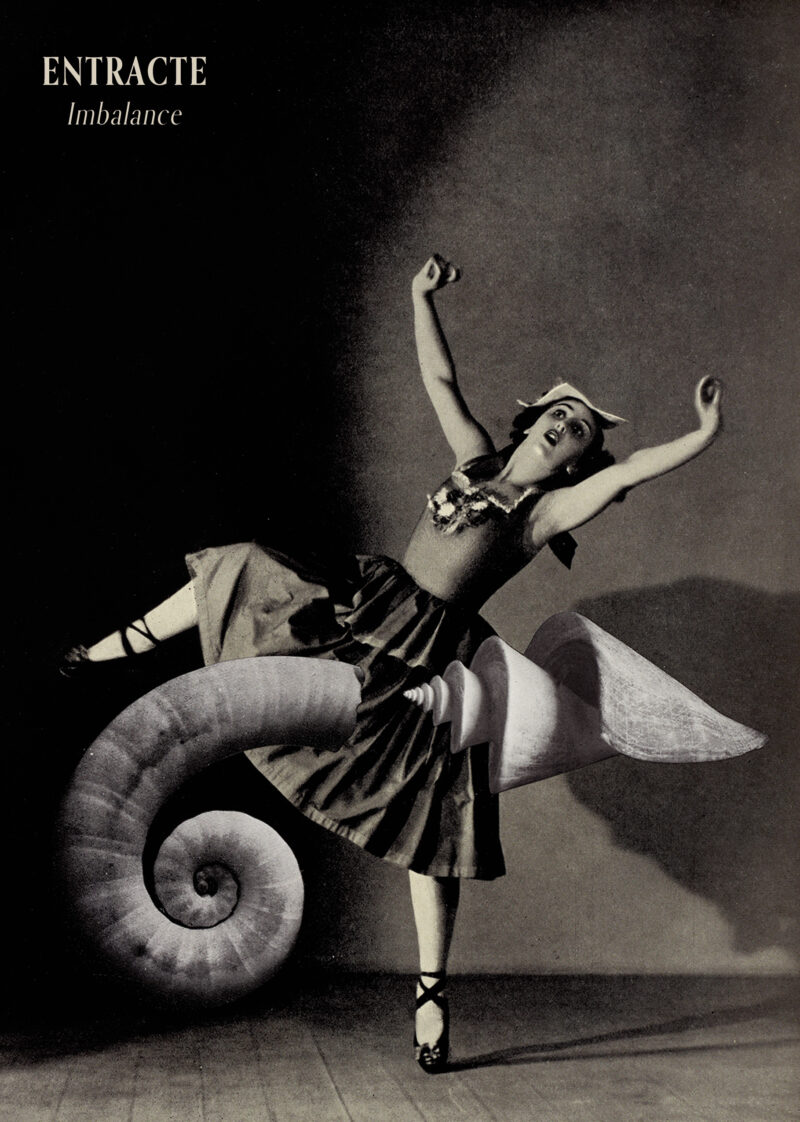
That silence has now been broken by Imbalance, released by Tiny Global Productions: an album-length CD paired with an A5 booklet of lyrics, history, and artwork. The release also carries a contribution from Linder Sterling, whose image Irina, a striking 1930s-inspired piece, fronts the package. The connection is not incidental. Dowdall, who passed away last year, played with Ludus, the avant-garde project Linder founded, and his long career also included work with Nico, Cabaret Voltaire, Pere Ubu, and John McKay.
There is no tidy legend waiting to be dusted off here, no ready-made mythology polished for reissue culture. But the missing paper trail only sharpens the intrigue. Entracte recorded roughly thirty songs across the late ’80s, and what survives feels both assured and strangely untouched. The band experimented with a wide range of rhythms and textures, likely absorbing some of the period’s expanding access to African and Middle Eastern musical forms. You can hear that openness in the songs: guitar lines that hint at highlife, patterns that bend away from rock orthodoxy, and arrangements alert to movement rather than mere mood.
Imbalance is arresting in that it arrives so fully formed. The record carries world-weariness without sinking into grey habit. Bowie and Kraftwerk hover somewhere in the background, particularly in the poised, slightly futuristic tension of the arrangements, but Entracte never feels derivative. Their music suggests a wider listening life, one shaped by the art, personalities, and collisions that made Manchester such a vital breeding ground at the time. It belongs to that moment, certainly, yet it also slips past it.
Umbridge himself puts it plainly: “I dug out the tapes and began listening, I was shocked. The more I heard, the more I realised our material was indeed as I’d once imagined, and it did stand the test of time.”
It is easy to understand that surprise. The band’s range feels unusually wide, their focus unusually steady. The ideas stretch across territories associated with Siouxsie and the Banshees, Magazine, Malaria!, and The Sound, without collapsing into homage. There is a shared discipline closer in spirit to the restraint of Young Marble Giants or the precision of Wire, a sense of a private post-punk language worked out in full. Even cult favourites like The Chameleons or The Passions can seem narrower by comparison; Entracte’s palette covers more ground, and does so with a rare combination of immediacy, charm, and formal curiosity.
These recordings were made on limited means, yet they arrive fully intact, their ideas unembarrassed by age. Sharon Quinn sings with clarity and presence, never overplaying the songs’ emotional intelligence. Umbridge’s guitar finds light in unexpected places. Dowdall, meanwhile, anchors the material with a restless, responsive intelligence that helps explain why the record never settles into any one school or formula for too long.
Perhaps being shelved for a few decades is part of the appeal now. Imbalance arrives without inherited hype, without nostalgia demanding obedience. It sounds new because its ideas remain generous and open, and because so much of what once slipped past the official story now returns with greater force. This is not merely a curio rescued from storage. It feels like a genuine correction.
And there is more to come. Tiny Global is already at work on a second volume, suggesting that Entracte were not a minor footnote but a body of work substantial enough to keep unfolding. For a band that left no public trace for decades, that feels less like an archival afterthought than the beginning of a belated life.
This is an astonishing recovery: a truly lost band, invisible for nearly four decades, resurfacing intact and strangely ahead of schedule. Dare we say it: a new cult favourite, arriving from the past.
Listen to Imbalance below and order the album here.
Follow Entracte:




 Or via: